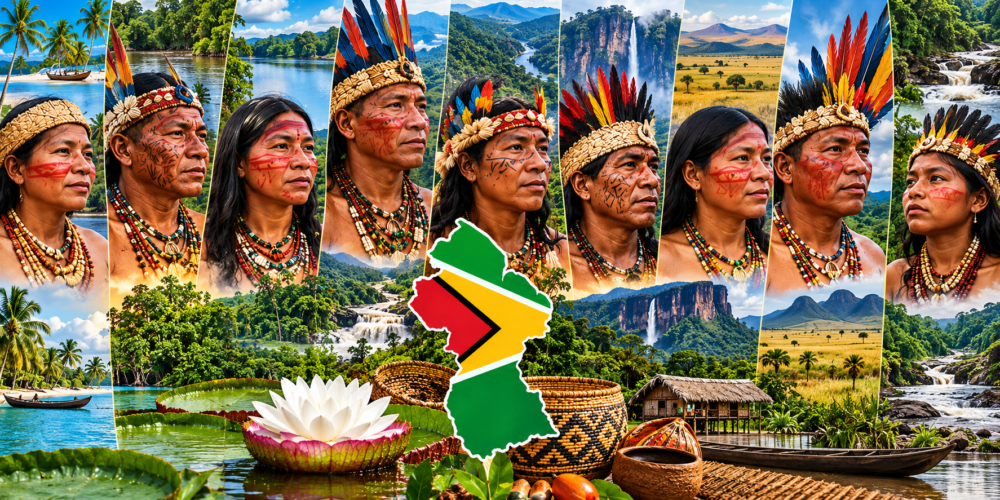
As Guyana observes Amerindian Heritage Month, the celebration of Indigenous culture and history also raises a broader question about development, land, resources and the distribution of the country’s growing oil wealth.
Guyana is home to approximately 78,500 Indigenous people, representing about 10.5% of the population, according to the National Toshaos Council (NTC). They belong to nine recognised Indigenous Nations and live in about 212 villages and communities, many of which hold legal land titles covering approximately 15.6% of Guyana’s land area. Most Indigenous communities are concentrated in the hinterland and interior, particularly Regions 1, 7, 8 and 9.
The Government’s Ministry of Amerindian Affairs also identifies nine Indigenous groups, traditionally referred to as tribes. Its descriptions show the remarkable geographical spread of Guyana’s First Peoples.
The Nine Indigenous Nations
- Lokono (Arawak) — Government descriptions identify the Arawak as primarily coastal dwellers, with communities associated with Guyana’s coastal and riverine areas. Their traditional economy has included fishing and cassava cultivation.
- Warao (Warrau) — The Warao are concentrated in the North West District, particularly the low-lying areas around the Barima and Pomeroon rivers and their tributaries.
- Kalina (Carib/Karina) — Kalina communities are traditionally associated with the Barama and Pomeroon rivers and the North West coast.
- Akawaio — The Akawaio are found principally in the Upper Mazaruni, with communities extending along the Barama, Upper Pomeroon, Demerara-Wenamu and Upper Cuyuni river systems.
- Arekuna (Arecuna) — The Arekuna are concentrated around the Kamarang River and Upper Mazaruni area, with historical connections extending into the wider Guiana Shield region.
- Patamona (Patamuna) — The Patamona occupy communities principally in the Northern and Southern Pakaraima Mountains and the Essequibo interior, including areas around Kaieteur.
- Makushi (Macushi) — The Makushi are concentrated in the Northern Rupununi Savannah, with communities extending across the Rupununi interior.
- Wapichan (Wapishana) — The Wapichan are predominantly associated with the Southern Rupununi in Region Nine, where communities are spread across the savannah and surrounding areas.
- Wai Wai — The Wai Wai occupy the extreme southern Rupununi, including some of Guyana’s most remote interior communities.
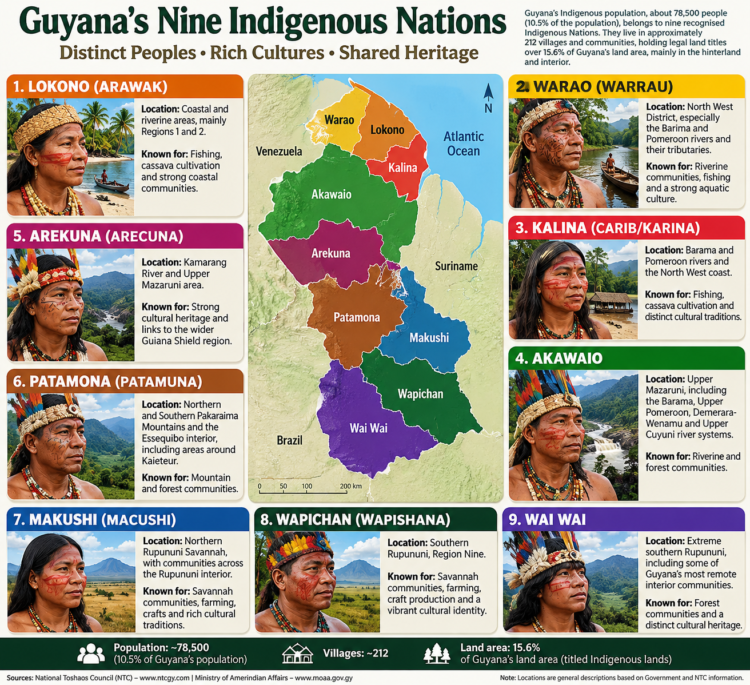
While the Ministry uses traditional names such as Arawak, Carib, Warrau, Macushi and Wapishana, the NTC currently identifies the nine recognised Nations as Lokono, Warao, Kalina, Akawaio, Arekuna, Patamona, Makushi, Wapichan and Wai Wai.
The distribution of these Nations matters because Indigenous development cannot be considered simply in terms of population. Communities are scattered across a vast territory, often separated by rivers, forests, mountains and long distances from coastal population centres.
The Cost of Distance
The Government says G$7.2 billion was spent in 2025 to support Amerindian communities, excluding carbon-credit transfers, while G$7.5 billion is earmarked for 2026.
Those figures represent significant public expenditure. But their adequacy cannot be assessed without considering the geography and the nature of the development needs.
A road, health facility, school, electricity project, telecommunications connection or transportation service delivered to a remote interior community can involve considerably different costs and logistical challenges from a comparable project on the coast.
The NTC itself is mandated to develop strategies addressing poverty, healthcare, education, protection of village lands and natural resources, good governance and the social and economic development of Indigenous communities.
The question, therefore, is not simply how much money is budgeted, but what that expenditure changes in the lives of people living in the communities.
Oil Wealth Changes the Equation
That question has become more consequential since the start of Guyana’s oil era.
Guyana has accumulated billions of dollars in petroleum revenues, dramatically expanding the financial resources available to the State. The Government’s 2026 budget continues to channel billions into Indigenous development, but petroleum wealth also raises expectations about what can now be achieved in communities that have historically faced significant infrastructure and service gaps.
The comparison must be made carefully. Oil revenue and Amerindian development allocations are not equivalent categories of expenditure, and the Natural Resource Fund finances national priorities well beyond Indigenous communities.
Still, the scale of petroleum income raises a legitimate policy question: what level of transformation should Indigenous communities experience during an era of unprecedented national wealth?
Land Is Central to the Question
Development also cannot be separated from land rights and resource management.
The NTC says Indigenous communities occupy approximately 15.6% of Guyana’s land area, while the Ministry of Amerindian Affairs has documented longstanding demands for additional titles, extensions, demarcation and protection from encroachment.
The NTC’s responsibilities include protecting, conserving and sustainably managing village lands and natural resources.
Guyana’s forest economy has also created another mechanism for Indigenous participation. Under the country’s REDD+ framework, the NTC says 15% of forest carbon-market revenues are allocated to Indigenous villages through the Village Sustainability Planning process.
These mechanisms point to a broader principle: Indigenous communities are not merely beneficiaries of government programmes. They are stakeholders in the management of land, forests and resources that have national and international economic value.
What Should Heritage Month Measure?
Heritage Month provides an opportunity to celebrate Indigenous languages, traditions, cultures and history. It can also prompt a more demanding assessment of whether development policy is producing lasting change.
The nine Indigenous Nations occupy very different environments, from the North West river systems to the Upper Mazaruni, Pakaraima Mountains, Rupununi savannahs and the deep southern interior. Their needs are therefore not identical.
The test of Guyana’s oil era will not simply be the size of budget announcements. It will be whether communities gain reliable transportation, electricity, healthcare, education, telecommunications, sustainable businesses, employment opportunities and greater economic participation, while Indigenous rights and decision-making authority are respected.
Guyana’s petroleum wealth gives the country an opportunity to address longstanding disparities. Heritage Month provides a fitting moment to ask whether that opportunity is reaching the people whose communities, cultures and territories form an essential part of the country’s history and future.
Heritage is more than something to celebrate. It is something a nation must protect, invest in and respect.