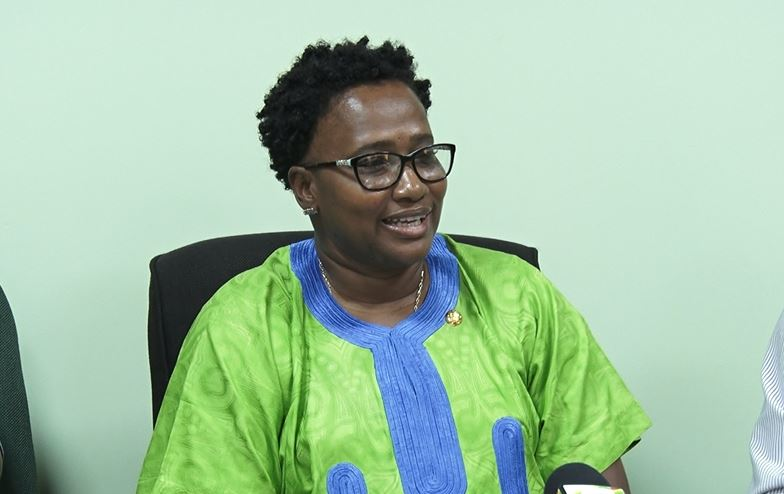
Former Minister and Parliamentarian Annette Ferguson is demanding answers about the implementation of police reform recommendations spanning more than two decades, questioning why the Guyana Police Force (GPF) continues to face calls for systemic transformation despite successive reports, committees and reform programmes.
In a social media post on Sunday, Ferguson said she supports comprehensive reform but argued that the country must first examine the failures of previous initiatives and establish who was held accountable for their shortcomings.
“Can genuine reform take place under the current leadership of the Guyana Police Force, particularly when serious allegations have been raised against individuals in positions of authority?”
Ferguson referred to allegations involving individuals she identified by the surnames Karim, Caesar and Hicken, including rape and bribery allegations. She called for the matters to be independently and transparently investigated, with due process respected. Her post did not provide further details about the allegations, which should not be treated as established findings.
She argued that the current debate must be informed by Guyana’s history of police reform, pointing to a series of initiatives dating back to 2000 that, she contends, have failed to deliver the institutional transformation repeatedly promised.
71 police recommendations still under scrutiny
Among the initiatives Ferguson highlighted was the 2000 Guyana Police Force Reform Programme prepared by British consultants, the Symonds Group, with support from the United Kingdom’s Department for International Development. The programme examined the need for a more accountable, professional and community-oriented police service.
She also recalled the G$100 million crime-fighting package announced under then President Bharrat Jagdeo in 2002 and the establishment of the Disciplined Forces Commission, chaired by Justice Ian Chang, which examined the shortcomings of the country’s disciplined services.
The Commission’s 2004 report contained 164 recommendations, including 71 specifically directed at the Guyana Police Force. These addressed areas such as recruitment, training, accountability, investigative capacity and the professional development of police ranks.
The recommendations took years to receive parliamentary consideration. In June 2010, then Home Affairs Minister Clement Rohee told the National Assembly that only seven of the 71 recommendations relating to the Police Force had been implemented at that time. Further parliamentary consideration of implementation proposals continued into 2013.
Ferguson also questioned the outcome of the Security Sector Reform Action Plan pursued by the Jagdeo administration with British assistance between 2006 and 2009. The programme encountered disagreements over oversight and implementation before the arrangement broke down.
Against that history, she posed six questions, including what became of the 71 recommendations, how many were fully implemented, how many remain outstanding, what happened to the earlier security sector initiatives and who was held accountable for the failures.
“Why are we still having conversations about systemic reform more than two decades later?”
Calls for political and institutional accountability
Ferguson said reform must go beyond announcements and reports, arguing that it should address political interference, corruption allegations, recruitment, promotions, professional standards, training, investigative capacity and public confidence.
She maintained that the PPP/C Government cannot separate itself from the present state of the Police Force, given its years in office and responsibility for addressing institutional challenges.
In a direct political statement, she declared:
“In my view, meaningful reform must also involve a change in political leadership. The PPP/C MUST GO!”
She further argued that meaningful change requires confronting the political and institutional arrangements that have contributed to the current situation.
Ferguson said Guyana needs a Police Force that serves all citizens, irrespective of political affiliation, race, class or social standing, and that protects human rights while upholding the rule of law.
Her central message was that another reform announcement would be insufficient without measurable implementation and accountability.
“Reform without accountability is simply another exercise in rhetoric!
She urged Guyanese to demand answers from those responsible for the Force and called for genuine institutional reform rather than another cycle of reports and unfulfilled commitments.