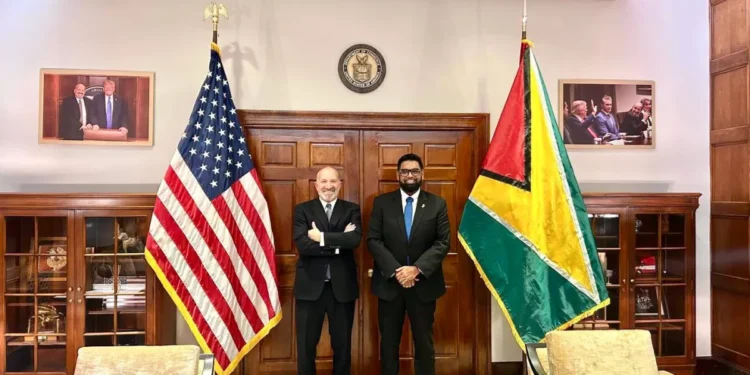
President Irfaan Ali’s sweeping new measures to control foreign exchange (forex) outflows and tighten regulation across Guyana’s banking sector have triggered concern among financial experts, who warn that the nine-point plan may strain institutions, stall trade, and create unintended consequences — including a rise in black-market activity.
Unveiled during a high-level meeting with key financial regulators and commercial banks, the President said the measures are aimed at stabilising Guyana’s financial system amid surging forex demand, credit card usage, and fears of capital flight.
“We’re now examining that growth [in credit card use]… to see whether personal credit cards are used to clear business transactions and in what volume,” the President said, citing a spike in credit card clearance from US$91.3M in 2023 to over US$347.5M in 2024.
Forex Demand Surges Despite Billion-Dollar Injections
According to President Ali, the Central Bank injected US$1.2 billion into the economy so far in 2025 — nearly quadrupling the US$332 million provided in 2024 — with an additional US$160 million pending. Yet demand remains high, a signal that deeper structural issues may be driving foreign currency outflows.
Analysts say the forex crunch is being exacerbated by increased import dependence, oil sector repatriation, and currency hedging by the private sector — not just poor documentation or misuse.
“Massive injections without structural reforms aren’t sustainable,” warned a former regional central bank economist. “You can’t inject your way out of a leaking system.”
Nine Measures — And Nine Potential Bottlenecks?
The plan’s core provisions include:
- Requiring importers to submit invoices and Bills of Lading before forex can be accessed
- Forcing banks to verify documents with the Guyana Revenue Authority (GRA) and Bank of Guyana (BoG)
- Penalising inflated invoicing and personal credit card misuse for business payments
- Mandating that oil and gas service firms repatriate foreign earnings into local accounts
Financial experts say these moves may introduce significant red tape and slow down legitimate business activity, especially for small and medium importers.
“The sheer volume of paperwork and cross-agency checks proposed is staggering,” said a Georgetown-based financial analyst. “It will likely delay forex approvals and choke supply chains.”
Enforcement Capacity in Question
A central weakness in the plan is that it assumes the existence of strong compliance infrastructure — which Guyana currently lacks.
The proposed “single window” post-clearing system at the Central Bank would require real-time data sharing between BoG, GRA, and all commercial banks — a system that does not yet exist.
“These agencies aren’t equipped for this level of coordination. The technology isn’t there, and the human capital gap is real,” noted a former high-ranking government official.
Banks are also now expected to monitor the intent behind credit card purchases — distinguishing personal from business transactions — something experts call “nearly impossible” without violating user privacy or deploying advanced AI tools not currently in place.
Risk of Black Market Expansion
With foreign currency access now tied to stricter controls, analysts warn that parallel market activity could surge, similar to what occurred in countries like Nigeria and Venezuela when forex restrictions tightened.
“When forex is difficult to access through legal channels, people find alternatives,” said the regional economist. “That creates a two-tiered market — official and unofficial — and undermines the entire system.”
Impact on Investors and Ease of Doing Business
Measure 8 — requiring foreign companies under Guyana’s Local Content Law to repatriate foreign earnings into local accounts — has also raised red flags.
Legal experts suggest this could breach bilateral investment treaties or discourage international investment in the fast-growing oil and gas sector.
“Forced repatriation is often seen as a red flag by investors. It implies capital controls, and that affects confidence,” said an analyst familiar with Guyana’s oil sector.
Such a move could contradict Guyana’s stated goal of improving its Ease of Doing Business rankings and attracting diversified foreign direct investment.
Experts Call for Structural Reforms, Not Just Paperwork
While President Ali’s plan tackles real problems — including forex abuse, capital flight, and documentation fraud — critics argue that the measures mostly treat symptoms rather than causes.
“The core issues are Guyana’s import-heavy economy, limited export diversification, and weak investment options for domestic capital,” one economist said. “None of that is fixed by requiring an extra invoice.”
Analysts are calling instead for policies that build trust in the local currency, promote non-oil exports, improve digital oversight systems, and invest in cross-agency regulatory infrastructure.
What’s Next?
While the commercial banks have publicly supported the plan — citing the need for clearer forex allocation protocols — privately, several bank officials have expressed concern about enforcement, system overload, and compliance risks.
As global commodity markets remain volatile and Guyana’s economy continues to expand on the back of its oil boom, the stakes are high. Whether the new forex strategy can bring stability — or create more complications — remains to be seen.
“You can’t regulate your way out of a forex crisis alone,” said one analyst. “You need trust, productivity, and credible economic policy — none of which can be substituted with paperwork.”