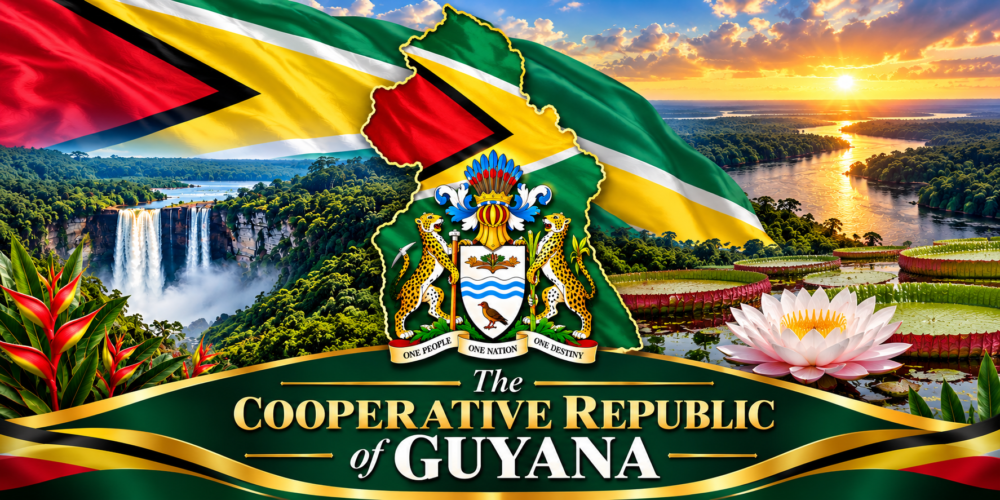
The word “Co-operative” in Guyana’s official name is not simply a relic of the political changes of 1970. It is connected to a much older history of land ownership, village development, mutual aid, local organisation and economic self-reliance that took shape after emancipation.
As Guyana considers constitutional reform, the debate over retaining “Co-operative Republic of Guyana” therefore reaches beyond political ideology. It concerns whether the Constitution should continue to recognise a tradition that helped ordinary Guyanese establish communities and participate in economic life after slavery.
Article 1 of the Constitution states:
“Guyana is an indivisible, secular, democratic sovereign state in the course of transition from capitalism to socialism and shall be known as the Co-operative Republic of Guyana.”
Article 1 is specially entrenched under Article 164(2)(a), meaning that changing it requires the constitutionally prescribed process, including approval by the electorate.
A History That Predates the Republic
The roots of Guyana’s co-operative tradition reach into the decades following emancipation.
Slavery ended in 1834, with apprenticeship ending in 1838, but freedom did not automatically bring land or economic independence. Plantations remained dominant, while formerly enslaved people sought ways to establish lives beyond plantation control.
Land acquisition became one of the most important expressions of that struggle.
On November 7, 1839, 83 people pooled their resources to purchase Plantation Northbrook, a 500-acre estate later renamed Victoria. The purchase became a landmark in the village movement, alongside acquisitions associated with communities such as Den Amstel, Buxton and Friendship.
These purchases created more than farms and homes. They provided the foundation for communities in which residents could establish businesses, churches and schools and organise their own affairs.
Co-operation Before Formal Co-operatives
The principle of collective action was also embedded in everyday institutions.
Friendly societies and burial societies provided assistance during illness, death and hardship. Box hands and rotating savings arrangements allowed people to pool money at a time when formal banking and credit were inaccessible to many. Farmers, workers and small businesses formed associations around shared interests.
These institutions gave ordinary people — farmers, labourers, artisans, shopkeepers and villagers — mechanisms to save, manage risk, access capital and support one another.
Formal co-operatives later provided a more structured framework for many of those practices.
This history matters because it demonstrates that Guyanese co-operation did not begin with the political ideology of the 1970s. The social practice was already present in communities for generations.
The Tri-Sector Economy
The co-operative tradition eventually became part of Guyana’s tri-sector economic model — public, private and co-operative.
The public sector represented the State and its responsibilities for governance, infrastructure and public services. The private sector provided entrepreneurship, investment, commerce and employment. The co-operative sector offered another form of economic participation through collective ownership, pooled resources and shared enterprise.
The three sectors were therefore not simply economic categories. They reflected different ways in which Guyanese could participate in national development.
Removing “Co-operative” from the country’s constitutional identity would consequently remove a reference to one of those traditions.
1970 Gave It Constitutional Meaning
Guyana became a republic on February 23, 1970, and “Co-operative” acquired explicit constitutional significance.
The 1970 Constitution described Guyana as a state:
“in the course of transition from capitalism to socialism”
and declared:
“Co-operativism in practice shall be the dynamic principle of socialist transformation and shall pervade and inform all interrelationships in the society.”
The language clearly reflected the political philosophy of the period and the administration of Forbes Burnham and the People’s National Congress (PNC).
But the existence of political ideology in the 1970 Constitution does not mean the underlying practice of co-operation originated with that era.
The village movement, mutual-aid societies, community savings arrangements and collective economic activity were already part of Guyanese society.
The Constitution gave that tradition a particular political and economic framework.
More Than an Adjective
The significance of “Co-operative” therefore extends beyond the ideological language of the 1970s.
It connects the modern republic to the experience of people who, after emancipation, pooled limited resources to acquire land, establish villages, create institutions and build economic security.
That history belongs not to one political party but to the broader development of Guyanese society.
It includes the farmer, worker, villager, artisan, shopkeeper and family who relied on collective effort when individual resources were limited.
The “Small Man” and the National Economy
At the centre of this history is the effort of ordinary citizens to secure a meaningful stake in economic life.
The village movement created access to land. Community organisation provided mechanisms for managing local affairs. Friendly and burial societies offered mutual support. Informal savings systems helped people accumulate and access money. Co-operatives extended collective participation into more formal economic activity.
Together, these traditions contributed to a distinctly Guyanese understanding of economic participation.
Guyana has since undergone profound changes, from independence and political transformation to the emergence of an oil-based economy and unprecedented foreign investment.
But the underlying question remains relevant: How do ordinary citizens secure a meaningful stake in national development?
One answer embedded in Guyana’s history is that development need not depend exclusively on the State or private capital. People can also organise, pool resources, share ownership and build together. That principle predates the republic and survives in the co-operative sector today.
A Constitutional Choice With Historical Weight
The argument to retain “Co-operative” does not require Guyana to reproduce the economic system envisaged in 1970. Nor does constitutional recognition mean every aspect of co-operativism must remain unchanged.
The issue is historical as much as political.
The word is part of Article 1, and Article 1 is specially protected by the Constitution. More importantly, “Co-operative” links the Republic to a distinctive history of post-emancipation land ownership, village development, mutual aid, community organisation and economic participation.
Removing it would therefore be more consequential than deleting what some perceived to be an outdated adjective from an official document.
It would remove from the country’s constitutional name a reference to one of the traditions through which generations of Guyanese built communities, created livelihoods and sought economic independence.
At the heart of that history are three words that remain embedded in the nation state development’s fabric:
The Co-operative Republic of Guyana.