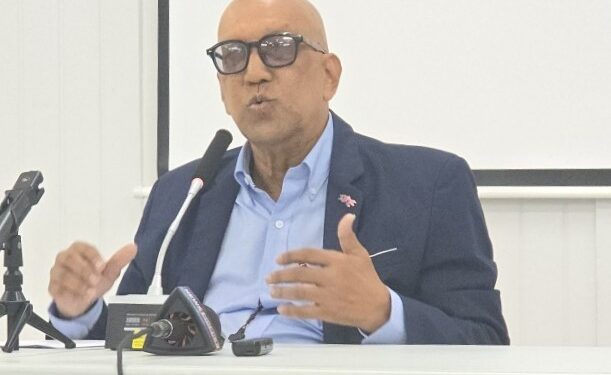
By Sharma Solomon MP (APNU)- The latest revelation that the Government has requested a one year extension to the final disbursement of its US$527 million Gas-to-Energy loan is yet another admission of the mismanagement that has characterised this project from its inception.
A project originally expected to be completed by the end of 2024 is now facing another missed deadline. The Government has now had to approach the US EXIM Bank to extend the final disbursement deadline from September 1, 2026, to September 30, 2027.
EXIM has granted an even longer extension, to December 30, 2027. This cannot be looked at as only a small adjustment. It is another indication that the Government’s project planning, execution and delivery have fallen behind its own commitments.
A sequence of failures have plagued this project through much mismanagement.
The gas pipeline was laid approximately two years before the power plant was ready to receive and utilise the gas. The plant has encountered significant construction and soil stabilisation problems, requiring additional interventions and hundreds of millions of dollars in expenditure. Questions remain about the additional costs associated with these works, including the further contractor arrangements and the request for more than US$100 million for soil stabilisation.
The country deserves a complete accounting of what was originally contracted, what was subsequently paid and what further payments are now being contemplated.
There is also the question of equipment and plant components completed and awaiting installation or commissioning. Government has spoken about equipment and components being ready well before the project itself. Where equipment is manufactured and completed months, or even years, before a facility is ready to receive it, there are consequences. Storage, preservation, insurance, handling, shipping, brokerage and other associated expenses do not disappear. They accumulate. Who is paying these costs, how much have they amounted to, and under which contracts are they being charged to the project?
The financial implications of this project are becoming very difficult for Guyanese ignore. The original two gas plants were expected to be completed by the end of 2024. Government’s latest report places the additional cost to the country at US$884 million above the initial cost. Nevertheless we are still being asked to accept revised timelines and further financial arrangements without a comprehensive public accounting of the consequences.
Also, what of the promises made to ordinary Guyanese? The Government sold this project on the promise of a 50% reduction in electricity bills. The Prime Minister has now acknowledged that this relief is conditional on achieving 228 megawatts under the first phase of the project. Meanwhile, the Minister of Public Utilities has spoken of only 57 megawatts being delivered by December 2026, while the head of the project task force had previously spoken of 228 megawatts by the end of the year and the full 300 megawatts by the middle of 2027.
These changing commitments tell their own story. The people who were promised cheaper electricity are still waiting. In the meantime, the country has had to rely on rented power ships, with another to arrive next month, so as to meet growing electricity demand. Carrying further costs while the project intended to reduce those costs remains unfinished.
The extension of the EXIM disbursement deadline raises another important set of questions. Is there a financial penalty, commitment fee or other charge attached to this extension? Are there additional interest or administrative costs? What are the conditions governing the delayed disbursement? What are the implications for the Government’s financing obligations and the overall cost of the project? Guyanese must not be left to discover these costs after the fact.
The Government must also disclose the complete financial position of the project, including the original contracts, variations, additional soil stabilisation expenditure, equipment storage and preservation costs, shipping and brokerage expenses, and every additional financing cost arising from the delays.
This is the fundamental problem with the Gas-to-Energy project. The pipeline was laid before the plant was ready. The plant encountered construction and soil problems. Equipment was completed ahead of the facility’s readiness. Deadlines were missed. Additional expenditure accumulated. Electricity relief was postponed. Now the Government is seeking more time to access the financing.
At every stage, the public has been asked to accept another explanation, another revised deadline and another commitment. However, explanations do not generate electricity, and announcements do not reduce electricity bills.
Guyana is an oil producing nation with the resources and opportunity to build a modern energy sector. What we cannot afford is a government that treats deadlines as suggestions, cost overruns as routine and public commitments as promises that can continually be postponed.
The people of this country are not asking for fancy gaffs in another an announcement. They are asking for a completed project, reliable and affordable electricity, and an honest account of what their money is paying for.
The gas may have reached the pipeline, but the promised benefits have yet to reach the homes and businesses of Guyanese.
In the meantime as the song of Kwesi Ace goes “blackout, blackout, everyday is blackout: Monday, Tuesday, Wednesday, Thursday, Friday Saturday, Sunday blackouts” that the entire nation can sing along loudly in chorus.
Hon. K. Sharma Solomon
Member of Parliament
APNU Rep for Natural Resources