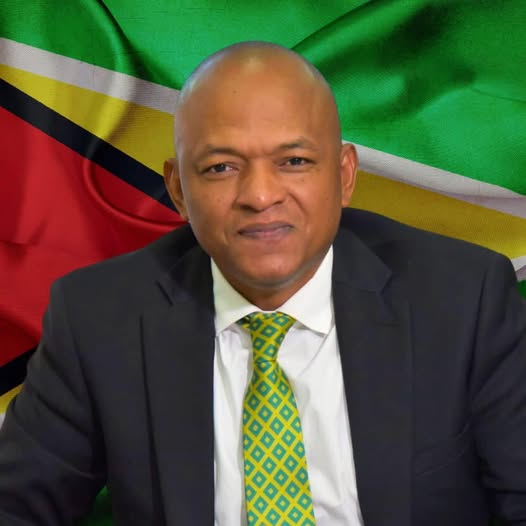
By Mark DaCosta- In a statement issued on 1 November 2026, A Partnership for National Unity (APNU) Member of Parliament (MP) Sherod Duncan argues that the Home Affairs Ministry’s response to the surveillance-footage controversy exposes a deeper failure of governance: the State is expanding its watching powers faster than Parliament can supervise them. He calls for an impartial, credibly scrutinised investigation into the alleged unauthorised extraction of footage, humane and lawful treatment of everyone detained, and a standing independent surveillance watchdog.
Duncan’s intervention comes days after the arrest and remand of Opposition Leader Azruddin Mohamed and Police Constable Ryan Greene. On 30 October, Magistrate Abigail Gibbs refused them bail at the Sparendaam Magistrates’ Court and remanded both until 24 November. Police allege that Constable Greene, a 20-year-old stationed at the Police Command Centre, copied government camera footage tied to the 12 October shooting at Kitty and passed it to Mr Mohamed for G$800,000. The charge falls under the Cybercrime Act. None of this has been proven, and the defence is reportedly turning to the High Court.
The MP, however, steers attention away from the personalities and towards the machinery. His central grievance is that he has been asking the right questions for nearly a year. In November 2025 he sought the legal basis for police drone surveillance, along with rules on how long footage is kept, who may view it and how access is recorded. In May 2026 he tabled a motion calling for an independent commissioner and proper enforcement of the nation’s data-protection framework. In October he filed three more questions on public cameras and the Safe Country initiative. By his account, none has been answered, which he blames on “ad hoc parliamentary sittings and largely non-functioning oversight committees.”
His sharpest rebuke is aimed at the Home Affairs Minister, whose announced review he regards as reactive rather than a substitute for safeguards that should have been established beforehand.
“The Minister must stop shooting from the hip,” Duncan writes, insisting that “Policy, not politics, ought to dictate governance.”
The title of his statement, Surveillance Needs Oversight, Not Improvisation, reinforces that criticism. Duncan argues that the review must establish what safeguards were in place, whether they were enforced, who was responsible and what corrective action will follow.
The questions he lists are practical ones that any citizen might ask. Who controls the footage and the facial-recognition data? Is it stored here or overseas? Which officers, contractors or foreign entities can reach it? What do the contracts cost, how accurate is the technology, and does a human verify a match before police act? He also raises “algorithmic bias” and the risk of misidentification, concerns that become more pressing as automated tools spread across public spaces.
On the investigation itself, Duncan asks for a “thorough, impartial investigation” that includes failures anywhere along the supervisory chain, not merely the lowest-ranking officer. He is firm that “Relevant recordings, access logs and instructions must be preserved,” and that “accountability must follow the evidence wherever it leads.” That wording reads as a pointed reminder that those who supervised the system, and not only those who allegedly exploited it, must answer for any lapse.
His statement also addresses the treatment of detainees. Echoing a recent APNU position, Duncan insists that Mohamed, Constable Greene and everyone in custody are entitled to humane treatment and the full protection of the law.
“Humane treatment, access to legal counsel, necessary medical care” and “full respect for due process and the presumption of innocence.”
He further stresses:
“Allegations must be tested fairly in court. Detention must never become punishment before conviction or an instrument of political pressure.”
The warning comes amid broader concerns over the treatment of political opposition. The Guyana Trades Union Congress (GTUC) has separately accused the administration of using State institutions against dissent, an allegation the Government is likely to contest.
The wider context adds weight to Duncan’s concerns. Earlier, the head of the Special Branch told a court that he began surveillance of Mohamed without instructions from his superiors. That disclosure has sharpened public questions about who directs the State’s surveillance operations and what mechanisms exist to ensure accountability.
Duncan’s closing argument is that the expansion of surveillance powers must be matched by effective institutional oversight.
“Guyana cannot continue to expand the State’s surveillance powers while its institutions of accountability fail to function effectively.”
He argues that the Government must move beyond announcing reviews whenever controversy erupts and explain how its powers are exercised and scrutinised.
His final message is direct:
“Guyanese deserve clear rules, functioning institutions and a Parliament capable of holding the Executive to account.”