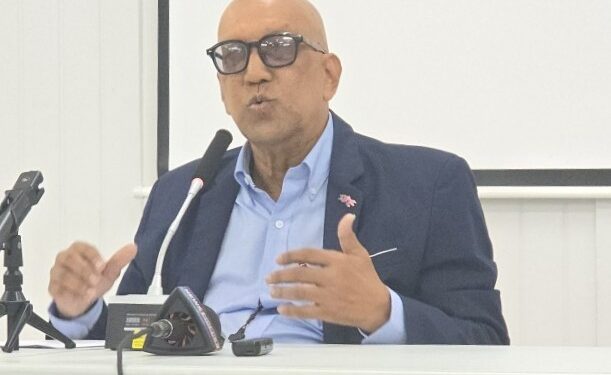
At a September 24 diaspora forum in Queens Village, New York, President Irfaan Ali made one of his clearest pitches yet to overseas Guyanese: invest directly in Guyana’s next phase of development.
The President said Government would soon launch a “special investment vehicle” through which members of the diaspora could put money into major industrial projects, specifically naming the planned fertiliser plant and gas bottling facility at Wales. He also spoke broadly about Guyana’s expanding infrastructure agenda and the opportunities being created around energy, housing, logistics and industrial development.
The message was clear: come home, participate, and bring capital.
It is an attractive idea, and one worth taking seriously. Guyanese abroad have supported families and communities for generations through remittances, property purchases, business investments and philanthropy. But investing in an industrial project is fundamentally different from sending money home to relatives. An investment comes with ownership rights, risk, expected returns and legal obligations.
That distinction matters.
The fertiliser plant, for example, is not a small project. Government has estimated the proposed Guyana Ammonia and Urea Plant at about US$300 million. It is expected to use up to 20 million cubic feet of natural gas per day and produce approximately 300,000 tonnes of fertiliser annually for Guyana, the Caribbean and potentially northern Brazil.
The proposed gas bottling and logistics facility is estimated at about US$40 million. Government says Guyana’s domestic LPG market is approximately three million 20-pound cylinders annually, worth around G$14 billion. The project is being structured as a public-private partnership and is intended to bottle and distribute LPG produced from the Wales gas development.
These are commercial ventures. A Guyanese nurse in Brooklyn, engineer in Toronto or small-business owner in London considering putting US$5,000, US$25,000 or US$100,000 into one of them should therefore be asking the same questions any serious investor would ask.
First, what exactly am I buying?
Is the diaspora vehicle a government bond, shares in a project company, units in an investment fund, preferred stock or some other instrument? Those structures provide very different rights. A bondholder is a lender. A shareholder is an owner. A fund investor owns units in a portfolio. The distinction determines everything from risk to repayment priority.
Second, what does “guaranteed returns” mean?
President Ali specifically said the investments would offer returns guaranteed by Government. That makes the details especially important.
Is the principal guaranteed, the return guaranteed, or both? Is the guarantee backed by the Consolidated Fund? Is Parliament required to authorise it? Will investors be paid in Guyana dollars or US dollars? What is the interest or dividend rate? Is the return fixed or tied to project performance?
Currency alone matters enormously to a diaspora investor. A 7 percent return paid in Guyana dollars is not economically identical to a 7 percent return paid in US dollars if exchange-rate risk rests with the investor.
Third, when can investors get their money back?
Will this be a five-year investment, ten years or longer? Can units be sold before maturity? Will there be a secondary market? What happens if the fertiliser plant is delayed, construction costs rise or projected export markets fail to develop as expected?
Infrastructure projects frequently encounter delays and cost changes. Investors need to know in advance who bears those risks.
Fourth, what protections will small investors have?
A diaspora investor living thousands of miles away will probably have no board seat and little direct influence over management. Who appoints the directors? Who audits the company? Will audited financial statements be published annually? What related-party transaction rules will apply? What information must management disclose when costs rise or contracts change?
And if an investor believes the rules have been breached, where does that person seek redress?
These questions are not arguments against the investment vehicle. They are the questions that turn an announcement into an investable product.
There are international precedents.
India successfully tapped its diaspora on three major occasions, raising US$1.6 billion through India Development Bonds in 1991, US$4.2 billion through Resurgent India Bonds in 1998 and US$5.5 billion through India Millennium Deposits in 2000. Those instruments specified maturity periods, currencies and interest rates.
The lesson is less that diaspora financing automatically succeeds and more that investors need a clearly defined instrument, credible issuer, transparent terms and reliable repayment mechanism.
Guyana has also discussed diaspora financing before. In May, President Ali announced plans for a diaspora bond to finance public infrastructure, while Guyana and Barbados announced work on a proposed Trident Arrow Investment Fund intended to allow citizens of both countries to invest in major projects.
The latest proposal may ultimately incorporate one of those earlier ideas, or it may be a separate structure. That is precisely why the next important document is not another speech. It is the prospectus.
That prospectus should identify the issuer, projects, minimum investment, currencies accepted, expected returns, maturity, government guarantee, fees, governance arrangements, audited financial reporting, risks and investor protections.
The opportunity could be significant. Guyana has a large overseas population with capital, professional expertise and emotional ties to the country. Properly structured, diaspora investment could allow ordinary Guyanese abroad to participate financially in projects that might otherwise be owned mainly by governments, banks and large institutional investors.
But patriotism should never be the substitute for due diligence.
“Come home and invest” is an invitation.
A prospectus is an investment.