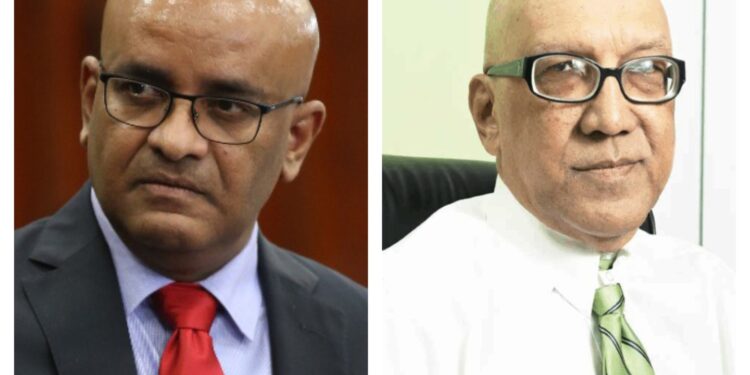
ExxonMobil Guyana president Alistair Routledge gave the oil debate its quote of the year this week. Asked why the world’s most profitable oil company isn’t doing more to raise living standards in Guyana, he said: “It’s not our job. They didn’t vote for us. We are not representatives of the people.”
Technically, he is right. And that is precisely the problem; not with him, but with us.
His candour arrived alongside Exxon’s victory lap: the US$55 billion Stabroek investment fully recovered, two years ahead of schedule, global output at a 40-year high, Guyana’s oil contributing an estimated 15% of Exxon’s operating income. The CFO has used Guyana as a selling point to other resource-rich nations. At the Barclays conference, Exxon told investors the good news plainly: the money is flowing, and fast.
Meanwhile, Guyana’s side of the ledger reads differently. UG economist Thomas Singh calls the 2016 production-sharing agreement “a terribly bad deal,” citing the country’s 14.5% share of consortium revenue, a fraction of what Norway or Brazil capture from their resources. Economist Richard Rambarran put the asymmetry in a single sentence: “It’s often said that Exxon saved Guyana. You could also say that Guyana saved Exxon.”
Here’s the hard truth Guyanese need to sit with: nobody rescued us. We signed the contract. We own the resource. Exxon is a tenant, not a benefactor, and tenants don’t build your house. The instinct to treat the company’s presence as a favour is the most expensive habit in this country’s political economy, because a favour is something you thank someone for, not something you negotiate against.
With the US$55 billion cost bank now cleared, Guyana’s share of profit oil has jumped from roughly 12.5% to 39.8%. That is the headline investors should carry into every valuation of the Natural Resource Fund. But it is not permanent. Every new project feeds costs back into the bank, recoverable against up to 75% of monthly production, and Exxon’s CFO has already told investors the share will decline again. Ring-fencing is the policy lever on the table; President Ali says he is taking expert advice. He should, and that advice should be public, because this is the hinge decision of the decade for the national finances.
For diaspora and foreign investors, this week is not a lesson in outrage but in discipline: price every Guyana exposure against the 39.8%-today-12.5%-tomorrow swing, not against the peak. And for Guyanese themselves, the lesson is sharper. When the world’s most profitable driller says nation-building isn’t its job, believe him. The job was never his. It is ours, and the risk is ours too.