Judicial independence, accountability and the rule of law are at the centre of discussions as judges and magistrates from across the Commonwealth meet in Kingston for the 2026 Annual Conference of the Commonwealth Magistrates’ and Judges’ Association (CMJA).
The five-day conference, which opened on September 20 and runs through September 24, is being held under the theme “Sustainable Justice: For Today, For Tomorrow, For All.” The programme brings together judicial officers to examine some of the most pressing challenges confronting courts, including judicial independence, access to justice, accountability, chronic underfunding and threats against judicial officers.
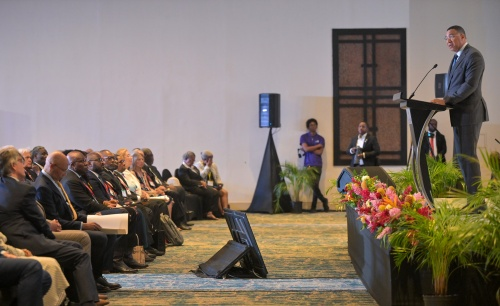
Jamaica’s Prime Minister Andrew Holness, addressing Monday’s opening ceremony at The Jamaica Pegasus hotel, said the conference provides an opportunity for Commonwealth jurisdictions to exchange experiences and consider how justice systems can respond to changing demands.
“This conference provides an opportunity to learn from one another, to compare experiences, examine emerging challenges, share innovations, and consider how the administration of justice can continue to evolve while preserving the fundamental principles upon which our legal system rests.”
Holness pointed to increasingly complex caseloads, technological changes, transnational organised crime, cybercrime and sophisticated financial crimes as challenges facing justice systems.
He also stressed the need for courts to be independent, properly resourced, technologically capable and accessible.
Independence and political pressure on agenda
The conference agenda places judicial independence under particular scrutiny.
A major session scheduled for Wednesday is titled “Current tensions between Judicial Independence and the Rule of Law.” Other sessions are examining judicial bullying and harassment, protection from online and physical threats, judicial integrity, judicial wellness and whether chronic underfunding is leaving justice systems dysfunctional.
The programme also includes discussions on data-driven justice and accountability, open justice versus privacy, environmental justice, gender-based violence, vulnerable witnesses, military justice, maritime matters and the rights of children and parents.
The CMJA says one of its principal objectives is to promote a greater understanding among Commonwealth judicial officers of issues surrounding judicial independence and to examine how those issues are addressed in different jurisdictions. It also seeks to increase awareness of international law concerning access to justice and strengthen professional networks among judges and magistrates.
Judicial Independence, Rule of Law Under Spotlight as Commonwealth Judges Gather in Jamaica
KINGSTON, Jamaica — Judicial independence, accountability and the rule of law are at the centre of discussions as judges and magistrates from across the Commonwealth meet in Kingston for the 2026 Annual Conference of the Commonwealth Magistrates’ and Judges’ Association (CMJA).
The five-day conference, which opened on September 20 and runs through September 24, is being held under the theme “Sustainable Justice: For Today, For Tomorrow, For All.” The programme brings together judicial officers to examine some of the most pressing challenges confronting courts, including judicial independence, access to justice, accountability, chronic underfunding and threats against judicial officers.
Jamaica’s Prime Minister Andrew Holness, addressing Monday’s opening ceremony at The Jamaica Pegasus hotel, said the conference provides an opportunity for Commonwealth jurisdictions to exchange experiences and consider how justice systems can respond to changing demands.
“This conference provides an opportunity to learn from one another, to compare experiences, examine emerging challenges, share innovations, and consider how the administration of justice can continue to evolve while preserving the fundamental principles upon which our legal system rests.”
Holness pointed to increasingly complex caseloads, technological changes, transnational organised crime, cybercrime and sophisticated financial crimes as challenges facing justice systems.
He also stressed the need for courts to be independent, properly resourced, technologically capable and accessible.
Independence and political pressure on agenda
The conference agenda places judicial independence under particular scrutiny.
A major session scheduled for Wednesday is titled “Current tensions between Judicial Independence and the Rule of Law.” Other sessions are examining judicial bullying and harassment, protection from online and physical threats, judicial integrity, judicial wellness and whether chronic underfunding is leaving justice systems dysfunctional.
The programme also includes discussions on data-driven justice and accountability, open justice versus privacy, environmental justice, gender-based violence, vulnerable witnesses, military justice, maritime matters and the rights of children and parents.
The CMJA says one of its principal objectives is to promote a greater understanding among Commonwealth judicial officers of issues surrounding judicial independence and to examine how those issues are addressed in different jurisdictions. It also seeks to increase awareness of international law concerning access to justice and strengthen professional networks among judges and magistrates.
Guyana participation amid Persaud travel controversy
Guyana’s participation has taken on an additional dimension following reports concerning High Court Justice Gino Persaud, who was reportedly unable to proceed with planned travel through Miami to attend the conference after being advised that his U.S. visa was under review.
Importantly, publicly available information does not establish that the judge’s U.S. visa has been revoked or cancelled, nor does it establish a connection between the visa issue and any of his judicial work.
The controversy has nevertheless prompted calls for Guyana’s judiciary to make representations on Persaud’s behalf. Former National Assembly Speaker Raphael Trotman urged the Acting Chancellor of the Judiciary to intervene.
The issue comes as Commonwealth judicial officers are discussing precisely the broader questions of judicial independence, institutional protection and the pressures that can confront members of the judiciary.
A timely regional conversation
The Jamaica conference is therefore unfolding against a backdrop in which courts across the Commonwealth are being asked to balance independence and accountability while responding to technological change, resource constraints and increasingly complex legal disputes.
Jamaica’s Governor-General, Sir Patrick Allen, told the opening ceremony that sustainable justice must involve institutions capable of serving future generations while remaining sufficiently independent to administer justice “without fear, favour or undue influence.”
The conference continues through September 24, with the judicial officers expected to conclude their deliberations with further discussions on judicial independence, threats to judges, judicial wellness and the future administration of justice across the Commonwealth
A timely regional conversation
The Jamaica conference is therefore unfolding against a backdrop in which courts across the Commonwealth are being asked to balance independence and accountability while responding to technological change, resource constraints and increasingly complex legal disputes.
Jamaica’s Governor-General, Sir Patrick Allen, told the opening ceremony that sustainable justice must involve institutions capable of serving future generations while remaining sufficiently independent to administer justice “without fear, favour or undue influence.”
The conference continues through September 24, with the judicial officers expected to conclude their deliberations with further discussions on judicial independence, threats to judges, judicial wellness and the future administration of justice across the Commonwealth