In November 1887, Black cane cutters in Louisiana asked to be paid in real money. The answer came in gunfire, and the silence that followed lasted more than a century. For a region built on the same crop, the story should sound familiar.
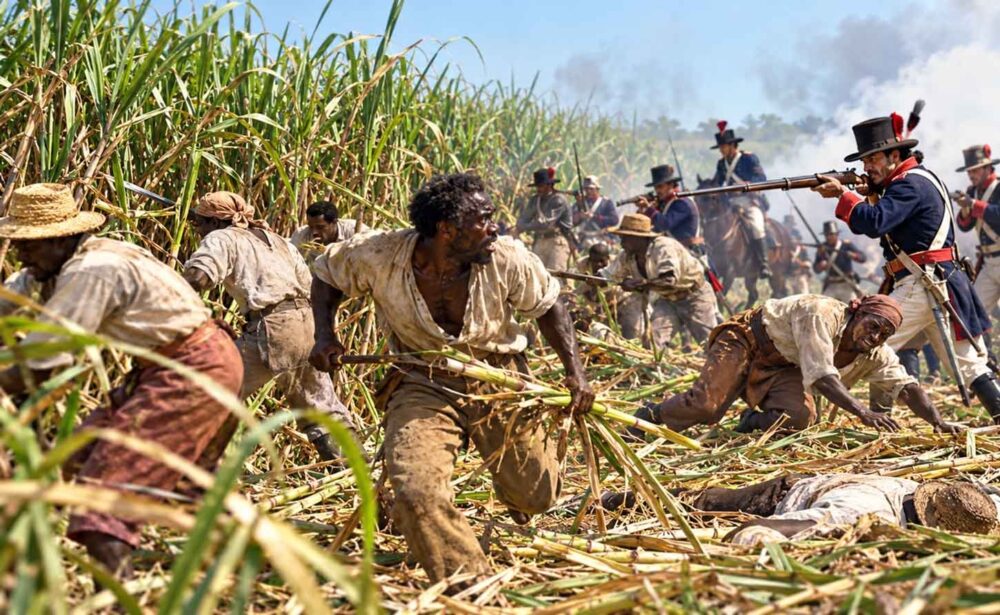
By Calvin G. Brown (WiredJA)- At first light on 23 November 1887, the back streets of Thibodaux, Louisiana, filled with armed white men. For roughly two hours, according to later accounts, they moved door to door through the town’s Black quarter, shooting unarmed people whose offence was to have gone on strike. By the time the smoke cleared, a labour movement lay dead alongside its members.
Paid in Paper, Housed in Slave Cabins
Two decades after emancipation, freedom in Louisiana’s sugar parishes looked suspiciously like the old order. Cane cutters, many of them formerly enslaved, still lived in the cabins their enslavers had built. They worked in gangs. And instead of cash, many were paid in scrip — paper that could be spent only at plantation stores, at prices the planter set.
The Knights of Labor, a national union unusual for its time in admitting Black members, saw an opening. In 1887 it put modest demands to the planters: cash instead of scrip, a small raise, and pay every two weeks. The planters did not reply.
A Strike Timed to the Harvest
On 1 November, an estimated 10,000 workers walked off the plantations of Lafourche, Terrebonne, St Mary and neighbouring parishes. Roughly one in ten was white. The timing was deliberate: it was grinding season, when cane left standing could be ruined by a single frost.
The planters’ fear was real; a lost crop could mean ruin. But their answer was force. Governor Samuel McEnery, himself a sugar planter, sent in the state militia to protect strikebreakers. Striking families were evicted from plantation housing, and thousands crowded into Thibodaux. A local judge declared martial law, and armed white “pickets” drawn from the town and nearby parishes sealed its roads.
In the early hours of the 23rd, shots wounded two of those pickets. Who fired has never been established. What followed is not in doubt.
Counting the Uncounted
The Reverend T. Jefferson Rhodes of Thibodaux’s Moses Baptist Church described companies of white men going about “night and day shooting colored men” who had joined the strike.
The coroner named just eight victims. Historians put the dead at between 30 and 60; some estimates run far higher. As the historian Rebecca Scott has noted, no credible official count was ever made, and bodies kept surfacing in shallow graves outside town for weeks. Accounts differ on how directly militia units took part in the killing; they agree on the outcome.
No federal inquiry was held. No one was convicted. Andrew Price, a planter whom Smithsonian Magazine places among the attackers that morning, won a seat in Congress the following year. The Knights’ local assemblies collapsed, and cane workers in the region would not organise again until the 1950s.
Thibodaux was not an American aberration. It was the cane world’s standard reply to Black workers who asked to be paid.
The Caribbean Mirror
For readers in Jamaica, the pattern is uncomfortably familiar. Twenty-two years before Thibodaux, at Morant Bay in 1865, the colonial state answered a protest by Black peasants with martial law and hundreds of deaths.
Fifty-one years after it, in the first days of May 1938, colonial police opened fire on striking workers at Frome in Westmoreland, where the West Indies Sugar Company, a Tate & Lyle subsidiary, had bought up estates across Westmoreland and Hanover. Four people died. The workers’ demand — a dollar a day — echoed the cash wage Louisiana’s cutters had sought half a century earlier.
The difference lies in what came after. Frome ignited the island-wide unrest that gave rise to Bustamante’s trade unionism, Norman Manley’s party politics and, eventually, Independence. Thibodaux produced only silence: a massacre that did not merely end a movement but erased it from memory.
Digging Up the Past
That silence has begun to lift. In 2017, the Thibodaux City Council formally condemned the killings. That same year the journalist John DeSantis, whose book revived the story, formed the Louisiana 1887 Memorial Committee, bringing descendants of victims together with descendants of planter and Confederate families. Ground-penetrating radar at a suspected burial site has detected signs of disturbed earth, but a mass grave has yet to be confirmed.
The cane cutters of Thibodaux asked for money they could spend where they chose. More than a century later, their descendants are asking for something simpler still: a name, and a grave.