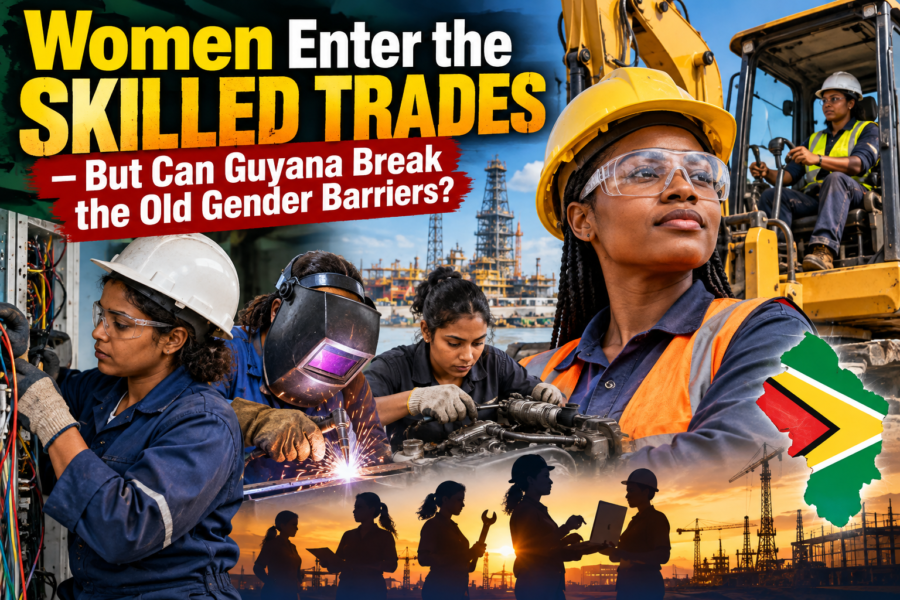
Women are increasingly entering occupations once regarded as men’s work, from electrical installation and auto-electrical work to heavy-equipment operation, welding and other technical trades. But as Guyana’s oil-driven economy expands, a larger question remains: will women gain equal access to the jobs, wages, advancement and economic opportunities created by the country’s transformation?
Recent Board of Industrial Training programmes show women making significant inroads into technical fields that have traditionally been male dominated.
In Linden alone, 47 women were among 174 recent technical-training graduates, including women trained in heavy-duty equipment operation and other industrial occupations. Earlier this month, Guyanese trainees Orella Trotman and McGiver Miller were highlighted while pursuing electrical installation training, with Trotman among the women challenging conventional assumptions about who belongs in technical trades.
The shift is significant because Guyana’s economic expansion is increasing demand for electricians, welders, mechanics, equipment operators, technicians and other skilled workers.
Women are half the population — but not half the workforce
Official data provides important context to the changing role of women in Guyana’s economy.
The 2022 Population and Housing Census preliminary results recorded 440,882 males, or 50.18 per cent of the population, and 437,792 females, or 49.82 per cent. In other words, women account for virtually half of Guyana’s population.
That near parity, however, is not reflected in participation in the labour market.
The 2025 Guyana Labour Force Survey recorded male labour-force participation at 53.8 per cent, compared with 40.9 per cent for women. The employment-to-population ratio was 49.8 per cent for men and 37.2 per cent for women.
The disparity extends to unemployment and the nature of employment. Female unemployment stood at 9.2 per cent, compared with 7.5 per cent for men, while 82.3 per cent of employed women were in informal employment, compared with 76.7 per cent of men. Women’s labour-underutilisation rate was 34.3 per cent, compared with 19.1 per cent for men.
The figures point to an important distinction: women are making significant inroads into traditionally male-dominated training programmes, but that progress has not yet translated into equal representation across Guyana’s wider workforce.
The opportunity is enormous
Guyana’s infrastructure and energy expansion is generating thousands of direct and indirect employment opportunities. But economic growth alone does not guarantee equality.
Women entering skilled trades can still encounter stereotypes about physical ability, workplace culture, recruitment and advancement. The issue therefore extends beyond training.
It involves who gets hired, who gets paid properly, who receives promotions and who is protected from discrimination and harassment.
Guyana’s ongoing labour-law review is examining discrimination, equal rights, occupational safety and industrial relations—areas that will directly affect women entering traditionally male workplaces.
A changing workforce
Government figures indicate that women are increasingly participating in skills programmes. According to the report during the first half of 2026, 711 women received skills training through the Women Innovation and Investment Network and the Board of Industrial Training, with training extending into areas including auto-electrical work, electrical installation, heavy-duty equipment operation, information technology and agro-processing.
Over a five-year period, the Labour Ministry has reported that 9,331 women received Board of Industrial Training skills training, compared with 7,021 men.
Among the occupations drawing women are fields historically dominated by men. The Ministry has reported 500 women trained in heavy-duty equipment operation and 386 in electrical installation, while women are also entering welding, fabrication, tractor operation and maintenance, plumbing, carpentry, auto-related trades and renewable-energy installation.
The numbers demonstrate growing access to training. They do not, however, mean that women now dominate these occupations in the wider workforce.
The broader labour-force data shows that craft and related trades, plant and machine operation, agriculture, forestry and fishing remain heavily male-oriented occupational areas. Women continue to be more concentrated in services, sales, clerical work and professional occupations.
Training is only the beginning
That distinction matters as Guyana spends heavily on developing a workforce capable of supporting its expanding economy.
A certificate alone does not guarantee employment. Nor does training automatically produce equal wages, safe working conditions or opportunities for promotion.
The real measure of progress should therefore be how many women move from training into decent, sustainable employment, how many remain in these occupations, what they earn, whether they advance into supervisory and management positions and whether they eventually become business owners and employers themselves.
Guyana’s oil wealth has created an opportunity to broaden women’s participation in the productive economy.
But training women for the new economy without confronting discrimination and unequal opportunity would leave the job unfinished.
Women are entering the trades. The next challenge is ensuring that the workplace doors stay open—and that women have an equal opportunity to climb through them.