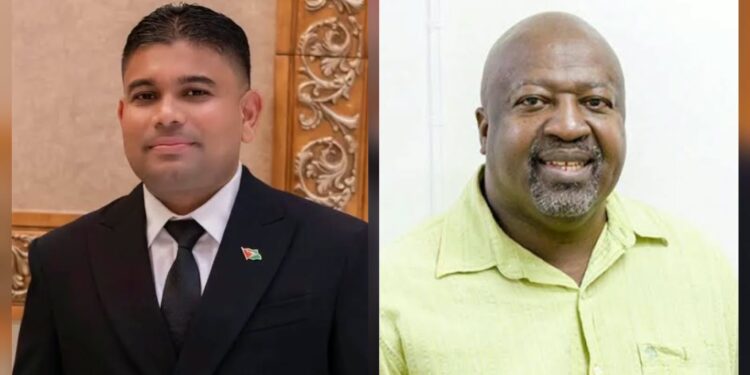
Senior Superintendent Prem Narine, head of the Guyana Police Force’s Special Branch, is not a junior officer recounting street rumours. He is the senior police officer responsible for the Force’s intelligence arm, and his testimony under oath has placed a series of serious questions at the centre of the extradition proceedings involving businessman and Opposition Leader Azruddin Mohamed and his father, Nazar “Shell” Mohamed.
The most troubling question is also the simplest: If Narine says he possessed intelligence linking Azruddin Mohamed to six “execution-style” killings, why was Mohamed never arrested or charged in connection with any of them?
Narine made the claims during cross-examination before Chief Magistrate Judy Latchman in the ongoing US extradition proceedings. The United States is seeking the extradition of the Mohameds over criminal allegations arising from their gold-trading business.
The extradition proceedings are not a trial of the murder allegations, and Narine’s testimony is not a judicial finding that Mohamed committed those crimes. That distinction is fundamental. So is the office from which the testimony came.
“I Have Information”
Asked by defence attorney Siand Dhurjon why he regarded Azruddin Mohamed as a national-security threat, Narine answered:
“I have information. It suggests that he’s involved in murders.”
He subsequently identified the information as relating to:
“Murders, torture, execution-style killings, beating of employees, bribery.”
Narine told the court that Special Branch intelligence linked Mohamed to six alleged execution-style killings, including an incident in which three people died following an explosion aboard a vessel at Friendship. He also said the information came from police sources and that he was not personally present when the deaths occurred.
These are extraordinarily serious claims.
But the greater public-interest question may be what happened after the intelligence was received.
Where Did the Intelligence Lead?
Narine acknowledged that Mohamed was never arrested or charged in connection with the three deaths aboard the vessel at Friendship. He said police statements had been taken that implicated Mohamed but, under questioning, could not recall their contents. Demerara Waves also reported that Narine acknowledged there had been no court finding that Mohamed committed murder, torture, execution-style killings, bribery or assaults on employees.
That creates an uncomfortable gap between intelligence and prosecution.
If the information was sufficiently credible for the head of Special Branch to place it before a court as the basis for a national-security assessment, why did it apparently not result in a murder charge?
If it was not sufficient to support an arrest or prosecution, what was its evidentiary value?
And if police statements existed, where are they?
Those are questions of policing, evidence and accountability—not conclusions about Mohamed’s guilt or innocence.
The Special Branch Factor
The significance of Narine’s evidence lies partly in his position.
Special Branch intelligence is supposed to be gathered, assessed, documented and acted upon through established professional processes. When its head tells a court that intelligence connects a person to multiple serious crimes, the public is entitled to ask how that intelligence was assessed and what followed.
Narine has also said he personally played a role in investigating some of the matters.
That makes the unanswered questions harder to dismiss as information merely circulating within the police force.
What did investigators do with it? Who received it? Was it corroborated? Was a case file opened? What evidence was gathered? And why did none of it culminate in a charge?
Then Come the Destroyed Records
The questions surrounding Narine’s evidence are compounded by his admission that he destroyed three books containing notes made in the course of his police duties.
Narine testified that the books were shredded and burned in January 2026. He said he destroyed them because of his understanding of obligations arising under the Official Secrets Act, and maintained that he was authorised to make the decision.
The defence has questioned whether the records should have been retained and what information they contained.
News Room reported that Narine acknowledged he knew he was a material witness in the extradition proceedings but had not informed the police legal adviser, prosecutor or prosecution team before disposing of the books. He also faced questions about police record-keeping requirements, including a standing order concerning the retention of pocketbooks.
The Guyana Police Force has rejected any suggestion that evidentiary records were destroyed. It says the material consisted of working notes, that relevant information had already been incorporated into Narine’s formal statement and that official records required for the proceedings were preserved and tendered in court.
That explanation is itself part of the story.
The question is not simply whether the destroyed books contained evidence. It is whether the destruction of contemporaneous police notes was appropriate, properly authorised and consistent with the requirements governing the preservation of potentially relevant records.
“By All Legal Means Possible”
Narine has also told the court that he presently regards Azruddin Mohamed as the “greatest threat” to Guyana’s national security.
When asked whether he wanted to “get rid” of Mohamed, Narine responded:
“By all legal means possible.”
The words “legal means” matter.
They place the focus squarely on process, evidence and professional conduct.
The defence has challenged Narine’s evidence and questioned whether political considerations influenced the arrests and the Special Branch’s actions. Narine has denied receiving political instructions and rejected suggestions that he was directed to destroy records or remove communications.
Chief Magistrate Latchman has made clear that she will base her decision on evidence properly placed before the court, rather than media reports or social-media material.
That is precisely why the unresolved issues deserve careful examination within the proceedings.
The Questions That Remain
Narine’s testimony does not establish Mohamed’s guilt, and the destruction of the notebooks does not, by itself, establish wrongdoing or a cover-up. Those are matters that would require evidence and legal findings.
But the evidence raises a narrower and more troubling question about the handling of intelligence by Guyana’s senior police authorities.
If Special Branch possessed information linking a prominent political figure to six serious killings, and police statements allegedly implicated him, what happened between the receipt of that intelligence and the decision not to arrest or charge him?
That question encompasses several issues that require clear answers: what was the intelligence, how was it corroborated, who reviewed it, what investigation followed, and why did it not produce a criminal case?
The destruction of Narine’s notebooks adds another layer. The Police Force says they were working notes and that relevant information was preserved elsewhere. The defence has questioned the circumstances and timing of their destruction.
That leaves a further, specific issue: were the records properly destroyed under the rules governing police documentation, and can the Force account for the information they contained?
These are not findings of guilt against Mohamed or Narine. They are questions about whether intelligence was properly assessed, whether investigative opportunities were pursued and whether the evidentiary trail was adequately preserved.
The extradition court will determine the legal issues before it.
But the broader public-interest question is difficult to avoid: If the intelligence was serious enough to help inform a claim that Mohamed represented a major national-security threat, why did it apparently never become a murder prosecution?
That is the question Narine’s testimony leaves hanging.