Georgetown — The Ministry of Finance’s Mid-Year Report 2026, tabled by Senior Minister in the Office of the President with Responsibility for Finance, Dr. Ashni Singh, describes Guyana’s exchange rate position in a single, reassuring sentence: the official rate “remained stable” through the first half of the year. Look past that sentence, though, and the same paragraph contains a number that tells a very different story.
What the report actually says
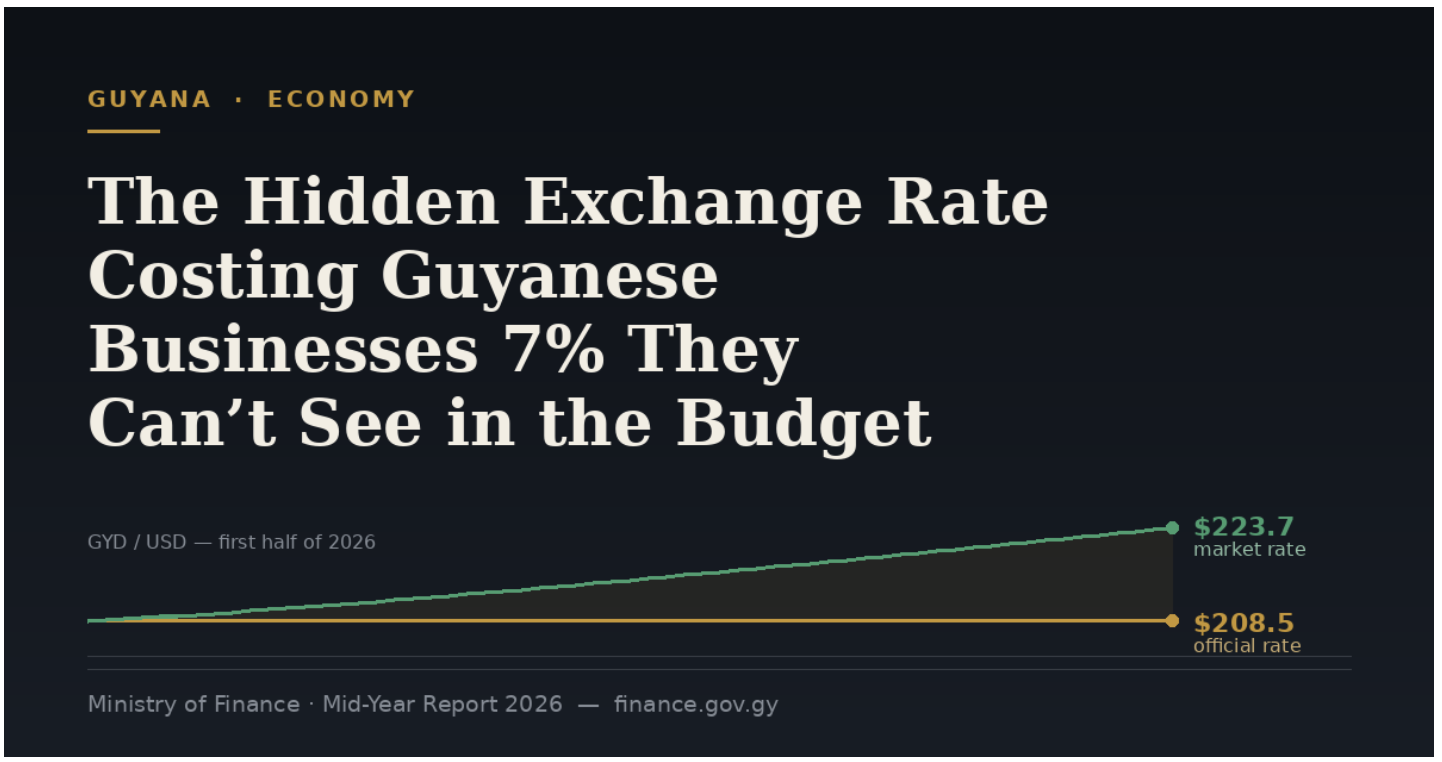
Section 3.37 of the document states that at the end of June 2026, “the official exchange rate of the Guyana dollar to the US dollar remained stable at $208.5,” unchanged from the position at the end of 2025. In the very next sentence, the report discloses that “the market mid-rate of the Guyana dollar to the US dollar moved from $220.6 to $223.7” over the same six months.
Put those two numbers side by side and the picture changes considerably. By June, the gap between the rate the government quotes as Guyana’s exchange rate and the rate at which Guyana dollars were actually changing hands had widened to roughly $15.20 — a spread of about 7.3 percent. And unlike the official rate, which the report says has not moved at all, the market rate kept climbing throughout the half-year.
Why the gap matters
An officially pegged rate that stays fixed while a parallel market rate keeps drifting away from it is a textbook signal of underlying currency pressure, even when, as here, the divergence is modest by the standards of countries with acute currency crises. It means that for a growing share of transactions, informal remittances, cambio trades, invoicing tied to imports, Guyanese are not actually paying $208.5 to the US dollar. They are paying closer to $224, and that premium has been rising, not holding steady, for six straight months.
This is not a new phenomenon in Guyana, but the persistence of a stated official rate detached from the observable market rate has a long history of controversy. Reporting by Stabroek News over the past decade has repeatedly noted that the Bank of Guyana’s quoted rate for the currency has, at various points, sat well below what commercial cambios and banks were charging customers for the same transaction, with one Finance Ministry account from 2014 already flagging that the market rate was running several dollars above the official one even then. Bank of Guyana officials have at times pushed back on suggestions that a currency shortage exists, but the report’s own figures now show the official-versus-market gap moving in the wrong direction over just the first six months of 2026.
A boom economy with a currency footnote
The irony is that this is happening in an economy the same report describes as expanding by 33.3 percent in real terms in the first half of the year, driven by a fourth offshore oil vessel coming fully online. Export earnings surged 76.4 percent to over US$16 billion, and the current account posted a US$3.3 billion surplus. By most conventional measures, an economy generating that kind of foreign currency inflow should see its currency strengthen, or at minimum see no widening gap between official and market pricing.
Instead, the Mid-Year Report shows the overall balance of payments, the broadest measure of money flowing in and out of the country, recording a deficit of US$293.9 million in the same period, financed by a drawdown of the foreign reserves held at the Bank of Guyana. Reserves stood at US$1,062.3 million at the end of June, though the report does not state what that figure was at the start of the year, making it difficult to gauge from the document alone how much of a drawdown occurred.
What it means for business
The spread is not just an abstract macroeconomic curiosity, it lands differently on different parts of the private sector.
Import-dependent businesses are the most exposed. Retailers, manufacturers and distributors that price in Guyana dollars but source inputs abroad often cannot reliably access foreign currency at the official $208.5 rate and are effectively paying closer to the market rate to secure US dollars through cambios. That amounts to input-cost inflation running well above the 4.4 percent headline figure the report cites for the first half of the year, a cost businesses (customers) absorb quietly rather than one that shows up in official statistics.
Exporters, by contrast, are on the favourable side of the same gap. Non-oil exporters earning US dollars from gold, sugar, rice or bauxite and converting those earnings informally are effectively being paid at the stronger of the two rates, a real, if narrow, competitiveness boost that mirrors the cost burden importers face.
The divergence also raises questions of access. Larger, well-banked firms and those with government or oil-sector ties tend to have more reliable access to foreign currency at the official rate than smaller and informal businesses do, though the report provides no data on how foreign exchange is actually allocated across the private sector to confirm the scale of that advantage.
Elsewhere, the report’s own figures show a private sector still investing with confidence despite the currency question: private sector credit expanded 11.5 percent in the first half of the year, and mortgages for industrial and commercial properties specifically jumped 63.7 percent, alongside a modest easing in the weighted average commercial lending rate, from 7.85 percent to 7.72 percent. A construction sector now expected to grow 27.6 percent for the year, fuelled by a Public Sector Investment Programme revised up to $829.7 billion, is also creating real opportunity for private contractors and suppliers, though it puts the state and private developers in direct competition for the same skilled labour and materials, a dynamic that tends to push up costs for projects outside the public purse.
One further pressure point sits with state-owned enterprises. Guyoil and GPL together drove a 53.5 percent jump in public enterprise expenditure in the first half of the year, largely on higher fuel acquisition costs, while electricity and fuel tariffs were held stable for consumers and businesses alike.
The bottom line
A “stable” headline resting on an official rate that has not been allowed to move, next to a market rate that has moved every month, is not the same thing as genuine stability. It is, more precisely, a widening gap that a mid-year report is required by law to disclose, and did, but did not frame as the developing story that the numbers themselves suggest it may be.
For a business that never touches foreign currency, that framing may not matter much. For the many that do, importers, exporters, and anyone financing growth against future costs, the market rate, not the official one, is already the number that counts.
This article is based on publicly available data published in the Ministry of Finance’s Mid-Year Report 2026, available at finance.gov.gy, and historical reporting on Guyana’s foreign exchange market.