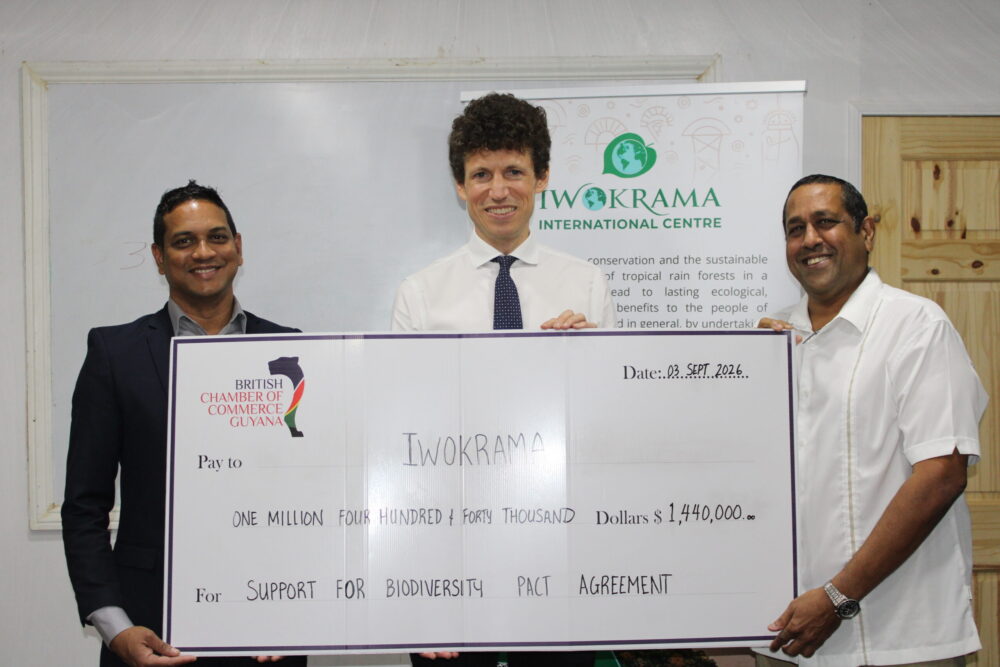
The Iwokrama International Centre (IIC) and the British Chamber of Commerce Guyana (BritCham) are strengthening their partnership with a three-year funding commitment aimed at supporting biodiversity conservation, sustainable forest management and other environmental initiatives in Guyana.
Under the arrangement, announced by Iwokrama last week, BritCham will provide annual funding to support the Centre’s work under the Global Biodiversity Alliance (GBA). The commitment builds on a cooperation memorandum of understanding signed by the two organisations in 2025.
Iwokrama Chief Executive Officer Dane Gobin welcomed the support, particularly because BritCham’s membership includes companies operating in Guyana’s oil and gas sector.
“the Centre is grateful to BritCham for this support which will help implement the Centre’s activities under President Ali’s GBA initiative – both the Centre and BritCham are members of the GBA. It is heartening to see the membership of BritCham, mainly involved in the oil and gas industry, recognize the importance of Guyana’s green agenda.”
Gobin also pointed to Iwokrama’s longstanding relationship with Britain and the Commonwealth, noting that the Commonwealth Secretariat was among the Centre’s founding partners and that King Charles III is its patron.
The partnership is expected to extend beyond financial support, with both organisations identifying possible joint initiatives in social and biological assessments, education and awareness, livelihood programmes, scientific research, sustainable forest management and fundraising.
BritCham: Growth and conservation must coexist
BritCham Guyana Chairman Faizal Khan said the initiative reflects the organisation’s belief that economic expansion and environmental protection should advance together.
“At BritCham Guyana, we believe economic growth and environmental stewardship must go hand in hand. Guyana has a unique opportunity to demonstrate to the world that a rapidly growing economy can also be a global leader in biodiversity conservation.”
Khan said the three-year commitment is intended to encourage broader private-sector involvement in conservation.
“While our annual contribution is modest for now, we hope it serves as a catalyst for greater collaboration between the private sector & organizations dedicated to protecting Guyana’s extraordinary natural heritage.”
British High Commissioner to Guyana Joseph Fisher, MBE, also welcomed the partnership, saying it demonstrates that conservation and sustainable economic development can work together.
“BritCham’s support for the Centre and its work on the Global Biodiversity Alliance demonstrates how environmental conservation and sustainable economic growth can go hand in hand.”
Iwokrama’s roots predate its formal establishment
While the Iwokrama International Centre was formally established in 1996 through a joint mandate between the Government of Guyana and the Commonwealth Secretariat, the initiative dates back to 1989 under then-President Hugh Desmond Hoyte.
At the Commonwealth Heads of Government Meeting in Malaysia that year, Hoyte offered approximately one million acres of Guyana’s rainforest to the international community for research into sustainable rainforest management and biodiversity conservation. Iwokrama’s historical records describe that commitment as the foundation of what became the Iwokrama project.
The project subsequently advanced under the administration of President Cheddi Jagan, with the Iwokrama Agreement signed in 1995 and the Iwokrama Act passed unanimously by Parliament in 1996, formally establishing the Centre.
Today, Iwokrama manages about 371,000 hectares of rainforest and operates through a model combining conservation, scientific research, sustainable economic activity and community participation. Its work involves approximately 20 surrounding communities and about 7,000 people.
The new BritCham commitment comes as Guyana seeks to position biodiversity conservation alongside its rapidly expanding resource-based economy. The partnership therefore places renewed emphasis on the challenge of demonstrating that economic growth, including growth driven by the oil and gas sector, can coexist with protection of Guyana’s forest and natural heritage.