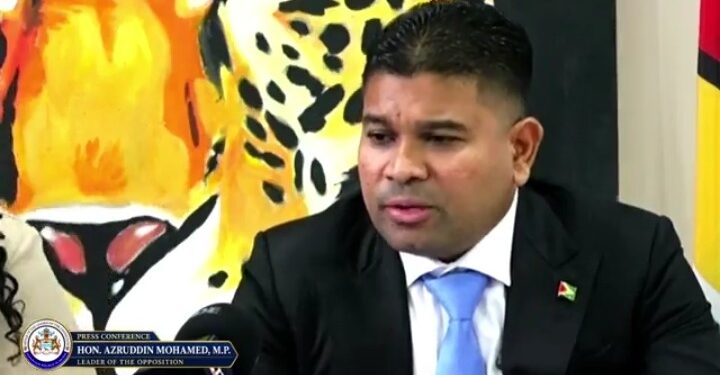
By Mark DaCotsa- In a statement issued on 15th September 2026, four APNU Members of Parliament sitting on the Foreign Relations and Economic Services Committees have told President Irfaan Ali that they will not allow themselves to be summoned merely to rubber-stamp decisions already taken.
The signatories — Dr. Terrence Campbell, Juretha Fernandes, Dr. Riaz Rupnarain and Coretta McDonald — insist that any engagement with the Head of State must come before agreements are signed, must carry a substantive agenda and advance documentation, and must allow the opposition to genuinely influence national policy.
The main parliamentary opposition has served notice that it will not be dragged into what it regards as a carefully staged exercise in political theatre, as President Irfaan Ali moves to convene meetings on the economy, the cost of living and energy. Four APNU legislators, in a statement signed on Monday by Dr. Terrence Campbell, Juretha Fernandes, Dr. Riaz Rupnarain and Coretta McDonald, declared themselves willing to sit with the President — but only where the encounter is properly organised, properly documented and capable of actually altering outcomes.
The central complaint is one of sequencing. Genuine consultation, the MPs argue, must happen before our nation is locked into agreements, financial obligations and international arrangements — not afterwards.
“Presenting the opposition with an accomplished fact and calling it consultation is an unacceptable fait accompli,”
they wrote, making plain that attendance at any meeting would be decided on the merits of context and content, not as a reflex. Their sharpest barb was reserved for the character of such post-decision briefings:
“Attending a meeting after national decisions have already been made with no genuine opportunity to change them is not consultation.”
On the energy front, the statement demanded full disclosure of the Gas-to-Energy project, where the government has acknowledged a 12.8 per cent adjustment to the original US759 million contract even while insisting the wider programme remains within budget.
Parliament, the MPs said, must see the original and revised costs, settlement terms, payments and completion milestones, together with a credible timetable for the cheaper electricity bills repeatedly promised to the public. They also pressed for clarity on the reported shortlisting of Lindsayca for further Phase Two works, asking what justifies entrusting additional work to a contractor while Phase One questions remain unresolved. On persistent blackouts and unreliable supply, they repeated their view that:
“A collection of contracts is not a national plan.”
The legislators turned equally hard questions towards the management of our country’s oil wealth. With the President himself conceding substantial unmet demand for foreign currency, they want an honest account of access, waiting times and actual transaction rates — arguing that an official reference rate does not tell the whole story of depreciation pressures on the Guyana dollar. On the Natural Resource Fund, they renewed their call for a defined minimum share to be preserved under transparent withdrawal rules, cautioning that:
“A balance in the Fund is not a substitute for a clearly protected intergenerational savings rule.”
Any move to diversify NRF assets beyond their current overnight-deposit arrangement at the Federal Reserve Bank of New York, they added, must follow independent professional assessment and published investment rules — not political direction.
The government’s confrontation with organised labour featured prominently. Noting that the Caribbean Union of Teachers has condemned the suspension of GTU dues deductions — a matter on which the High Court ruled in the union’s favour in April 2024 and the Court of Appeal refused the State a stay in January 2025 — the MPs demanded compliance with operative court orders and the restoration of deductions.
“Workers’ rights must not depend on political loyalty,”
they insisted.
On the cost of living, the statement challenged the government to move beyond:
“growth figures do not pay a grocery bill”,
calling for measurable relief for households, workers and pensioners. In education, they demanded a region-by-region account of teacher availability, facilities and learning resources, declaring that:
“A child’s community must not determine the quality of that child’s education.”
They pointed to the Orealla Secondary School, where reporting on 14 September described yet another planned retender while pupils remain in temporary accommodation, and called for published school-by-school completion schedules and action against defaulting contractors.
The statement closed on a defiant note:
“We are prepared to help shape sound decisions for Guyana. We are not prepared to decorate decisions already taken.”