Guyana is being transformed from one of the Caribbean’s poorest economies into a resource-rich state, but a harder question is emerging beneath the oil boom: how much control do Guyanese actually have over the wealth being extracted from their own soil and waters?
From offshore oil operated by American and Chinese-controlled companies to gold dominated by Chinese ownership and bauxite controlled by foreign companies, some of Guyana’s most valuable natural resources are being developed by corporations whose ultimate ownership lies outside the country.
The issue is not whether Guyana receives revenue. It does.
The issue is who owns the companies extracting the resources, who controls production, who receives the profits, and how much of the value remains in Guyana.
That distinction is becoming increasingly important as the scale of the resource boom expands.
Oil: Guyana’s Biggest Resource, Foreign-Controlled
The most dramatic example is the Stabroek Block, Guyana’s principal producing oil province.
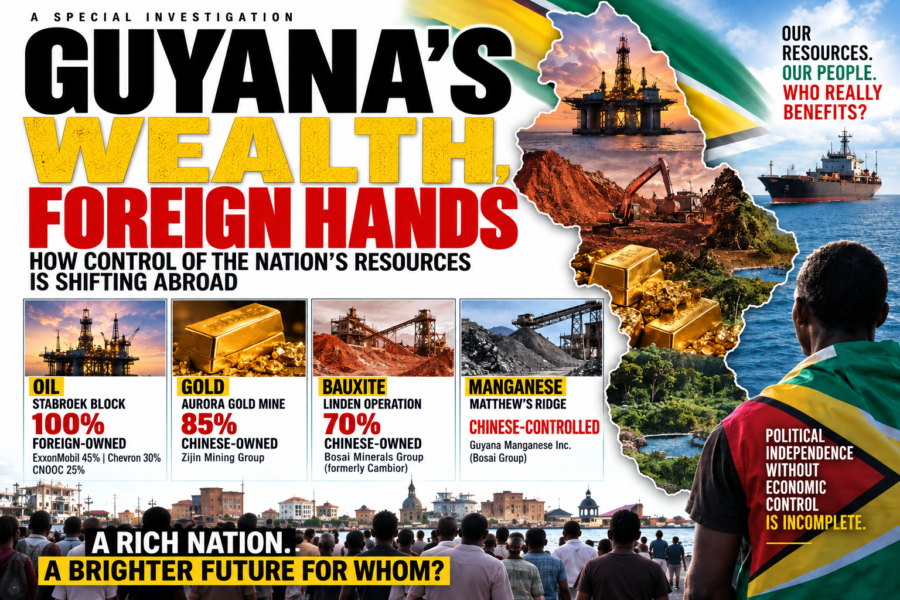
The block is operated by ExxonMobil, with ExxonMobil holding 45%, Chevron 30% and China’s CNOOC 25%. The three companies therefore hold 100% of the consortium’s working interests.
The block has more than 11 billion barrels of oil equivalent in discovered resources and production surpassed 900,000 barrels per day in 2025, with approved developments expected to take capacity toward 1.7 million barrels per day by 2030.
The numbers involved are staggering.
In 2025, ExxonMobil Guyana reported approximately US$8.1 billion in revenue and US$4.67 billion in profit from its Guyana operations. Guyana, meanwhile, received billions through petroleum revenues, royalties and its share of profit oil.
Those figures expose the central contradiction.
Guyana owns the resource, but foreign companies operate the machinery generating the wealth.
Under the original 2016 Stabroek agreement, the consortium could recover up to 75% of production as cost oil, after which profit oil is divided between the contractors and Guyana. Guyana also receives a 2% royalty.
Guyana’s position has improved substantially as project costs have been recovered. In August 2026, President Irfaan Ali said Guyana was then entitled to approximately 39.8% of production, compared with the original 12.5%.
But the foreign ownership of the producing companies remains.
Gold: China’s Growing Footprint
Guyana’s gold sector tells another part of the story.
China’s Zijin Mining Group acquired Guyana Goldfields in 2020, taking control of the Aurora Gold Mine. Zijin now holds an 85% interest in the operation.
Aurora contains approximately 181 tonnes of contained gold, according to Zijin, making it one of Guyana’s most important industrial gold assets.
So a major Guyanese gold asset moved from Canadian-controlled Guyana Goldfields to majority Chinese ownership.
The question is not whether foreign investment is inherently bad.
Foreign companies bring capital, technology, equipment, expertise and access to international markets.
The question is whether Guyana is developing sufficient domestic ownership and downstream capacity so that foreign investment becomes a tool for Guyanese wealth creation rather than a permanent substitute for Guyanese ownership.
Bauxite: The Linden Reversal
Perhaps nowhere is the question of economic sovereignty more politically sensitive than Linden.
Guyana nationalised the major bauxite industry in the 1970s. Decades later, under the PPP/C administration, the Linden operation was privatised.
A 2014 parliamentary statement by PPP/C MP Neendkumar acknowledged that in December 2004 the Linden bauxite operation was privatised, with Canadian company Cambior holding 70% and the Government of Guyana 30%. Cambior’s interest was subsequently sold to China’s Bosai Minerals Group in 2007.
That means an industry once brought under Guyanese state control ultimately ended up under majority foreign control.
Another major bauxite operation tells a similar story. Russia’s RUSAL owns 90% of the Bauxite Company of Guyana, with the Government holding 10%, although its operations are currently frozen.
And Now Manganese
The pattern extends beyond oil, gold and bauxite.
Guyana’s manganese industry at Matthew’s Ridge has been revived through Guyana Manganese Inc., a subsidiary of China’s Bosai Minerals Group.
Guyana therefore has a growing resource economy in which major strategic assets are increasingly connected to foreign capital and corporate ownership.
Ownership or Royalties?
This is where Guyana’s resource debate must go beyond the familiar argument about how much money enters the Treasury.
The government can point to billions flowing into the Natural Resource Fund. But a resource-rich country can collect royalties and taxes while foreign corporations retain substantial ownership and operational control of productive assets.
The historical comparison is striking:
Bauxite: Nationalised → state controlled → privatised → majority Chinese ownership.
Gold: Guyanese resource → Canadian-controlled Guyana Goldfields → acquired by China’s Zijin Mining.
Oil: Guyanese offshore resource → ExxonMobil 45% + Chevron 30% + CNOOC 25%.
The issue is not that Guyana has literally surrendered its resources to foreign countries. It has not. Guyana retains sovereignty and receives substantial revenues.
The harder question is who controls the companies extracting those resources, who supplies the capital and technology, who captures the profits, and whether Guyanese ownership is growing alongside the resource boom.
Guyana may have achieved political independence more than six decades ago. The oil era presents a second challenge: whether it can build Guyanese capital, Guyanese technology, Guyanese ownership and Guyanese-controlled industries.
Otherwise, the country risks becoming the paradox of a resource-rich nation whose greatest productive assets remain substantially controlled by foreign capital.
After the oil, gold, bauxite and manganese are extracted, how much enduring wealth—and how much economic control—will actually belong to Guyanese?