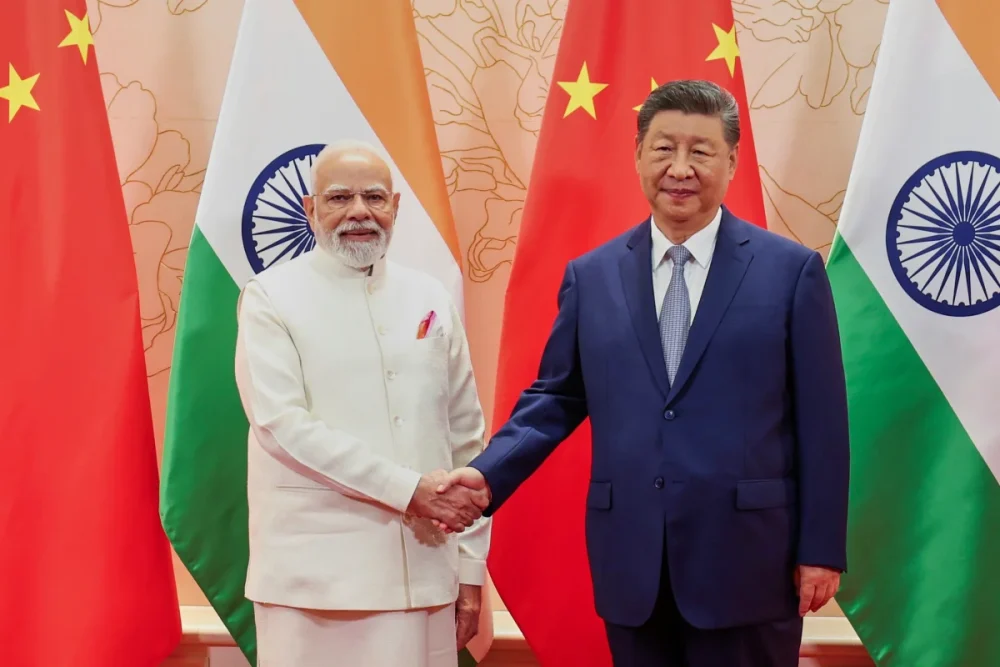
India and China are attempting to put their most serious confrontation in years behind them, with Prime Minister Narendra Modi and Chinese President Xi Jinping holding talks in New Delhi on Saturday as both sides seek to stabilize relations without resolving the deep strategic disputes that continue to divide them.
The meeting, held on the sidelines of the BRICS summit, marked Xi’s first visit to India in seven years and represented the latest step in a cautious diplomatic thaw following the deadly 2020 border confrontation in the Himalayas. At least 20 Indian and four Chinese soldiers were killed in the Galwan Valley clash, sending relations between the nuclear-armed neighbours to their lowest point in decades.
The two governments subsequently imposed restrictions on investment, business and people-to-people exchanges. But an October 2024 disengagement agreement led to troop withdrawals and opened the door to renewed diplomatic and economic engagement. Flights and business visa processes have since resumed or improved, while bilateral trade has rebounded.
China became India’s leading import partner in the 2025/26 financial year, with bilateral trade reaching about US$132 billion. Yet the relationship remains heavily imbalanced, with India recording a trade deficit of roughly US$112 billion with China.
That economic dependence is one reason New Delhi has an interest in stabilising relations, even as it remains deeply cautious about Beijing.
During Saturday’s meeting, both leaders stressed the need to approach relations from a strategic and long-term perspective. Xi emphasized mutual support and cooperation, while Modi stressed the importance of ensuring that differences do not turn into disputes.
But the diplomatic language masks substantial unresolved problems.
The two countries continue to dispute territory along their roughly 3,800-kilometre Himalayan border. India remains concerned about Chinese military infrastructure and Beijing’s position on Arunachal Pradesh, while China remains wary of India’s growing strategic relationship with the United States and its participation in groupings designed partly to counterbalance Chinese influence.
Economic tensions are also significant. India wants greater access to Chinese markets while attempting to reduce dependence on Chinese manufacturing and attract companies seeking alternatives to China’s supply chains. New Delhi remains particularly sensitive about Chinese investment in strategic areas such as telecommunications and defence.
For both governments, however, prolonged confrontation carries costs.
India needs a stable regional environment as it expands its economy and pursues a larger role in global affairs. China, facing mounting strategic and economic pressure from the United States and other Western powers, has an interest in avoiding another prolonged confrontation with its giant Asian neighbour.
BRICS provides a useful diplomatic umbrella.
The meeting between Modi and Xi demonstrates that the grouping can serve not only as an economic forum but also as a venue for managing disputes between major emerging powers.
Still, analysts caution against interpreting the meeting as a full restoration of relations. Deep mistrust remains, and the border dispute has not disappeared.
The emerging relationship is therefore likely to be based less on friendship than on managed competition—cooperating where interests overlap while containing disagreements that could once again destabilize the relationship.
The real test will come after Xi leaves India.
If the two countries can maintain the military disengagement, expand trade, restore regular diplomatic contact and prevent border disputes from escalating, Saturday’s meeting could become an important turning point.
If not, the latest thaw could prove little more than another temporary pause in one of Asia’s most consequential rivalries.

![Short dramas produced by Flytoto Culture &Technology Co draw crowds of visitors at the 23rd China-ASEAN Expo. [Photo provided to CHINA DAILY]](https://villagevoicenews.com/wp-content/uploads/2026/10/6abeef0ce4b06d4a392d76e2-750x375.jpeg)