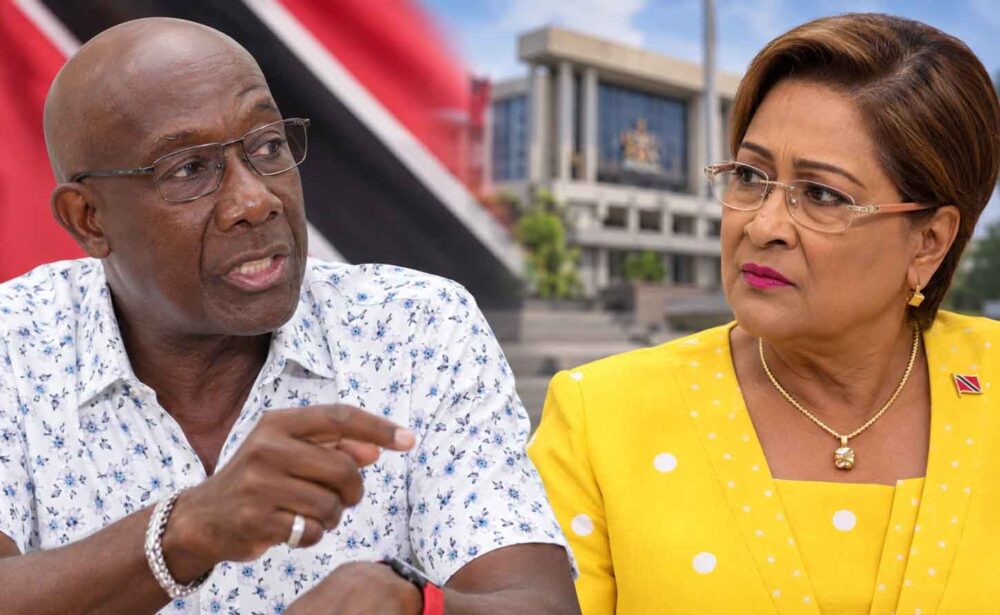
Calvin G. Brown (WiredJA) Sixty-four years after Eric Williams walked Trinidad and Tobago out of the British Empire, the country spent its Independence weekend arguing about whether the Empire had been so bad after all — and whether its Prime Minister had just handed a lit match to the national fabric.
Former prime minister Dr Keith Rowley lit the quarrel. In a statement on his Facebook page he demanded that Prime Minister Kamla Persad-Bissessar apologise to the nation for defiling the 64th anniversary of Independence with what he called “vile racist rubbish”. She has not apologised. She has, in the manner that has defined her second premiership, gone the other way.
Two messages, one weekend
The row has two roots, issued a day apart. On Sunday, in her message to the nation, Persad-Bissessar told citizens to stop blaming colonialism for the country’s failures. Trinidad and Tobago entered 1962, she said, with a functioning legal order, an advanced oil industry, a railway and a per capita income then ahead of Japan, Singapore, Spain and Brazil — nearly all of which have since overtaken it. The British left a very prosperous functioning country, she concluded, and after 64 years it is time to grow up.
On Monday — Independence Day itself — came a second message, addressed not to the nation but to what she called the UNC family. It honoured ancestors who suffered in the lagoons, cane fields and oilfields, accused post-Independence PNM governments of subjecting them to ridicule and hatred, then reached a register no Independence message here has previously occupied: it is either peace or total war, nothing in between; finesse and diplomacy backed by steeliness and savagery when the membership must be defended.
Rowley’s charge
Rowley’s reading was unsparing. He called the addresses a racial appeal to the rural Indian population, an invitation for one section of the country to feel separate and apart from the rest. He treated her “one per cent” language as ethnic targeting of the Arab community, and her instruction to descendants of the enslaved to move past colonial grievance as insensitive racism that cuts the ground from under CARICOM’s reparations effort. None of the six prime ministers, presidents and governors general before her, he said, had arranged the social structure this way.
“This is no longer a matter of inept political picong.” — Dr Keith Rowley
“Fake outrage”
The Prime Minister gave no ground, dismissing the criticism as fake outrage she could not care less about and disposing of Rowley with a line about a jammette who cannot attract customers. A leader incapable of defending her own family, she argued, can defend no one. Opposition Leader Pennelope Beckles called the messages insensitive and divorced from reality, objecting that the party had been addressed before the nation.
Then it left the realm of commentary. On 1 September, First Wave Movement leader Umar Abdullah wrote to Commissioner of Police Allister Guevarro asking that the Prime Minister be investigated for sedition, arguing that total war and savagery are not metaphors of peace. No investigation has been announced. Her answer was that they know where to find her — days after she stood at police headquarters and assured Guevarro her government was firmly in his corner.
The part that is not Trinidad’s alone
At the PNM’s own Independence event at City Hall, former St Vincent and the Grenadines prime minister Dr Ralph Gonsalves took the colonial-legacy claim apart in public. Cricket, the common law, the elective principle and a professional public service were real inheritances, he conceded — but they arrived by way of native genocide and the enslavement of African bodies.
Weighing colonialism, he said, is not an accountant’s ledger. He recalled the £20 million paid to slave owners at abolition, a borrowing Britain finished retiring only in 2015, and the life expectancy of a Vincentian male at his birth: 47 years, against roughly 75 today.
The awkwardness is that Persad-Bissessar knows this ground. She chaired CARICOM in 2013–14, when she and Gonsalves helped establish the CARICOM Reparations Commission — the body whose entire case rests on the proposition that the Empire left damage, not prosperity.
Rowley may never get his apology, and the sedition letter may die quietly in a commissioner’s in-tray. But when a sitting Caribbean prime minister testifies that Britain left a prosperous functioning country in 1962, the lawyers in London need not say a word in their own defence. It has already been said for them — in our own accent, on our own Independence Day.