In ten days El Salvador put as many soldiers into Haiti as the UN-authorised Gang Suppression Force struggled to field in more than a year — and the United Nations now says most of them are not under its mandate at all. But Jamaica has 26 personnel inside that mission’s headquarters and CARICOM backed it at the Security Council, and neither has said a word about a second army fighting on the same ground and answering to San Salvador.
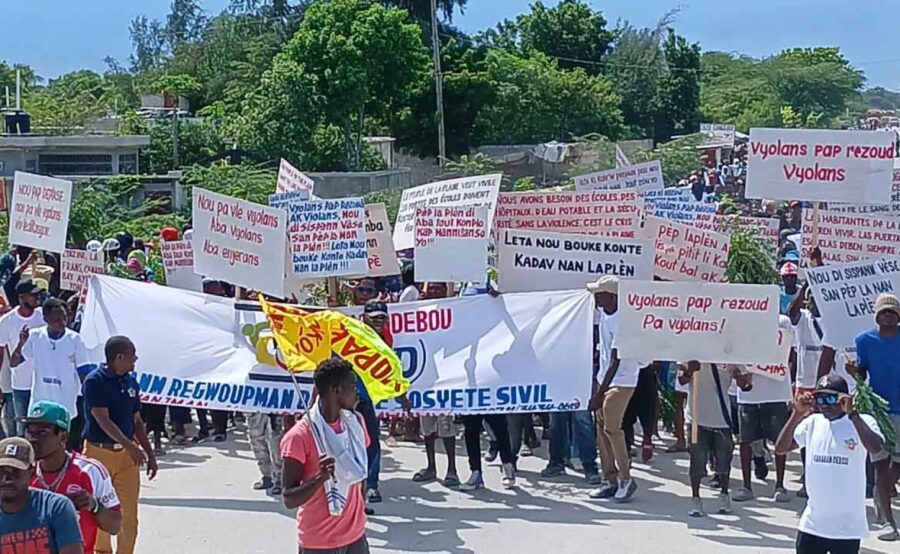
By Calvin G. Brown (WiredJA)- On Monday, November 2, residents of the Plaine du Cul-de-Sac walked out of Bon Repos behind a rara band, carrying signs — “Stop spilling the people’s blood in La Plaine” and “Down with violence! Down with foreign intervention!” Haïti Liberté, which hosts footage of the march, says about 1,000 people walked several miles to Kanaran 3, organised, it says, by schoolteachers from the three townships under Kanaran Debou (KAD), which it describes as a coalition of more than 60 community organisations.
The Spanish wire EFE, the same day, relayed reports in unnamed media that La Plaine’s residents had taken to the streets against the security operations and the Salvadoran force, which they called an “invasión” — reports that also alleged the marchers had been forced out by the Viv Ansanm gang coalition under threat of death. EFE did not confirm that, and no Haitian outlet carrying it has been found.
That same day, Salvadoran soldiers in about ten armoured vehicles rolled into the plain alongside the Haitian National Police — Santo 17, the Croix-des-Missions bridge, Carrefour Shada — in what EFE called their first major operation. Haitian press reported at least ten gang fighters killed; the PNH released no toll, and a source told the Miami Herald the troops barely came under fire. The four Salvadoran aviation technicians abducted on October 18 were not found.
And in New York that day, the office of UN spokesperson Stéphane Dujarric answered reporters’ questions about the Salvadorans in a written note: “The vast majority of those are not deployed under the Gang Suppression Force.”
Pressed at the noon briefing the next day, he put a number on it — an approximate number, he stressed: “we’re talking about 200 that fall under the GSF mandate.” Of the rest: “It’s a bilateral issue,” Dujarric said — though any security operation must be done “within the framework of international human rights law”.
President Nayib Bukele confirmed 2,500 soldiers in Haiti over the weekend of October 31. Roughly 200 of them — the aviation and medevac contingent that was already there — sit inside the Security Council’s mandate and its UN monitoring. The rest, the Herald reports, answer to a Salvadoran commander in Port-au-Prince, not to Major General Erdenebat Batsuuri, who commands the multinational force; they deployed without the human-rights training required of personnel in international missions, and their arrival preceded a formal signed agreement with Haiti’s government.
It took ten days. The technicians, Salvadoran Air Force personnel attached to the GSF, were attacked with explosives in Santo, Croix-des-Bouquets, on October 18. About 200 special forces landed on October 22 and 23, a security source told AFP; around 1,000 were in by October 27; on October 28 the foreign ministry said deployment of “more than two thousand soldiers” would continue, and Reuters put around 2,000 in the country that night. El Salvador, Reuters wrote, was matching in ten days what the UN-backed force had struggled to deploy over more than a year.
Resolution 2793, adopted on September 30, 2025, authorised the GSF with a ceiling of 5,550 and was renewed on September 29 this year to March 31, 2027. On that same September 29, El Salvador’s Legislative Assembly passed a transitional law extending its participation in the GSF to October 2027 — no troop cap, the old medical-evacuation wording dropped, and the government saying El Salvador “is in a position to support the mission with military aid and defence equipment”. The law authorises soldiers for the GSF. The UN says most of the soldiers are not in it. Nobody has explained the gap.
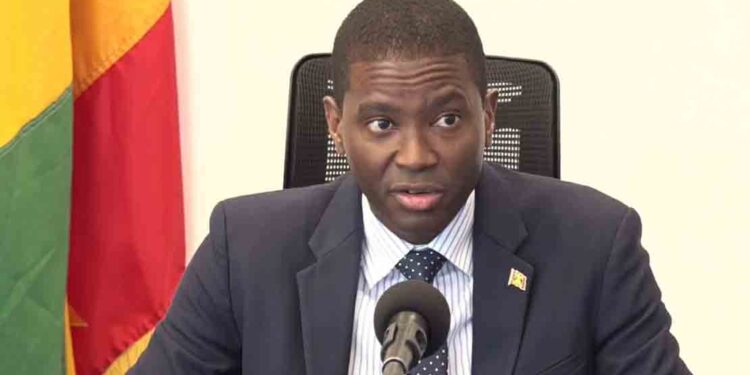
Asked who the troops report to, Damian Merlo, a lobbyist for El Salvador’s government, told AP they coordinate closely with the GSF and the prime minister’s office — and declined to say. Acting Prime Minister Alix Didier Fils-Aimé, flanked by the Salvadoran officer commanding the troops and a senior GSF officer, said “each of the forces has its own responsibility” under “the authority of the government”, and of Bukele: “He understands our fight.”
Romain Le Cour Grandmaison of the Global Initiative Against Transnational Organized Crime counts five armed structures on Haitian ground — police, army, the GSF, the Salvadorans and a task force working with Erik Prince’s Vectus Global. “Haiti’s security response is already an orchestra without a conductor,” he told AP.
No independent body has counted civilian casualties from these operations — not BINUH, not the UN human rights office, not RNDDH. The only independent number is from Médecins Sans Frontières: 30 people wounded by gunfire or drone explosions admitted to its Tabarre and Cité Soleil hospitals between October 18 and 26. MSF attributes those injuries to no actor; its head of mission, Davina Hayles, said she was “very concerned about this surge in violence… particularly with the arrival of additional international security forces”.
Everything else is allegation and denial. UNA-Haiti — a civil society body, not the UN — wrote to António Guterres on October 28 alleging Salvadoran helicopter strikes on civilians in Croix-des-Bouquets, Canaan and the plain. Bukele answered on X that the mission did not even have bombs; the GSF said no explosives had been used by any unit under its command, including Salvadoran aircraft — a denial that by its own terms covers only the roughly 200 inside the mission. One sign in Bon Repos read: “The State, we are tired of counting dead bodies in La Plaine.” Nobody with standing is counting at all.
Now the Caribbean. Jamaica has 26 personnel in Haiti, soldiers and police assigned to GSF headquarters. Jamaica sits on the Standing Group of Partners that gives the force its strategic direction. When the Security Council renewed the mandate on September 29, it was Jamaica that spoke for CARICOM: “Armed gangs will not be allowed to determine Haiti’s future nor, indeed, that of the Caribbean region.” Since then, nothing public from Kingston on the Salvadoran force. CARICOM’s last word on the GSF, on its own website, is dated that same September 29.
So Jamaican officers now staff the headquarters of a mission whose commander does not command the largest foreign force on its battlefield. The people of La Plaine will not sort the soldiers among them by flag, and when the accounting comes it will be charged to the mission Jamaica and CARICOM lent their names to. The marchers of Bon Repos — if their signs are read plainly — asked who answers for what falls on them. The United Nations’ answer was “a bilateral issue”. In the sixteen days since the first Salvadoran special forces landed, no government in the Caribbean has offered a different one.