by Randy Gopaul
There are few offices in Guyana that carry more authority than that of the President. With that authority comes a responsibility that extends far beyond politics. Every word spoken by the Head of State carries weight. Every accusation has consequences. Every public statement has the potential to influence public opinion, reputations, and even confidence in the institutions of justice. That is precisely why a President cannot afford to treat allegations of serious criminal conduct as campaign rhetoric or political talking points.
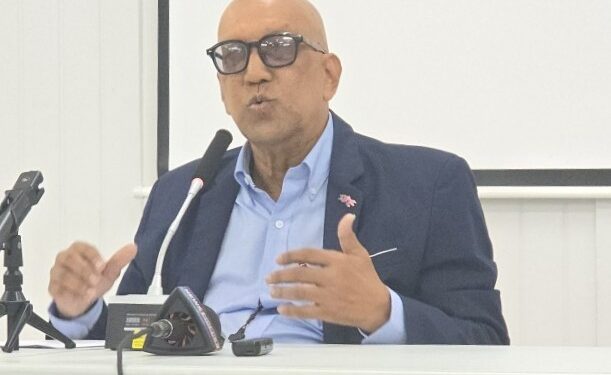
During his recent address defending questions surrounding his private farm, President Irfaan Ali made a series of extraordinary allegations against opposition leader Azruddin Mohamed. He spoke not only about U.S. sanctions and an indictment abroad, but also made references to murder, kidnapping, smuggling, robbery of the people of Guyana, and other serious criminal conduct. These are not casual accusations. They are allegations of offences that, if supported by evidence, demand immediate criminal investigation.
That raises a simple but unavoidable question. If the President possesses credible evidence that Mr. Mohamed has committed these crimes, why is that evidence being presented in a political speech instead of being placed before the Guyana Police Force, the Director of Public Prosecutions, or the courts? The Constitution does not empower the President to prosecute citizens from a podium. It empowers the institutions of justice to investigate allegations, evaluate evidence, and determine guilt or innocence according to law.
This is not about defending Mr. Mohamed. The principle would be exactly the same if the allegations were directed at a government minister, a businessman, a journalist, or an ordinary citizen. In a democratic society governed by the rule of law, accusations are not substitutes for evidence. Serious allegations require serious investigations. If there is credible evidence of murder, kidnapping, organized smuggling, or large-scale theft from the people of Guyana, then every hour that evidence remains outside the hands of investigators is another hour in which justice is delayed. If the allegations are true, the President has a duty to act. If they are not supported by evidence, they should never have been made.
Some will argue that Mr. Mohamed has already been sanctioned by the United States and faces legal proceedings there. Those are matters for the American legal system. They do not relieve the Government of Guyana of its own responsibilities. If crimes have been committed in Guyana, they should be investigated in Guyana under Guyanese law. Our justice system should not rely on foreign governments to determine who is guilty of offences committed against the people of this country. If our leaders possess evidence, they should have confidence in our own institutions to pursue justice.
There is another issue that should concern every Guyanese regardless of political affiliation. When the President repeatedly accuses a political opponent of the most serious crimes imaginable without presenting evidence through the appropriate legal channels, public confidence in the justice system begins to erode. Citizens begin to wonder whether criminal allegations are being used to inform the public or to influence public opinion. That uncertainty weakens trust in our institutions, and trust is one of the most valuable assets any democracy possesses.
The Presidency must always be held to a higher standard than partisan politics. Ordinary citizens can speculate. Politicians can debate. The President should be expected to speak with the authority that comes from verified facts and lawful process. If the Head of State has evidence of criminal wrongdoing, the proper place for that evidence is before investigators and prosecutors, not in a political address. If the evidence is sufficient, let charges be laid and let the courts do their work. That is how justice is supposed to function.
This issue extends far beyond the current political moment. Today the allegations may be directed at one opposition leader. Tomorrow they could be directed at someone else. Once we accept that serious criminal accusations can be made publicly without first passing through the institutions established to investigate them, we lower the standard for everyone who follows.
The answer is straightforward. If President Ali possesses credible evidence that Azruddin Mohamed committed murder, kidnapping, smuggling, robbery of the state, or any other serious offence, he should immediately provide that evidence to the Guyana Police Force and every relevant investigative authority. Let the law take its course. If, however, those allegations cannot be supported by evidence sufficient to justify criminal investigation, then the President should publicly withdraw them. The Office of the President should never become a substitute for the courts.
Justice belongs in the courtroom. Politics belongs on the campaign trail. Guyana deserves leaders who understand, and respect, the difference.