As Guyana awaits the release of the 2026 National Grade Six Assessment (NGSA) results today, thousands of eleven-year-olds are experiencing what should never become a defining childhood memory: the fear that a two-day examination will determine their worth, their future, and their place in society.
The anxiety is real. Research from educational psychologists around the world has consistently found that high-stakes examinations increase stress, anxiety, sleep disturbances, and diminished self-confidence among children. Studies published by the OECD, UNICEF, and researchers in educational psychology have found that when a single examination carries major consequences, children often experience significant psychological pressure, while schools narrow teaching to test preparation at the expense of broader learning.
That alone should force us to ask whether the NGSA, in its current form, is serving the children of Guyana or serving the bureaucracy that administers it. But there is another issue that deserves equal attention. For years, the Ministry of Education has allowed itself to become the sole owner of the nation’s examination results. Every increase in scores is celebrated as evidence that government policies are working. Every decline becomes a political liability. That is a profound misunderstanding of what educational research tells us.
Children do not arrive at Grade Six as blank slates shaped only by six years inside a classroom. Long before they sit the NGSA, many have already fallen behind.
Research stretching back decades, including work by Nobel Prize-winning economist James Heckman, demonstrates that children’s academic performance is strongly influenced by factors outside the school gates. Poverty, parental education, early childhood language exposure, nutrition, health, housing stability, and opportunities to read at home all shape educational outcomes before formal schooling even begins. UNESCO, UNICEF, and the World Bank have repeatedly documented that learning gaps emerge in the earliest years of life and become increasingly difficult to reverse without sustained intervention.
By the time many Guyanese children enter Grade One, the race has already begun, and far too many are starting several steps behind. If roughly half of our children begin primary school without the foundational literacy, vocabulary, and early numeracy skills needed for success, it should surprise no one that many never completely catch up. That reality cannot be solved by teachers alone. Nor can it be solved by a minister.
Yet the Ministry has increasingly embraced ownership of examination outcomes as though they are simply the product of ministry policy. In doing so, it has created immense pressure upon itself to demonstrate continuous improvement regardless of whether corresponding improvements have actually occurred across the educational landscape.
That brings us to the published NGSA performance figures.
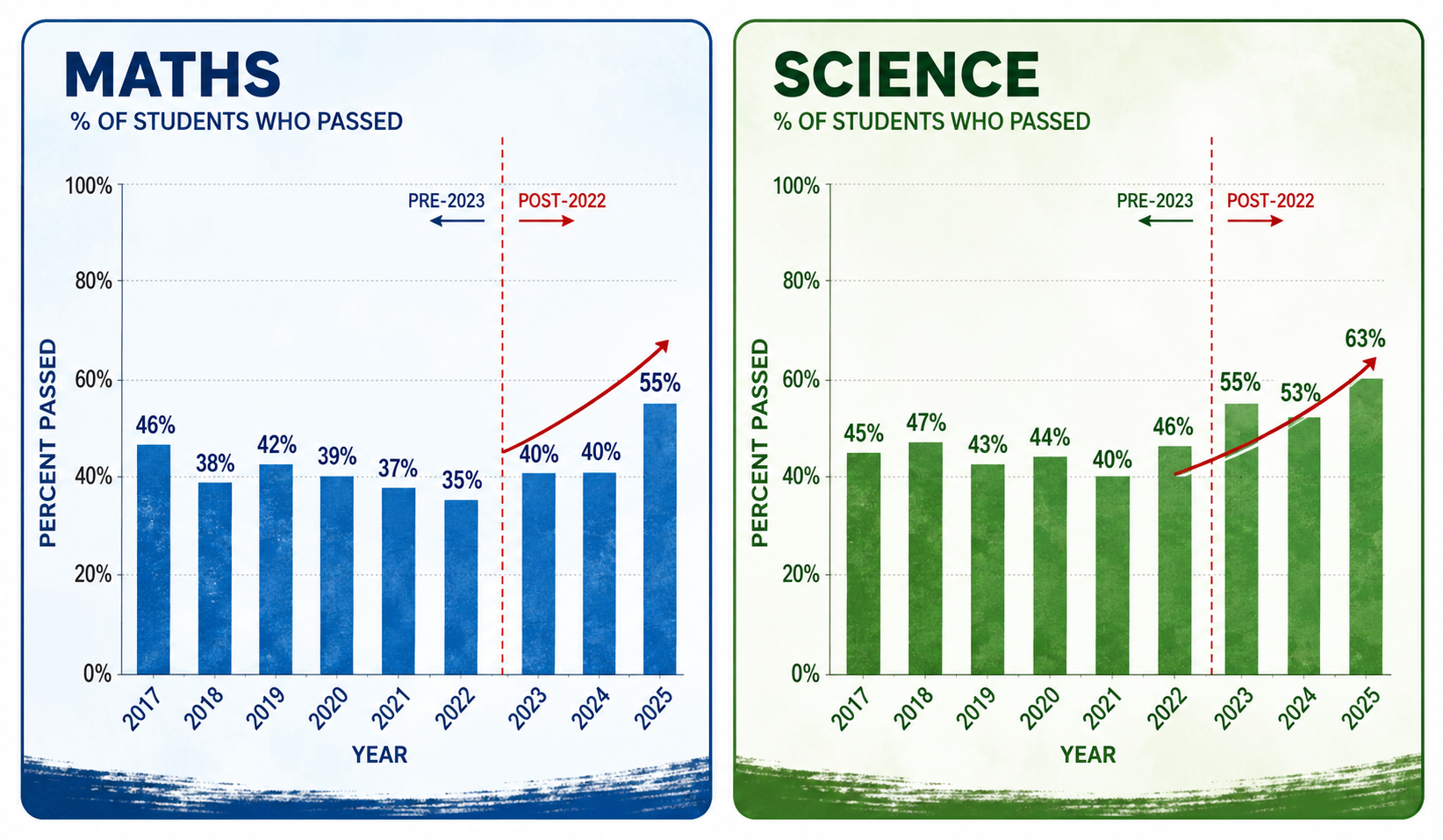
The Ministry reported that the proportion of students achieving a passing standard in Mathematics rose from approximately 35 percent in 2022 to 55 percent in 2025, a remarkable twenty percentage point increase in just three years. Even more striking is the reported fifteen-point increase between 2024 and 2025 alone. NGSA Science tells a similarly dramatic story. Reported pass rates increased from roughly 46 percent in 2022 to 63 percent in 2025, including an apparent ten percentage point increase in a single year. These are extraordinary improvements, especially in a global environment where student scores have fallen across the board, even among the children of the middle class in the United States. Therefore Guyana’s extraordinary improvements require extraordinary explanations.
What nationwide intervention produced gains of this magnitude? Was there a transformational curriculum? Universal access to tutoring? Dramatic reductions in childhood poverty? Comprehensive nutrition programmes? Large improvements in teacher quality? Independent evidence demonstrating learning gains across the education system?
If such evidence exists, it should be presented to the public. If it does not, then the public is entitled to ask difficult questions.
This editorial raises a hypothesis that no one else has publicly articulated: that the reported examination outcomes deserve independent scrutiny to determine whether they accurately reflect student performance or whether changes in reporting, grading, scaling, or other administrative processes may have contributed to the dramatic increases.
This is not an accusation. It is a call for transparency. Because if the reported numbers are not an accurate reflection of student learning, the greatest victims are not politicians. They are the children.
Artificially optimistic statistics create the illusion that problems have been solved. They discourage investment in literacy, early childhood development, nutrition, family support, teacher development, and interventions for struggling learners. They allow policymakers to congratulate themselves while thousands of children continue to leave primary school without mastering fundamental skills.
False confidence is among the most dangerous forms of educational failure. Today, the new Minister of Education faces a dilemma not entirely of her own making. She has inherited a system that has celebrated spectacular improvements in examination outcomes. If this year’s results continue the upward trajectory, critics will inevitably ask what new intervention produced yet another leap in performance. If the results fall back toward earlier levels, others may conclude that educational standards have suddenly declined.
It is the classic Guyanese proverb brought to life. She has been handed a basket and told to fetch water. No minister should be placed in that position. The responsibility of the Ministry of Education is not to produce politically convenient statistics. Its responsibility is to produce educated children. That requires honesty.
It requires acknowledging that education is influenced as much by poverty, nutrition, literacy in the home, parental engagement, and early childhood development as by classroom instruction. It requires recognising that sustainable improvement is measured over decades, not election cycles.
As the nation awaits today’s results, we should remember that the most important number is not how many children passed an examination. It is how many children can confidently read, reason, solve problems, think critically, and leave school prepared for productive lives. Those are the numbers that matter.Those are the numbers the people of Guyana deserve to see.