By Mark DaCosta- Philip Moore was born on October 12, 1921, in Manchester Village, Corentyne, marking the beginning of a life destined to leave an indelible mark on the artistic landscape of our nation.
Growing up surrounded by the lush landscapes of British Guiana, Moore’s childhood was a canvas painted with images of hardworking friends and neighbors toiling in the fields by day, and spirited games of cricket filling the evenings. Accompanying his father, a rubber-gatherer, into the forests, young Moore found enchantment in the mystical embrace of nature, a place he believed to be filled with a sentient spirituality.
At the age of 19, Moore’s life took a transformative turn when he converted to Jordanite Christianity, aligning himself with principles of self-help, personal pride, communal life, hard work, and the study of the Bible. However, his spirituality was expansive, and in 1955, a dream revealed a divine calling. I’m his dream Moore said that he saw a large hand reaching down from the heavens, commanding him to embark on his journey as an artist. Moore considered himself “spirit-taught,” and this encounter became a decisive moment shaping his artistic destiny.
Beginning modestly by carving wooden canes and demonstrating proficiency in manipulating tropical hardwoods, Moore swiftly evolved into a visionary artist. His creations spanned from portraits, animal figures, and sports heroes to stylised magic drums. By 1964, his intuitive carving abilities garnered attention, leading to his role as a craft and arts teacher at the Department of Culture.
Motivated by a profound love for Guyana, Moore, with government support, crafted what would become his magnum opus – the 1763 Monument. Standing nearly 25 feet tall, this bronze sculpture dominates the Square of the Revolution in Georgetown, embodying the defiant spirit of an African warrior, ready to protect his homeland against any desecration. Moore’s creation fuses traditional African motifs with non-Western sculptural proportions, leaving an enigmatic yet powerful mark on our nation’s capital.
Despite his growing fame, Moore maintained a deep connection with his roots. Often seen carrying paintings and sculptures to classes in a converted donkey cart, he faced initial skepticism from fellow artists in Georgetown. However, his originality and departure from academic models gradually earned him the respect of his colleagues.
In the 1970s, Moore’s reputation expanded beyond local confines, leading to an invitation to Princeton University as a guest professor. Through his painting “Canje Bridge,” he depicted angelic figures streaming across a bridge, symbolising his continuing concerns about issues like race relations, the fate of the younger generation, God, and politics.
Throughout his illustrious career, Moore received several awards, including the prestigious Cacique Crown of Honour. These accolades underscored his significant contributions to the artistic landscape of our country, solidifying his status as a Guyanese icon.
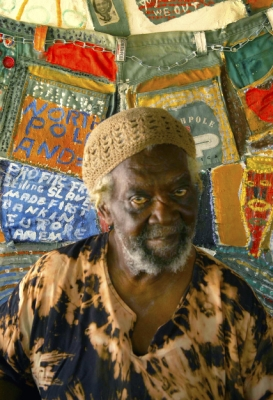
In mid August 2011, a year before his death, we find Philip Moore spending most of his days surrounded by his creations at his Lancaster, Corentyne home. Despite retiring, he remained nationally known as “the man who designed the monument,” embodying the enduring link between the artist and his iconic creation.
In a poignant moment of reflection, Moore shared, “An artist cannot stop thinking.” Even at 89, with physical health deteriorating, he maintained an active mind, spending his nights reading newspapers, novels, and the Holy Bible. His creations adorned his home, from paintings on verandas depicting historical narratives to sculptures like the ‘Masking of Martin,’ portraying Dr. Martin Luther King Jr. surrounded by other “heads” symbolizing those who fought for the redemption of black people from slavery.
To this day, Philip Moore’s legacy stands tall. A self-taught painter and sculptor, he left an indelible mark on Guyana’s artistic landscape. His solo exhibition at the Studio Museum in Harlem and stints as an artist-in-residence at prestigious institutions like Livingston College and Princeton University testify to the international recognition of his talent.
The journey of this Guyanese icon reached its conclusion on May 14, 2012, as Philip Alphonso Moore passed away peacefully in his sleep at the age of 90. Bedridden and suffering from ailments of the heart and kidneys, Moore left behind a rich legacy that continues to resonate through his sculptures and paintings.
Philip Moore is remembered as more than an artist; he was a spirit-taught visionary, a humble soul who carved his way into the artistic history of our nation. His life’s work, including the 1763 Monument, remains a testament to the enduring spirit of a man who believed that art is a form of visual education to stimulate people – a sentiment that is both inspirational and profoundly insightful.