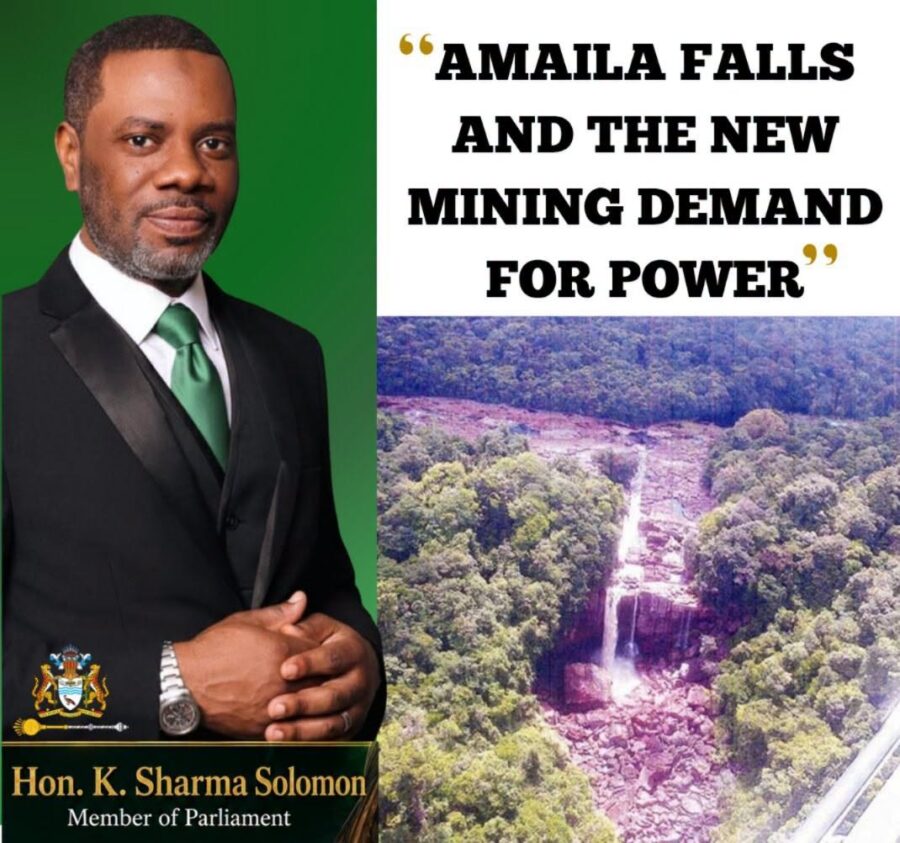
By Sharma Solomon MP (APNU)- President Irfaan Ali’s renewed announcement last week on Amaila Falls deserves more than raised eyebrows. It deserves serious scrutiny.
The President says his Government is now evaluating five proposals for the 165 megawatt project and expects to identify a preferred bid in the coming weeks. He has also pointed to the growing electricity demand of two major gold mining operations, each expected to require about 85 megawatts.
I understand the argument. Guyana’s electricity demand is growing. We need reliable electricity. We need affordable electricity. We need cleaner electricity.
However, after all the positions taken on Amaila over the years, the President now has a responsibility to explain to Guyanese what has changed, what Guyana is buying, what we are committing ourselves to and what will Guyanese ultimately have to pay.
We cannot discuss Amaila by starting with last week’s announcement.
This is the same project around which successive governments raised questions about financing, tariffs, risk, GPL’s capacity and the commercial structure. The project has been retendered and reshaped more than once. In his latest announcement, the president told us his administration is pursuing a Build Own Operate Transfer arrangement, with the tender requiring consideration of the Power Purchase Agreement and the lowest PPA price.
This is exactly why Guyanese are asking to see the specifics of the numbers.
Before another long term obligation is placed on the people of Guyana. The country must know the price per kilowatt hour. We must know the guarantees being offered by the State. We must know the financing structure and the duration of the obligation. We must know who carries the risk if the projected demand does not materialise.
This is where the President’s announcement meets the reality facing the Guyanese people.
Government is asking the country to embrace another major generation project while the electricity system we have today remains under serious pressure. The President himself has acknowledged the unreliability of the GPL network. Peak demand on the Demerara Berbice Interconnected System has risen from about 205 megawatts in 2024 to 242.6 megawatts in August 2026. Government has now announced a six month programme to stabilise the system, including major maintenance, additional generating capacity, and a major transmission link.
What any Guyanese would consider a reasonable question.
If the present system is struggling to reliably carry today’s demand, are we building the transmission and distribution capacity required to carry tomorrow’s electricity?
That question brings us directly to Wales.
We cannot separate Amaila from Wales. For years, Government has told Guyanese that Gas to Energy would transform electricity generation and reduce costs. That project has faced over two years of delays, $2 billion US overpriced and continuing questions about its execution. At the same time, billions are being spent to upgrade the transmission and distribution network.
The 2026 Budget itself identifies the movement of power from Wales through Garden of Eden, Goedverwagting, and Sophia and onward across the Berbice River as a major transmission objective.
From that reasoning alone, Guyanese understand that a power plant is not an electricity system.
You can generate all the electricity you want. If you cannot move it, distribute it and manage the system properly, Guyanese will not get the benefit.
At the same time, we cannot overlook the enormous electricity requirements of the new mining economy. If two mines alone are expected to require approximately 170 megawatts, then we must ask whether every megawatt of that demand should automatically become a burden on the national grid.
As a Lindener, I am aware that the Bauxite companies generated electricity to support their industrial operations and surrounding communities. That does not mean we should return to the company town. It means we should ask a very reasonable question in today’s Guyana.
When major energy intensive enterprises are driving extraordinary new demand, should they not participate appropriately in some way or the other, if not through generation, transmission or infrastructure required to support that demand?
The national grid belongs to the people of Guyana. It must serve the country as a whole. It cannot become an indirect mechanism for transferring the cost of industrial expansion onto ordinary consumers.
So, Mr. President, if you are saying to us that Amaila is the right project, make the case with the numbers.
Tell Guyanese what the PPA will cost. Tell us what the State will guarantee. Tell us what transmission investment will be required. Tell us how much of Amaila’s capacity is intended to serve mining. Tell us what the mining companies will contribute. Also, tell us what happens if the projected demand changes.
The disclosed bids reportedly range from approximately US$416.9 million to US$800.1 million. That is serious money. The difference between those proposals alone tells us why Parliament and the public must understand the commercial structure before a decision is made.
Amaila, as a project, has its strong argument for and against.
What Guyanese are concerned about are the announcements of massive power generation projects without presenting the whole electricity architecture to the people.
The President is right on one point. Guyana cannot continue with an unreliable electricity system. However, the answer cannot simply be another power plant.
What is needed then is a national grid capable of carrying the power we generate. Also, to be able to generate power where it makes technical and economic sense. We need modern distribution. We need proper system management. We need renewable energy working together. Also, we need a fair arrangement with the major industries that are driving the new demand.
However, before Guyana commits billions more, the President must answer the questions that matter to every household, every worker, and every business in this country:
Who is paying?
How much are they paying?
What kind of electricity system will actually be built for the people of Guyana?
Hon. K. Sharma Solomon
Member of Parliament
APNU Rep Natural Resources