By Aubrey Subner- The emergence of additional surveillance footage concerning the October 12 incident involving Senior Superintendent Prem Narine and Opposition Leader Azruddin Mohamed raises serious questions about the accuracy and credibility of the Guyana Police Force’s original account. Beyond the pending criminal proceedings, the controversy has assumed significant constitutional and institutional importance, testing public confidence in law enforcement, the administration of justice and Guyana’s commitment to the rule of law.
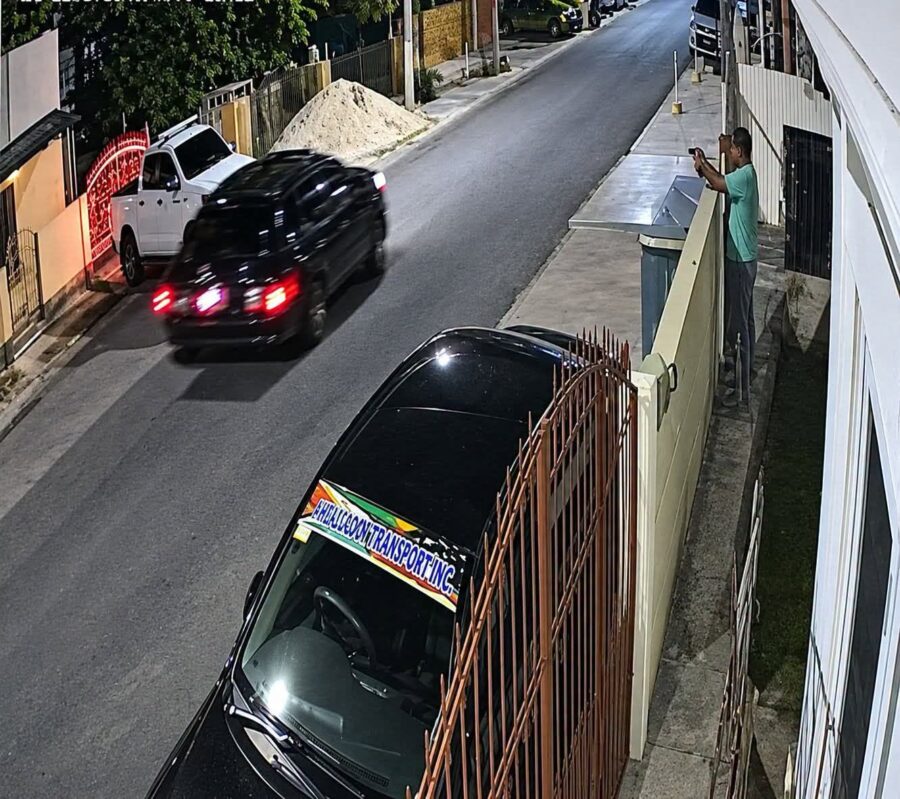
The footage, reportedly released on November 8, appears to depict a sequence of events materially different from the account initially advanced by the police. This is particularly consequential because that account informed public understanding of the incident and the subsequent arrest and charging of Mohamed and two associates.
According to the original police account, Narine, Head of the Special Branch, was at his Barr Street, Kitty residence when he observed a black Toyota Allion travelling slowly through the area. After the vehicle reportedly passed and returned, he heard what appeared to be a gunshot, took cover and discharged several rounds from his service firearm towards the vehicle.
The newly circulated footage, however, appears to show Narine standing in a yard before the vehicle approaches, raising his firearm and discharging several rounds as it passes. The recording reportedly does not show the vehicle firing at him or him taking cover before discharging his weapon. It also appears to show him subsequently joining a police vehicle that pursues the car.
If authenticated and considered alongside the complete recording and forensic evidence, these images raise material questions about the factual basis of the original police account. The legal distinction between responding to an imminent threat and discharging a firearm at a passing vehicle without an apparent preceding attack is substantial. The legality, necessity and proportionality of the use of force therefore warrant independent examination.
While the footage alone cannot establish the complete circumstances or determine criminal liability, its apparent inconsistencies cannot responsibly be disregarded. The public is entitled to an explanation grounded in evidence rather than institutional assurances.Intrs
Interestingly, the controversy acquired further significance on November 9, when the Director of Public Prosecutions (DPP) issued a public statement concerning the circulating footage.
The DPP clarified that the recording forms part of the prosecution’s evidential material, was disclosed to defence counsel on November 6 and constitutes an excerpt from a longer video submitted by a principal prosecution witness in support of a written statement. The office cautioned that discussing an extracted recording without considering the accompanying evidence could prejudice the fair trial process and potentially obstruct the administration of justice.
The DPP is entitled, and indeed obligated, to safeguard the integrity of criminal proceedings and protect the constitutional right to a fair trial. Evidence must be evaluated in its entirety, and questions of guilt or innocence are matters for judicial determination.
Nevertheless, the statement raises an important constitutional distinction: protecting pending proceedings from prejudice is not synonymous with insulating public officials from legitimate scrutiny.
The fact that the footage forms part of the prosecution’s own evidential case makes its complete and impartial examination imperative. Its authenticity, context, continuity and relationship to witness testimony and forensic findings must be established through proper evidential procedures.
There is an important distinction between deliberately manipulating evidence or attempting to prejudice a trial and responsibly questioning whether an official police account accurately reflects the available evidence. The former may undermine justice; the latter is a legitimate component of democratic accountability.
In any case, the DPP’s caution should not be interpreted as a determination of the questions surrounding police conduct, nor should it create the perception that public scrutiny of law enforcement is impermissible. Any potential offence arising from public commentary must be assessed against the applicable law and established through proper legal processes; not assumed merely because criticism has been expressed.
Perhaps, the most consequential institutional risk arising from this controversy is the erosion of public confidence in the Guyana Police Force.
Police legitimacy depends not simply on statutory authority to arrest, investigate and prosecute, but on the public’s confidence that officers exercise those powers lawfully, impartially and transparently.
Consider a resident who witnesses an encounter between a police officer and a civilian, provides information to investigators, and subsequently encounters an official account apparently inconsistent with that experience. If emerging video evidence appears to corroborate the resident’s observations, yet no credible investigation or explanation follows, the resident may reasonably become reluctant to cooperate with law enforcement again.
Such a breakdown in confidence has practical consequences: reduced witness cooperation, diminished intelligence gathering, weakened community policing and compromised criminal investigations. Ultimately, public safety suffers.
No police officer’s account should attract presumptive credibility merely by virtue of rank, just as no civilian should be presumed culpable by virtue of accusation. Equality before the law demands impartial scrutiny of both.
Guyana’s many professional and dedicated police officers deserve institutional protection. However, that protection must not be confused with immunity from accountability. Institutional loyalty cannot lawfully or ethically supersede the duty to establish the truth.
Also, given Guyana’s political history, the involvement of the Leader of the Opposition makes this matter especially sensitive. A perception that law enforcement is politically influenced, or that different standards of accountability apply according to status or political affiliation, could further polarise an already divided society.
As former United States Supreme Court Chief Justice Earl Warren observed:
“It is the spirit and not the form of law that keeps justice alive.”
The principle is particularly pertinent. Public confidence cannot be sustained through procedural formalities or institutional declarations alone. Justice must be administered impartially and must command public confidence through demonstrable fairness.
Ultimately, this controversy should not divide Guyanese between defenders of the police and supporters of the Opposition Leader. It should unite the nation around the fundamental principles of truth, due process, accountability and equal protection under the law.
The ultimate test of Guyana’s democracy is whether its institutions possess the independence and resolve to establish the truth, even when the findings may be uncomfortable for those entrusted with public power.
That is the foundation of public trust, social cohesion and constitutional democracy. Guyana cannot afford to compromise any of them.