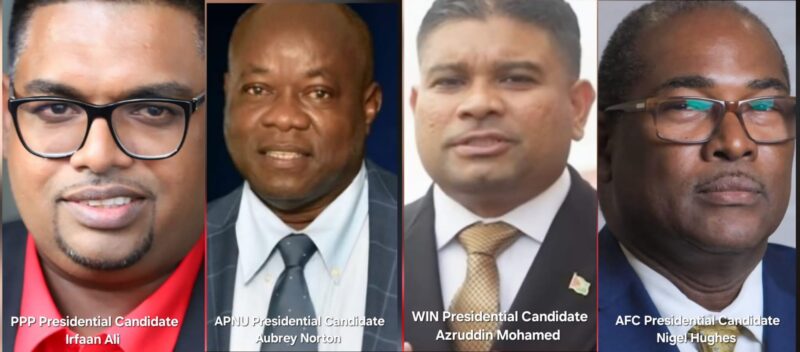
Guyana’s upcoming General and Regional Elections, scheduled for September 1, are taking on an increasingly unpredictable character, marked by political defections, shifting alliances, and the rising influence of oil money. As the country prepares for a heated contest in the coming months, traditional political powerhouses are showing signs of strain, while a new and unconventional player threatens to disrupt the electoral status quo.
The governing People’s Progressive Party (PPP), led by President Irfaan Ali and Vice President Bharrat Jagdeo, faces growing political pressure—not from its traditional rival, the People’s National Congress (PNC), but from businessman Azruddin Mohamed, a political newcomer who has emerged as a surprising challenger.
Mohamed, dubbed “Mohamed the Younger” by political commentator GHK Lall, has been making steady inroads across the country, prompting visible unease within the PPP leadership. His unconventional campaign style, including public events featuring a live jaguar, has drawn national attention—and, increasingly, resistance from the PPP
“He goes from one place to another, and the PPP waits in ambush,” Lall writes in his recent op-ed. “A dirty war will get dirtier.”
Opposition in Disarray
While the PPP fends off this new challenge, the traditional opposition appears adrift. The PNC, once the main political counterweight to the PPP, is now described by Lall as being in a “deep swoon”—struggling with internal divisions and a crisis of relevance. The Alliance for Change (AFC) fares little better, grappling with questions about its direction and public appeal.
Meanwhile, A New and United Guyana (ANUG) has suffered a significant blow with the departure of two founding members, Attorneys-at-law Ralph Ramkarran and Timoty Jonas- both nationally recognised political figures. The loss has raised questions about the party’s future role in Guyana’s increasingly fractured political environment.
Together, these developments have left many Guyanese wondering who—if anyone—can credibly mount a challenge to the PPP.
Oil Reshapes the Stakes
Underlying this political drama is the immense influence of oil, which continues to transform Guyana’s economy—and, increasingly, its politics. According to Lall, oil revenue has dampened public scrutiny and emboldened political actors.
“Take away the oil, and elections are drab, drab, drab,” he writes. “The PPP could teef from sunup to sundown and all summer long, and few are the Guyanese that would give a damn.”
From 2020-2024 Guyana earned $ 5.812 Billion in oil revenue and is projected to earn more than US$2.5 Billion in 2025.
2020: US$198 million
2021: US$335 million
2022: US$1.253 billion
2023: US$1.456 billion
2024: US$2.57 billion
With billions of dollars in oil production on the line, election campaigns are no longer focused on governance or development policy, but on spectacle and influence. Critics say public discourse has become distracted by giveaways, brand sponsorships, and empty political theatrics.
Mohamed’s Rise and the PPP’s Reaction
Azruddin Mohamed’s political ascent has been marked by flamboyance and a media-savvy approach. But his deeper impact may lie in the reaction he has provoked. Lall argues that the PPP’s efforts to discredit him may backfire, drawing even more public attention to his campaign.
“Seeing he has Jagdeo rocking back on his heels,” Lall notes, “a skunk (a crab dawg in Guyanese) would send him into a full sprint.”
Reports suggest the government has enlisted lobbyists to brand Mohamed as a mere puppet of Venezuela’s Nicolás Maduro, a ruthless regime that has escalated its aggressive and unlawful claims over the vast Essequibo region, which constitutes two-thirds of Guyana’s territory. The sight of a governing party unsettled by a once-dismissed outsider now reshaping the electoral landscape speaks volumes.
Unanswered Questions Ahead
With ANUG weakened, the PNC and AFC adrift, and the PPP under pressure, Lall suggests that Guyana could be headed for a largely two-man race—between Jagdeo’s PPP and Mohamed’s upstart movement. That would leave the once-formidable opposition parties sidelined, reduced to the role of “bystanders and bit players.”
He also questions the opposition’s long-touted call for “shared governance,” noting their failure to cooperate meaningfully with one another. “If they cannot even agree to split and share between themselves,” Lall writes, “then that doesn’t inspire confidence about what they could navigate at the national level.”
A Nation Watching the Curtain Rise
As the electoral calendar moves closer to September, the political temperature is rising—but with less clarity about who stands for what, or where the country is headed.
As July begins, Guyana is bracing for a showdown that has less to do with governance and more to do with spectacle. The PNC and AFC risk being reduced to bystanders, while the PPP scrambles to fend off a man it once ignored.
In a system bloated by oil and dulled by distraction, the electoral stage has become unrecognizable. Lall closes with a parting note: “The fun is now starting. The best is still ahead.”