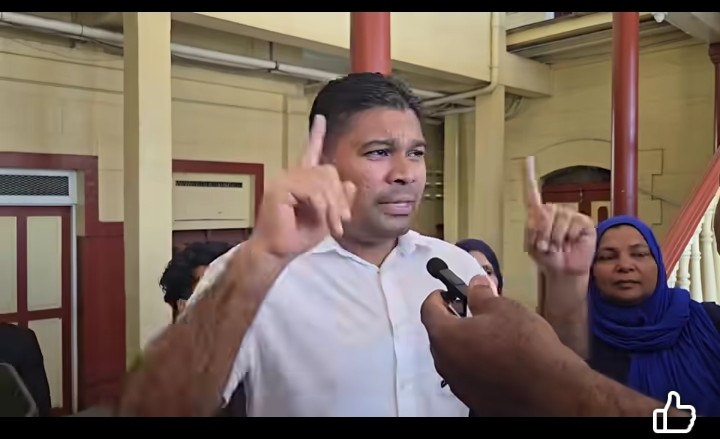
By Mark DaCosta- Monday 23 November is shaping up as a testing day for Opposition Leader Azruddin Mohamed, who must answer in two separate courtrooms. At the Georgetown Magistrates’ Court, the extradition case that has hung over him since October 2025 returns before Chief Magistrate Judy Latchman. The High Court, meanwhile, will hear the Director of Public Prosecutions’ bid to strip him of the $150,000 bail he holds in that same extradition matter.
Together, the two hearings show how far a single legal saga has spread across the country’s courts.
Start with the extradition case itself. Mohamed and his father, Nazar, were arrested on 31 October 2025 on a request from the United States, where they are named in an 11-count indictment filed in Florida. Washington alleges wire fraud, mail fraud, money laundering, conspiracy and customs offences tied to a gold export scheme, and says more than US$50 million in taxes and royalties were evaded. Both men deny wrongdoing and are fighting their removal.
Many Guyanese assume this is a trial. It is not. A committal hearing asks a narrower question: whether the paperwork and legal conditions for surrender are satisfied. Guilt or innocence is for an American court, should it ever come to that. If the Chief Magistrate finds the requirements unmet, the men would be discharged. If she finds them met, she would commit them to await a decision on surrender, which normally leaves room for further challenge in the High Court and beyond. A constitutional appeal is also still pending, so even a ruling in the Magistrates’ Court on Monday would not settle the matter.
Progress has been slow. Since the substantive hearing opened on 6 January, only two prosecution witnesses have testified: Foreign Affairs Permanent Secretary Sharon Roopchand-Edwards and Senior Superintendent Prem Narine, head of the Special Branch. Their evidence covers the documents supporting the American request and the circumstances of the arrests.
Attorney General Anil Nandlall has accused the defence of stalling through lengthy cross-examination and repeated applications. The Chief Magistrate has countered that the case raises complex questions deserving careful treatment. Defendants are entitled to test the evidence against them, and courts are right to be cautious, yet a case now over a year old tests public patience.
The High Court application is a different contest. On 2 and 3 November, Chief Magistrate Latchman declined to revoke Mohamed’s extradition bail, even though he had since been charged with other offences. Her reasoning, as reported, was that new charges alone, without a conviction, do not justify withdrawing bail. DPP Shalimar Ali-Hack says that was an error of law and wants Chief Justice Navindra Singh to overturn both rulings.
The prosecution argues that a conviction is not a precondition for revoking bail where credible material suggests further offending or interference with witnesses. The charges that followed the 12 October shooting outside Senior Superintendent Narine’s Kitty home give that argument its force. Narine is a witness in the extradition proceedings, and Mohamed has also been accused of paying a police constable $800,000 for Command Centre surveillance footage related to the incident.
This is a review of a magistrate’s decision, not a rehearing. The Chief Justice must decide whether the Chief Magistrate acted unlawfully, irrationally or unfairly, not whether he would have ruled differently. That is a demanding standard, and the defence will likely lean on it. The prosecution may take some encouragement from Justice Priscilla Chandra-Hanif’s judgment of 18 November, which upheld the refusal of bail on the cybercrime charge. She accepted that courts need not wait for another offence before acting on a well-grounded risk of witness interference. That ruling concerned a different bail decision under a different charge, however, and it also stressed that an accusation must not be mistaken for proof.
The consequences differ sharply. If the DPP succeeds, the extradition bail ends and Mohamed would face custody on that front as well. If she fails, the bail stands, but with little practical relief for the Opposition Leader. He remains on remand at Lusignan on the cybercrime charge, with that remand reportedly running to 24 November, and the defence may renew its bail application if circumstances change.
None of this has produced a verdict on anything. Mohamed has not been convicted of any offence, and the presumption of innocence applies to every charge he faces. Still, Monday brings the extradition case and the fight over his liberty before the courts at once, with the Opposition Leader’s political future bound up in both. For a nation that has watched this drama for more than a year, the day may offer clearer signals than it has had in a long time, though final answers are likely still some way off.