The Ministry of Health has received new national guidelines designed to improve the medical response to rape and intimate partner violence, with authorities emphasising the need for timely, confidential and compassionate treatment for survivors across Guyana.
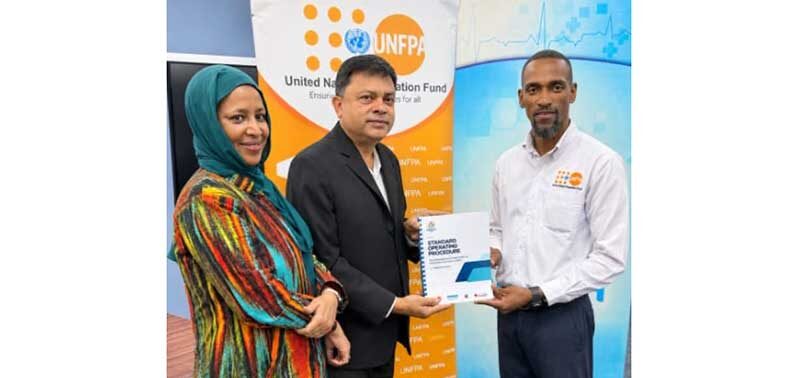
The Standard Operating Procedures (SOPs) for the Clinical Management of Rape and Intimate Partner Violence were formally handed over to the Ministry on November 12 by the United Nations Population Fund (UNFPA) Guyana Liaison Office. The development was reported publicly on November 19.
The guidelines were developed with technical support from UNFPA, in collaboration with the Pan American Health Organization (PAHO) and the Guyana Responsible Parenthood Association (GRPA), following consultations with healthcare providers and other stakeholders.
The procedures are intended to establish a more consistent approach to managing cases of sexual violence and domestic abuse within healthcare facilities, ensuring that survivors receive appropriate attention regardless of where they seek assistance.
A central feature of the guidelines is the emphasis on survivor-centred care, including respect for patients’ dignity, privacy and informed consent throughout the treatment process.
The procedures are also intended to provide healthcare workers with practical guidance on responding to cases of rape and intimate partner violence, helping to reduce inconsistencies in the way survivors are treated and supported.
Speaking at the handover, UNFPA Guyana Liaison Specialist and Head of Office Adler Bynoe said every survivor of rape, intimate partner violence or domestic violence should have access to high-quality, compassionate and confidential healthcare, regardless of their location in Guyana.
He described the handover as an important step towards translating existing commitments into practical services for people affected by violence.
Chief Medical Officer Dr Narine Singh said the procedures would help ensure standardised and quality treatment and care for survivors throughout the country’s healthcare system. He also acknowledged UNFPA’s technical support and continued partnership with the Ministry.
The introduction of the protocols comes amid continuing concerns about violence against women and girls and the challenges survivors face in accessing medical and other support services.
PAHO reported in September 2024 that World Health Organization estimates indicated that 31 per cent of ever-married or partnered women and girls aged 15 to 49 in Guyana had experienced physical and/or sexual intimate partner violence during their lifetime, while 10 per cent had experienced it within the preceding 12 months. These are estimates from the period cited by PAHO, rather than current 2026 prevalence figures.
The new guidelines represent an important policy development, but their effectiveness will depend on implementation, adequate resources and training for healthcare personnel.
Questions remain about how quickly the procedures will be introduced across public health facilities, whether medical staff will receive specialised training, and how survivors in hinterland and remote communities will access the services.
Equally important will be the coordination between healthcare providers, police, social services and organisations supporting survivors, particularly where individuals require ongoing medical attention, counselling, protection and assistance in pursuing justice.
The Ministry of Health and its partners will therefore face the task of ensuring that the new standards translate into accessible and consistent care, rather than remaining a policy document.