There is a particular kind of exhaustion that comes from being told, repeatedly, that you are living through a miracle. Guyana’s economy has grown faster than any other in the world for four years running. The government’s own reports describe growth rates that read like typos, 33 percent in six months, 47 percent a year on average since 2022. And yet, for the shop clerk, the construction labourer, the security guard, and the schoolteacher, the miracle has a strange texture: it is real in the statistics and largely invisible in the pay packet.
This is the contradiction at the centre of Guyanese life right now, and it deserves to be named plainly. Wages have not moved anywhere near as fast as the economy has, and for a majority of working Guyanese, that gap is not an abstraction. It is the difference between managing and drowning.
What “working” actually pays
Guyana’s national minimum wage is GYD $60,147 a month, a rate that has stood since July 2022. The median income across the workforce sits close to that figure; wage data compiled from Guyana’s own labour statistics puts the median individual income at roughly GYD $50,000–$60,000 a month, meaning half the working population earns at or below that line. At the pegged official exchange rate, that is a little over US$280 a month. At the market rate Guyanese actually pay when they need US dollars, which has drifted further from the official rate every month this year, it is worth even less.
Set that beside the cost of living. Guyana’s poverty line, measured against the international US$5.50-a-day benchmark used by the UNDP, works out to roughly GYD $1,150–$1,200 a day, meaning a full month at minimum wage leaves a worker only narrowly above the line the United Nations itself defines as poverty. Guyana’s poverty rate under that benchmark has been estimated at 38.8 percent, among the highest in Latin America and the Caribbean, in the same economy now classified as high-income by the World Bank.
This is not a coincidence of bad luck. It is what economists call in-work poverty, and the International Labour Organisation has found that informal workers, those without contracts, benefits, or reliable pay — make up between 70 and 90 percent of the working poor across this region. In Guyana, that description fits an enormous share of the labour force: the shop clerk, the domestic worker, the market vendor, the security guard. They are not unemployed. They show up in the statistics as success stories. And many of them still cannot afford to get sick.
Where the jobs actually are
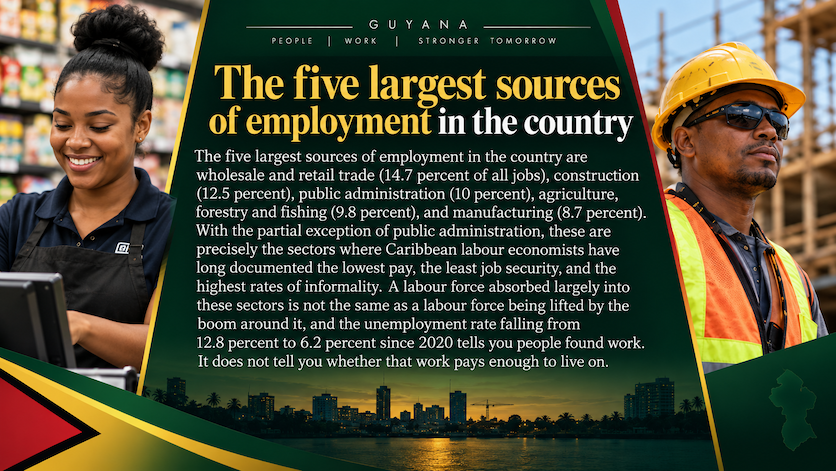
Guyana’s own labour force data confirms this isn’t a marginal problem, it’s structural. The five largest sources of employment in the country are wholesale and retail trade (14.7 percent of all jobs), construction (12.5 percent), public administration (10 percent), agriculture, forestry and fishing (9.8 percent), and manufacturing (8.7 percent). With the partial exception of public administration, these are precisely the sectors where Caribbean labour economists have long documented the lowest pay, the least job security, and the highest rates of informality. A labour force absorbed largely into these sectors is not the same as a labour force being lifted by the boom around it, and the unemployment rate falling from 12.8 percent to 6.2 percent since 2020 tells you people found work. It does not tell you whether that work pays enough to live on.
The uncomfortable part: Guyana is sold on this
Here is what makes this harder to simply blame on bad luck or a lagging bureaucracy. Guyana’s low-wage workforce is not incidental to the country’s growth model, in some sectors, it is the pitch. In promoting the country’s business process outsourcing industry, Finance Minister Dr. Ashni Singh has told investors directly that Guyana offers an English-speaking, well-educated population sitting four to five hours from Miami and five to six from New York — the same time zone as the US East Coast, easily accessible to major North American cities. Industry analysts describe Guyana as an attractive “nearshore” alternative precisely because it offers this profile at a fraction of North American labour costs.
None of that is dishonest, it is a genuine geographic and linguistic advantage, and it has brought real jobs. But an investment pitch built partly on labour-cost arbitrage has an uncomfortable logic buried in it: the pitch works because wages stay low relative to the markets being served. A BPO sector genuinely competing on cost has structural reasons to resist the wage growth that would make Guyanese workers’ lives easier, because that same wage growth is what makes the country less attractive to the next call centre deciding between Georgetown and San José.
The other side of the argument
The other side of the argument is reflected in the IMF’s Article IV consultations on Guyana which have repeatedly flagged “overheating” risk, the danger that rapid income growth, especially concentrated wage gains, could push inflation higher and drive up the real exchange rate faster than the underlying economy can sustain, eroding competitiveness elsewhere. Vice President Bharrat Jagdeo has invoked this logic directly in defending measured public-sector salary increases, warning that outsized wage hikes risk “Dutch Disease”, the syndrome where resource wealth pushes up costs across an economy until everything except the resource sector becomes uncompetitive. Yet Guyanese citizens are already dealing with outrageous inflation, climbing exchange rates and many economists make the case that Guyana is already suffering from ‘dutch disease’, so why must citizens continue to bear the burden of living with low wages.
What that trade-off costs, in practice
But naming the trade-off honestly doesn’t make it painless, and the people absorbing the cost of “measured” wage policy are rarely the ones the caution is designed to protect. When food inflation runs at nearly 4.4 percent in six months, when the currency gap widens month over month, and when the minimum wage hasn’t moved since 2022, “measured” starts to look, from the ground, indistinguishable from “frozen.” A macro strategy that makes sense on a whiteboard in Washington or in a ministry briefing still has to be lived through by someone deciding whether to buy meat this week.
The consequences are already visible, even if they rarely make it into a mid-year report. Guyana continues to lose a significant share of its most educated citizens to emigration, roughly half of Guyanese with tertiary education are estimated to have left the country, according to World Bank data, a brain drain that both reflects and worsens the wage gap between what Guyana pays and what the diaspora economies pay for the same skills. Households absorb the difference through remittances, through informal work stacked on top of formal jobs, through debt. None of this shows up as a headline statistic. All of it is the lived arithmetic of a boom that hasn’t yet reached the people doing the work.
What would actually change the picture
None of this requires abandoning fiscal caution. It requires the same rigor currently applied to inflation targets and overheating risk being applied, visibly, to the cost of living itself: a minimum wage that is reviewed against CPI on a fixed schedule rather than left to stand for years at a time; genuine data on informality and in-work poverty published alongside employment figures, not left for outside institutions to estimate; and a public acknowledgment, from the institutions selling Guyana’s low-cost workforce to investors, that the same workforce needs a floor under it that keeps pace with what oil wealth has done to prices.
Guyana does not need to choose between macroeconomic stability and a living wage forever. But right now, it has been choosing the former by default, and calling the result a miracle. The workers holding up that miracle are entitled to ask when their turn comes.
Sources: Guyana Bureau of Statistics / Ministry of Finance Mid-Year Report 2026; WageIndicator.org minimum wage data; UNDP poverty estimates as cited by Food For The Poor; International Labour Organisation 2022 Labour Review as reported by Stabroek News; IMF Article IV Consultation press releases and staff statements on Guyana (2023–2025); Department of Public Information (DPI) Guyana remarks by Finance Minister Dr. Ashni Singh on the BPO sector; World Bank data on tertiary-educated emigration; Nearshore Americas industry commentary on Guyana’s BPO positioning.