The Guyana Chronicle this week carried an article under the headline, “Strong fiscal management, economic discipline restored confidence in Guyana,” based on remarks by President Irfaan Ali reflecting on Guyana’s economic journey from the crisis years of the 1970s and 1980s to the present. There is no question that Guyana experienced severe economic hardship during that period.
But there is a serious problem with asking Guyanese in 2026 to judge the quality of current economic stewardship by comparing today’s Guyana with the Guyana of 1988. That is an extraordinarily low benchmark for a country that now produces more than 900,000 barrels of oil per day, has accumulated billions of US dollars in petroleum revenues, enjoys one of the fastest-growing economies in the world and has access to financial resources previous generations of Guyanese governments could scarcely have imagined.
The economic struggles of 1980s also had more than one cause. Under Forbes Burnham, Guyana pursued co-operative socialism, nationalizing major industries, expanding the role of the state, controlling prices, trade and foreign exchange and placing a large share of productive activity under public management. Anyone living in Guyana today, has a better understanding of the impact of the foreign colonialization of key industries, carting massive profits out of Guyana, while the majority of Guyanese struggle with low wages, poor quality healthcare, schools and other services. Forbes Burnham was courageous enough to stand up for the people of Guyana and the Western leaders made sure that the nation paid an unforgettable price for it.
Burnham’s policies reduced private investment while western governments responded by reducing their demand for Guyana’s rice, sugar, bauxite resulting in growing fiscal pressure. At the same time, Guyana was a small commodity exporter and an oil importer, making it vulnerable to external shocks. Rising energy costs, weaker commodity conditions and declining export earnings compounded domestic weaknesses and deepened the crisis.
As production fell, foreign-exchange earnings weakened, machinery and essential imports became harder to obtain, and public enterprises became increasingly difficult to sustain. Debt and arrears mounted. The economic hardship of that period was therefore mainly the product of an adverse international environment, and any serious account of that period should recognize that.
The recovery did not begin in 1992 as Irfan Ali stated. The Economic Recovery Programme was launched under President Desmond Hoyte in the late 1980s, when Guyana began dismantling much of the state-controlled economic model, liberalising trade, reforming the exchange-rate system, reducing transfers to public enterprises, removing price controls and rebuilding relations with international financial institutions. Guyana cleared arrears to the International Monetary Fund in 1990 and regained access to international financing before the PPP/C took office.
But the nature of that recovery also matters. A substantial share of Guyana’s debt burden was eliminated because international creditors forgave it through HIPC and other debt-relief mechanisms. Today’s comparatively low debt-to-GDP ratio is also heavily influenced by the extraordinary expansion of the economy following oil production. Guyana can therefore borrow significantly more money in absolute terms while maintaining a relatively low debt-to-GDP ratio because GDP itself has expanded so dramatically.
That is why the discussion about economic management must now move beyond comparisons with the crisis years. Low debt matters. Economic growth matters. Foreign reserves and investor confidence matter. But none of those indicators, by themselves, proves that a country is being managed as effectively as it should be. The purpose of sound economic management is to convert national resources into stronger institutions, productive capacity and measurable improvements in the lives of citizens.
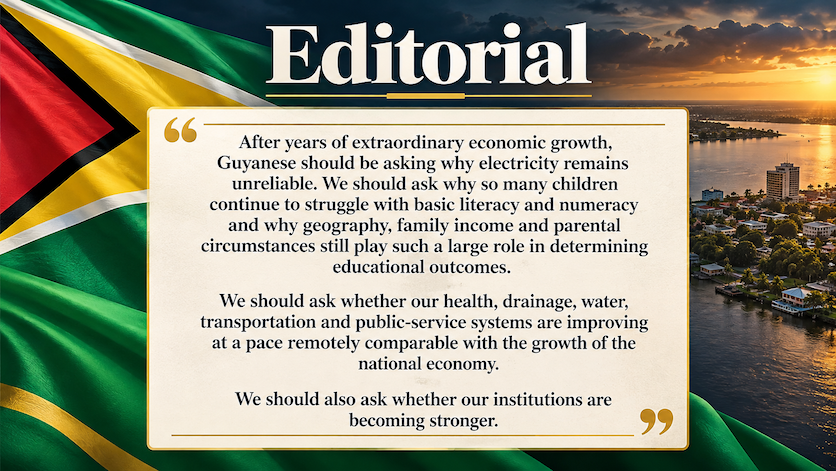
After years of extraordinary economic growth, Guyanese should be asking why electricity remains unreliable, why so many children continue to struggle with basic literacy and numeracy, and why geography, family income and parental circumstances still play such a large role in determining educational outcomes. They should also be asking whether health services, drainage, water, transportation and public-service systems are improving at anything approaching the pace of growth in the national economy, and whether the institutions responsible for managing this unprecedented wealth are becoming stronger.
The International Monetary Fund has itself recommended that Guyana establish a comprehensive medium-term fiscal framework with an explicit fiscal anchor, strengthen multi-year budgeting, improve public-investment management and deepen fiscal transparency. Those recommendations matter because Guyana is now spending and investing at a scale never before seen in its history. The larger the revenues and the faster the spending, the more important discipline, scrutiny and institutional capacity become.
There is also the issue of data. Guyana can announce GDP growth, oil production, Natural Resource Fund balances and public debt with considerable precision, yet comprehensive and regularly updated information on household income, household expenditure, poverty, living conditions and the distribution of economic gains remains far less available than it should be. In an economy transformed by oil, that is not a minor statistical weakness. It goes directly to the question of whether national growth is translating into broader prosperity.
The relevant questions are therefore increasingly household questions. How much has the financial position of the ordinary Guyanese family improved? How much more disposable income remains after paying for food, transportation, housing, electricity and education? Has the economic position of lower-income households improved at anything close to the pace of national GDP? Are small businesses becoming stronger? Are young people finding productive pathways into the new economy? Are rural and hinterland communities closing the development gap with the coast?
There is also an important distinction between investor confidence and citizen confidence. International lenders may have confidence in Guyana because the country has enormous oil reserves and substantial future revenue streams, while the only serious foreign investors interested in Guyana are attracted by exceptional Oil and Gas related growth opportunities.
The experience of the ordinary citizen is quite different however. The small business waiting for payment, the parent paying for private lessons because a child is struggling in school, the household facing high food prices or the family enduring another blackout may reasonably ask whether headline economic success is being translated into everyday security, opportunity and quality of life.
Guyana has travelled an extraordinary distance from the economic hardship of the 1980s. Successive governments, international financial institutions, debt relief, private investment and petroleum production have all contributed to that transformation, and that history should be acknowledged. But it is deceitful to name 1988 as Guyana’s economic benchmark.
The question in 2026 is not whether the country is being managed better than it was when Guyana was struggling economically nearly forty years ago. The question is whether a country experiencing one of the greatest increases in national wealth in its history is converting that wealth into stronger institutions, better schools, reliable infrastructure, productive industries, greater opportunity and a measurably better quality of life for the majority of its people. That is the standard by which economic stewardship should now be judged, and it is a standard Guyana can afford to set.