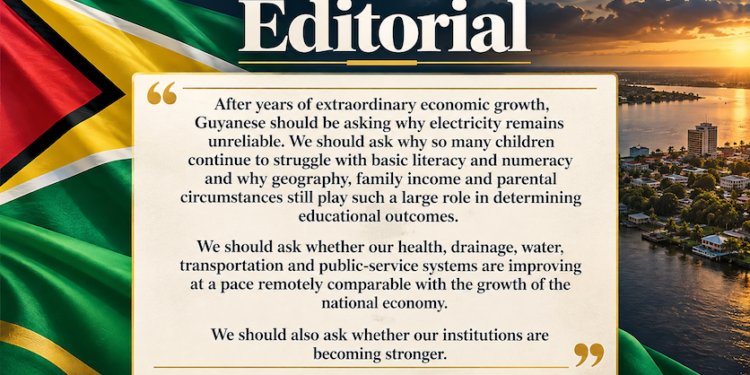
Guyana has three great rivers—the Essequibo, Demerara and Berbice—but the country’s deepest divide is not geographical. It is the widening gulf between the Guyana its leaders describe and the Guyana its people are forced to endure.
One Guyana exists behind podiums. It is prosperous, transforming, booming, modernising and marching confidently into a golden future. Billions are flowing. Projects are announced. Contracts are signed. Ribbons are cut. Speeches are made.
Then there is the other Guyana. It is waiting for electricity. Waiting for roads to be fixed. Waiting for public services to work. Waiting for answers when things go wrong. Waiting for promises to become reality. And increasingly, waiting for leaders to stop talking long enough to actually solve something.
This is a country awash with money but increasingly starved of competent management, accountability, critical thinking and honest leadership. The dichotomy cannot be ignored.
Guyana’s 2026 Budget is $1.558 trillion—the largest in the nation’s history. Yet citizens are being told that the next six months will be “critical” to stabilising electricity after years of promises that the power crisis was being fixed. How many six-months does a crisis require before it becomes evidence of a failure to plan?
The problem is not simply money. It is what happens to money when competence is absent.
The Auditor General’s reports have repeatedly exposed weaknesses in procurement, contract management, documentation and financial controls. These are not abstract accounting problems. They are symptoms of a state machinery that can spend enormous sums while struggling to demonstrate that every dollar produces the value citizens were promised.
And there is something even more troubling. Guyana appears increasingly afflicted by the dangerous belief that certification is competence. A certificate may prove that someone completed a course. It does not prove that the person can think under pressure, interrogate a bad proposal, identify waste, anticipate consequences or solve a complicated national problem. Neither does political loyalty. Neither does proximity to power. Neither does shouting the loudest.
Yet our public discourse increasingly resembles a permanent quarrel in which evidence is replaced by insults, questions are treated as attacks and disagreement is answered with the political equivalent of a fistfight. The cuss-out has become a substitute for critical thinking.
Accountability is increasingly being replaced by an elaborate art of explanation—explaining why yesterday’s promise cannot be delivered today, why failure must be blamed on someone else, and why citizens who dare to ask questions are dismissed as “haters.” Questioning is not hatred. It is citizenship. Demanding answers is not sabotage. It is civic responsibility. And listening to those questions is not weakness. It is a basic obligation of leadership.
The tragedy is that the masses continue looking upward. They look to presidents, ministers, parliamentarians, technocrats and political leaders for direction because that is what leadership is supposed to provide. Instead, too many are being offered spectacle. Too many are being offered political warfare. Too many are being offered excuses dressed as explanations.
And while those at the top argue, ordinary Guyanese absorb the consequences: higher costs, poor wages, lost productivity, unreliable services, wasted time, deteriorating confidence and the quiet desperation of people who know that the country’s extraordinary wealth should have produced a very different quality of life.
This is not an argument that Guyana lacks intelligent people. It does not. It is an argument that intelligence is useless when institutions reward obedience over questioning, credentials over competence and political allegiance over performance.
Guyana cannot spend its way out of poor governance. It cannot announce its way out of incompetence. It cannot cuss its way out of failure. And it certainly cannot deceive itself into development.
The three rivers will continue carrying Guyana’s waters to the Atlantic. But another current is carrying the country somewhere else—the widening river between what leaders say and what citizens live. That is the real tale of Guyana’s two cities. One is being built in speeches. The other is drowning in reality.