Guyana’s oil production has crossed 900,000 barrels per day and is projected to approach 1.7 million barrels per day by the end of the decade, further cementing the country’s emergence as a major global oil producer.
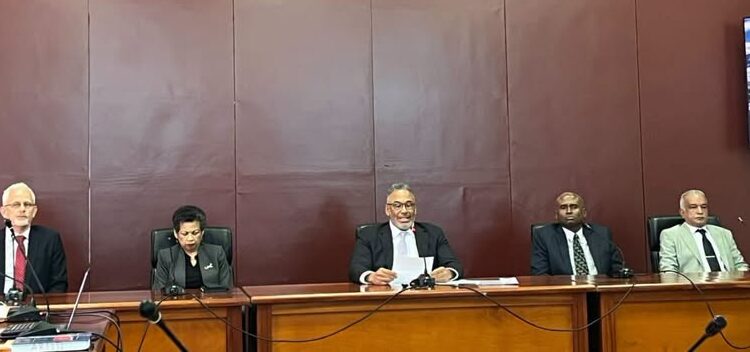
Natural Resources Minister Vickram Bharrat announced the projection Thursday as Guyana’s offshore petroleum industry enters another phase of rapid expansion.
The scale of the increase is extraordinary.
Guyana was producing approximately 80,000 barrels per day in 2020, shortly after commercial production began offshore. Output has since increased more than tenfold.
The next major jump is expected with the Uaru development.
Guyana’s fifth FPSO, the Errea Wittu, arrived last month and is expected to begin production in September, pushing national output beyond one million barrels per day.
The US$12.7 billion Uaru project is expected to recover more than 800 million barrels of oil.
Production is projected to rise further as additional offshore developments come on stream.
According to World Oil, Guyana could reach approximately 1.3 million barrels per day by the end of 2027 before approaching 1.7 million barrels per day by 2030.
The expansion is being accompanied by a rapidly growing oil-services sector.
Bharrat said nearly 1,300 companies are now registered with the Local Content Secretariat, while almost 7,000 Guyanese workers have received training and certification for direct employment in the oil and gas industry.
The Government is also attempting to use the expanding petroleum sector to transform the wider economy.
A roughly 300-megawatt Gas-to-Energy project is being developed to use natural gas from the Stabroek Block to generate electricity for the domestic market, with power generation targeted before the end of 2026.
But the rapid expansion of production also raises questions about Guyana’s ability to manage its petroleum wealth and reduce dependence on oil.
The country has already accumulated billions of dollars in petroleum revenues, while government spending on roads, housing, health, education, agriculture and other sectors has expanded dramatically.
Yet significant gaps remain, particularly in hinterland communities where residents continue to report problems with transportation, water, roads and access to essential services.
That contrast is becoming increasingly difficult to ignore.
Guyana is moving toward oil production levels normally associated with much larger economies, while parts of the country continue to struggle with basic infrastructure.
The Government has repeatedly promised that petroleum wealth will be converted into long-term national development and greater opportunities for Guyanese.
With production potentially approaching 1.7 million barrels per day within four years, the stakes are rising.
The challenge is no longer simply producing the oil.
It is ensuring that the unprecedented wealth generated from it is translated into measurable improvements in the lives of ordinary Guyanese—and that enough of the economy is diversified to remain viable when the oil boom eventually fades.