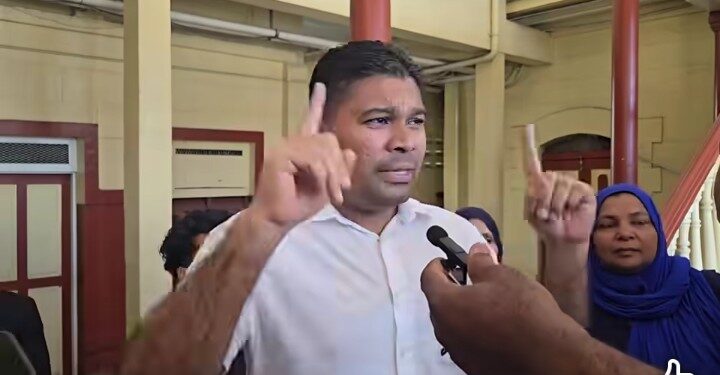
By Mark DaCosta- The Alliance For Change (AFC) has called on the Government and the Guyana Police Force to open their investigation of Opposition Leader Azruddin Mohamed to public scrutiny. In a statement issued on 16 October 2026, the party invoked “transparency and accountability” as the test of a credible inquiry into a reported shooting at the home of Special Branch head Prem Narine. It wants the video footage, ballistics findings and gunshot residue results made public, warns against treating tinted windows as proof of guilt, and insists that the law be applied impartially.
The events behind the appeal are serious and disputed. Police confirmed that they arrested Mohamed and two of his workers after an incident near Narine’s home. Police said a black Toyota Allion passed the officer’s residence on Barr Street twice, and that on the second pass he heard what seemed to be a gunshot. Spent shells were recovered nearby, and Mr Mohamed and his lawyer maintain that the firearm found under the accelerator pedal was planted.
The Government has taken a harder line. It alleges that the men were filming Narine’s home and that an unlicensed firearm was found in the vehicle. It also ties the episode to the extradition proceedings in which the senior officer is a witness. United States prosecutors allege that Mohamed and his father conspired to commit fraud and launder money through their gold-exporting firm, which they deny. Mohamed was elected Opposition Leader in January and has had several run-ins with the police since the extradition case began.
Against this backdrop, the AFC’s central demand is that the evidence speak for itself. It wants the relevant footage released so that Guyanese can see whether the vehicle’s occupants “discharged firearms first”. The party argues that “the public deserves access to credible evidence” and that rumour and political spin should not be left to fill the vacuum.
The forensic record is a second plank of the appeal. The AFC asks for the ballistics results on the weapon reportedly recovered, and the gunshot residue tests carried out on the occupants. Such findings, it says, may prove “critical in establishing the facts” and the sequence of events. It does not ask for recklessness: disclosure should come “to the fullest extent permitted by law”, with no prejudice to the investigation or any court process.
The party also addresses the matter of tinted windows, a point that has drawn comment among motorists. Driving a tinted vehicle, it argues, “is not, in itself, a crime”, and tint cannot stand in for evidence of wrongdoing. Any police action must be “grounded in the law” and rest on lawful and reasonable grounds. Where tint regulations are genuinely at issue, the AFC says, they should be handled through the proper procedures.
The statement is careful not to deny the Police Force its duty to investigate alleged crime. Its concern is the manner of that duty. The AFC insists that policing must be carried out “impartially, professionally and without political influence”, so that citizens are satisfied that justice does not bend “regardless of an individual’s political affiliation”. That is a pointed reminder in a country where public trust in institutions is regularly tested along party lines.
The closing passage reaches for first principles. The rule of law, the AFC says, must be upheld “without fear or favour, affection or ill will”. “No individual should be presumed guilty” before evidence has been weighed, and none should be “placed above the law”. Every citizen, it adds, is owed “due process, equal protection under the law” and a fair, credible hearing.
The AFC concludes that it “stands firmly for justice”. Whether the authorities release the footage and forensic results will show how seriously they take that call. For ordinary Guyanese, who want facts rather than faction, how openly this matter is handled will say much about the health of our democracy.