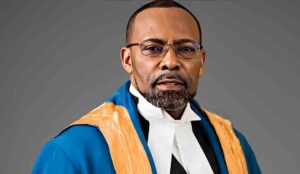
A Partnership for National Unity (APNU) parliamentarians have intensified their assault on the leadership of the Caribbean Court of Justice (CCJ), calling for the resignation of its President, Justice Winston Anderson, as allegations of internal division and controversial political engagement threaten to erode confidence in the region’s highest court.
In sharply worded statements, Lead APNU parliamentarian Dr. Terrence Campbell and parliamentarian Sherod Duncan warned that the credibility of the CCJ—Guyana’s final appellate court—now hangs in the balance, with the institution facing what may be its most serious test since its establishment.
Dr. Campbell underscored that the CCJ’s authority is rooted not in power, but in public trust—trust he argues is now under strain.
“The Caribbean Court of Justice is one of the Caribbean’s most important institutions. Its authority rests not on political power, but on the confidence of Caribbean citizens, governments and the legal profession that the Court is independent, impartial and beyond political influence. That confidence is now at risk.”
Central to the controversy are reports that Justice Anderson engaged then Opposition Leader Aubrey Norton on the sensitive and constitutionally governed process of appointing Guyana’s Chancellor and Chief Justice—a role requiring agreement between the President and the Leader of the Opposition.
“Serious questions have been raised about Justice Anderson’s engagement with [then] Opposition Leader Aubrey Norton concerning the appointment of a substantive Chancellor and Chief Justice… Mr. Norton has confirmed that Justice Anderson engaged him on the issue… and that he terminated the discussion when he concluded that the engagement was not in the best interests of Guyana.”
The matter has taken on added significance following the decision by acting Chancellor Justice Yonette Cummings-Edwards to proceed on pre-retirement leave, a development Campbell said has “intensified concerns about what occurred.”
But the controversy extends beyond Guyana. Reports out of Trinidad and Tobago point to a deepening rift within the CCJ itself, including disputes among judges and concerns over leadership conduct—most notably surrounding the reported removal of Justice Chile Eboe-Osuji from a judicial panel.
“These reports raise questions not simply about one intervention in Guyana, but about the manner in which the President exercises authority over the Court and interacts with his fellow judges.”
For Campbell, the issue is not whether allegations have been definitively proven, but whether the cumulative effect has already damaged the court’s standing.
“A final court must be scrupulously independent of governments, political parties and political personalities… The issue is whether the accumulation of these allegations and reported internal divisions has damaged the confidence that must exist in the leadership of the CCJ.”
He concluded with an unambiguous call for the CCJ President to step aside.
“Justice Anderson should therefore resign as President of the Caribbean Court of Justice. His resignation would not be an admission of guilt. It would be an act of institutional responsibility.”
Duncan reinforced those concerns, arguing that the current controversy reopens questions the Opposition has raised for years—particularly following the disputed 2020 elections—about whether the CCJ has maintained sufficient institutional distance from political actors.
“We were assured that this was an institution securely insulated from political and external influence… Yet the present controversy… requires those assurances to be revisited with the seriousness they deserve.”
Duncan pointed to Norton’s 2025 disclosure as a pivotal moment now requiring deeper scrutiny, questioning why the President of a final appellate court would engage directly in a live constitutional process.
“The legitimate question is therefore: what institutional interest did the CCJ have in the outcome of that process… and where should the proper boundary lie between judicial advocacy for institutional reform and involvement in an unresolved constitutional process within a member state?”
While careful not to allege wrongdoing without proof, Duncan stressed that perception alone can undermine judicial legitimacy.
“Independence is also about appearances, boundaries and public confidence… the public is entitled to ask where those boundaries begin and end.”
He further linked the issue to cases of major political consequence, including the CCJ’s recent ruling allowing extradition proceedings against Azruddin Mohamed and Nazar Mohamed to proceed.
“I am not asserting that there was undue influence over that judgment… But given what is now being reported from inside the Court itself, it is certainly not remiss for Guyanese to ask the CCJ to state specifically what its judges meant.”
Duncan pressed for clarity on whether the internal concerns relate to administrative control, judicial panel selection, or deeper questions about independence within the court—issues he said go to the heart of due process.
“Those distinctions matter enormously… Guyanese are entitled to an unequivocal assurance that none of the institutional concerns… had any bearing whatsoever upon the composition of the panel, the deliberative process or the outcome of that case.”
Established to replace the UK-based Privy Council, the CCJ has long been promoted as a pillar of Caribbean sovereignty and legal independence. Guyana is among the countries that have fully embraced its appellate jurisdiction.
But Campbell warned that its broader regional ambitions could now be jeopardised.
“The Court cannot credibly persuade countries to entrust their final judicial appeals to the CCJ while questions persist about the independence of its leadership.”
Duncan echoed that warning, insisting that legitimacy cannot be assumed—it must be demonstrated.
“Confidence cannot simply be demanded… It must be earned and preserved through transparency, demonstrable independence, appropriate institutional distance and processes that leave… no reasonable doubt about the integrity of the Court and its decisions.”
The statements signal a deepening confrontation over the integrity of the CCJ—one that places the region’s highest court under intense public and political scrutiny, with its leadership now facing mounting calls for accountability.