The unexplained decision to place High Court Justice Gino Persaud’s United States visa “under review” has moved from an unexpected travel disruption into a wider controversy over transparency, the independence of the judiciary and what information may have triggered Washington’s intervention.
Persaud was stopped from boarding a flight through Miami to Jamaica on September 19, where he was scheduled to attend the Commonwealth Magistrates and Judges Association conference. He was reportedly told that his U.S. visa was under review and directed to contact the U.S. Embassy.
Five days later, a critical question remains unanswered: what information triggered the review?
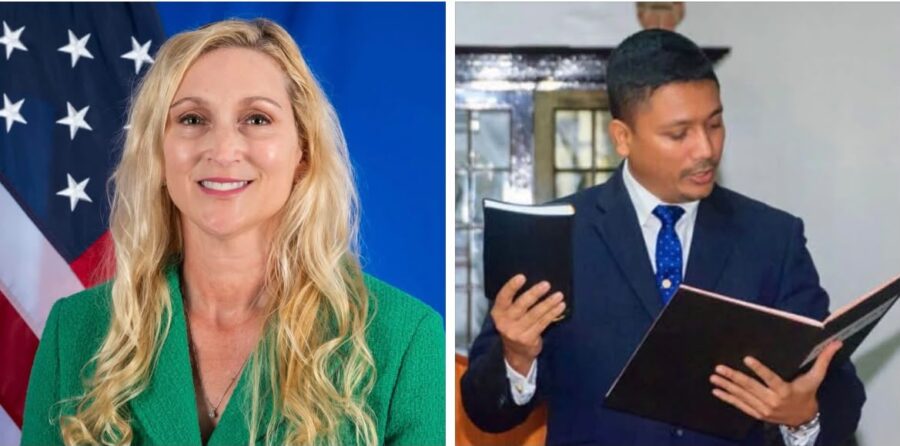
U.S. Ambassador to Guyana Nicole Theriot said Wednesday that the embassy in Georgetown was not aware that Persaud’s visa was under review when he was stopped from travelling.
“On occasion we would submit that information, but in the case that I think you are talking about, we were not aware.”
Theriot explained that visa reviews are handled at the Washington level and may occur when a U.S. government agency receives information that causes it to reconsider an individual’s eligibility to retain a visa. The local embassy, she indicated, may not know about such a review until a decision has been made.
That explanation has complicated rather than ended the questions surrounding the case, particularly because no public explanation has been given for why Persaud’s visa came under scrutiny.
Attorney General Anil Nandlall has categorically rejected suggestions that the Guyana Government played a role.
Speaking on his programme Issues in the News, Nandlall said:
“The government of Guyana, including the President, the Vice President and the Attorney General have absolutely no influence whatsoever over American, US foreign policy or any aspect of US governance and in particular certainly no influence whatsoever in relation to whom the US would permit to travel to the United States of America.”
Nandlall acknowledged that the government had publicly criticised some of Persaud’s rulings involving the Mohamed family, but denied that this had anything to do with the U.S. visa matter.
The scrutiny surrounding Persaud is significant because his recent judicial record has placed him at the centre of several contentious cases involving the Guyana Revenue Authority and the Mohamed family.
In April 2025, he issued an interim order restraining the GRA from seizing several luxury vehicles belonging to the Mohameds. In November 2025, he ruled that the GRA could not impose approximately $421 million in additional taxes on three vehicles belonging to Azruddin Mohamed. The GRA disputed the ruling and announced an appeal.
In July 2026, Persaud again ruled against the revenue authority in cases involving a Ferrari and Rolls-Royce, quashing tax assessments totalling nearly $800 million and finding aspects of the GRA’s actions unlawful and beyond its statutory authority. The GRA has appealed that decision.
The judicial record therefore provides important context—but it does not establish that Persaud’s rulings caused the U.S. visa review.
Against that backdrop, political activist Mark Benschop wrote on social media:
“If it is true, as some assert, that Justice Gino Persaud’s visa was unjustly placed in review by a rogue CBP or other officer, then it may be appropriate for Ambassador Theriot to apologise just as publicly to Justice Persaud for the public inconvenience and embarrassment caused by the embassy she leads”
Benschop’s statement is conditional. There is currently no public evidence establishing that a “rogue” CBP officer initiated the review.
Another controversy has been introduced by Melissa “Melly Mel” Atwell-Holder, who, alleged that information concerning her 2025 immigration detention may have been improperly shared with individuals connected to the PPP. Atwell-Holder said she intends to raise her concerns with U.S. and international authorities. While the allegations have not been independently substantiated, and she did not identify a specific U.S. official, it is important to note there is no public evidence connecting her allegations to Persaud’s visa review.
The two matters should therefore not be conflated.
What remains is a simple but consequential information gap: the U.S. says the Georgetown embassy was unaware, the Guyana Government says it had no influence, Persaud has not publicly explained the circumstances, and the reason for the Washington-level review remains undisclosed.
Until that gap is addressed, speculation will continue to fill the space left by the absence of an official explanation.