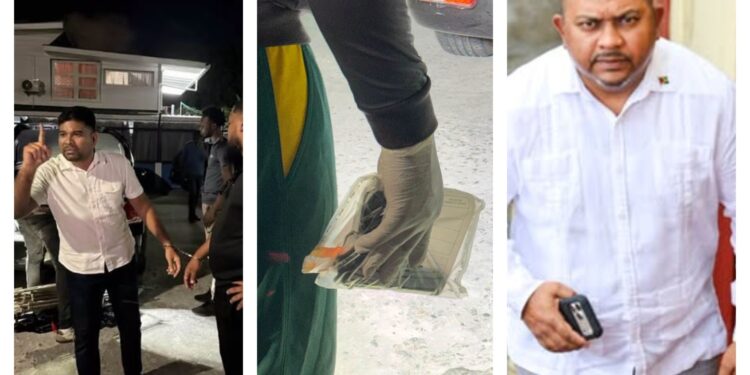
The rush to declare that High Court Judge Gino Persaud’s United States visa has been revoked demonstrates how readily an unconfirmed development can be transformed into an accepted “fact.” Yet the information publicly available does not establish that the judge’s visa was revoked or cancelled.
What has been reported is that Persaud was told his U.S. visa was “under review” when he attempted to travel to Jamaica. That distinction is fundamental. A review is a process of examination; a revocation is a decision to cancel a visa. They are neither legally nor factually interchangeable.
The reported incident occurred on Saturday, September 19, 2026, when Persaud was preparing to travel to Kingston, Jamaica, via the United States to attend the Commonwealth Magistrates’ and Judges’ Association Annual Conference, scheduled for September 20–24. The CMJA says the conference brings judicial officers from throughout the Commonwealth together to address issues including judicial independence, access to justice and developments affecting the administration of justice.
According to the report on the incident, Persaud was unable to proceed with his scheduled journey after being informed that his U.S. visa was under review. That is the reported circumstance—not a confirmed notification that his visa had been revoked.
The U.S. Department of State distinguishes additional review or administrative processing from a final visa action. Such processing may involve further checks or the collection of additional information before a determination is made. A visa revocation, by contrast, is an affirmative action by U.S. authorities that makes the visa no longer valid.
It follows that “under review” cannot reasonably be presented as proof of “revoked.” To make that leap without documentary evidence is to substitute assertion for verification.
That appears to be precisely what has happened in some of the public commentary surrounding Persaud. An unresolved visa issue has been presented as though it were a settled determination, with repetition gradually being used to give an unsubstantiated claim the appearance of fact.
The timing has naturally invited speculation because Persaud has recently presided over cases involving members of the Mohamed family and the Guyana Revenue Authority. But speculation about timing is not evidence of causation. The report on the visa issue itself notes that there is no established evidence linking the reported review to Persaud’s judicial rulings.
Legitimate questions can and should be asked. Why was the visa reportedly placed under review? What information prompted the review? What, if anything, has been communicated by the U.S. authorities? Those are proper questions. What is not proper is answering them with conjecture and then circulating the conjecture as established fact.
Persaud was appointed a Puisne Judge in July 2017 after the appointment process involving the Judicial Service Commission. Contemporary records describe him as a lawyer with extensive professional experience, including work with the Guyana Revenue Authority and involvement with the Transparency Institute of Guyana.
The broader issue is therefore one of public responsibility. A sitting judge should not be tried in the court of public opinion on the basis of an unexplained travel difficulty, an unverified inference or a politically convenient narrative. Where the facts are incomplete, responsible journalism should acknowledge what is known, identify what remains unknown and resist the temptation to manufacture certainty.
The facts presently available are simple: Judge Gino Persaud’s U.S. visa was reported to be under review. There is no publicly established evidence that it was revoked.
Those promoting a “revoked visa” narrative should produce the official evidence on which that claim rests. Until they do, the assertion remains unsubstantiated.
What is particularly troubling is the willingness of some actors to exploit an unresolved matter to malign a person’s reputation. That is how propaganda takes hold: a question becomes an allegation, an allegation becomes a claim, and repetition eventually attempts to pass the claim off as fact.
Guyana’s democracy and the rule of law are not strengthened by this practice. Public figures—including judicial officers—are entitled to scrutiny, but scrutiny must be grounded in evidence. The standard should be proof, not propaganda; verification, not vilification; facts, not insinuation.