A new column by Terrence Richard Blackman—Chair of the Math Department at CUNY Medgar Evers College and MIT-trained mathematician—is raising sharp questions about how power communicates in Guyana, arguing that the true test of governance is whether official language reveals the truth or conceals it.
In his August 9, 2026 column, “George Orwell Comes Alive in Guyana,” published in the Guyana Business Journal, Blackman draws on the ideas of George Orwell—the author of 1984 and Animal Farm, who warned that governments often manipulate language to obscure reality—to examine a week of national developments. His central test is simple: does the language of power clarify, or does it hide?
“Precision is not a partisan weapon. It is a democratic ethic.”
Blackman emphasises that his critique is not directed at one administration alone. Instead, he argues that government, opposition, corporations, and media alike must all be subjected to the same standard of clarity and honesty.
Protest Rooted in Barima Tragedy
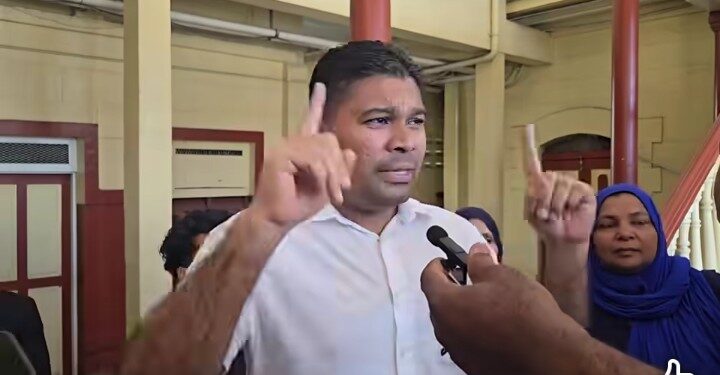
He begins with a recent protest in Santa Rosa, where citizens gathered outside a government outreach not as a routine demonstration, but in response to the July 18 sinking of the MV Barima—a disaster that left dozens dead and plunged the nation into grief, anger, and demands for accountability. Families of victims and concerned citizens have been calling for answers on how the 87-year-old vessel was allowed to operate, and whether failures in inspection, maintenance, and oversight contributed to the tragedy.
Against that backdrop, the President’s response—inviting protesters inside to engage respectfully—may have sounded conciliatory, but Blackman contends it subtly shifts the terms of dissent.
“In eight words, protest… is converted into a matter of etiquette.”
By recasting protest as an issue of behaviour rather than substance, he argues, the state maintains control of the space and narrative, even while appearing open.
Enforcement and Uneven Rigour
The column then turns to the interception of a vessel carrying Opposition Leader Azruddin Mohamed. Authorities described the stop as routine enforcement, citing missing documentation and requirements under the Amerindian Act.
Blackman does not dismiss enforcement—in fact, he underscores its importance, particularly in the aftermath of the MV Barima disaster, which exposed serious concerns about maritime oversight and the consequences of regulatory failure.
But he insists that enforcement must be transparent and consistent.
“A state that invokes the rulebook must open the rulebook.”
He calls for clear disclosure: which rules were breached, how often inspections occur, and whether the same standards are applied universally. Without such detail, he argues, public confidence cannot be sustained.
The deeper question he raises is unavoidable—why this level of scrutiny appears now, after tragedy struck, rather than before.
Barima, Leaks and Suppressed Questions
Blackman is especially critical of how information about the MV Barima has surfaced. Reports that a Dutch firm had been quietly invited to submit a salvage proposal—before a formal tender—emerged through leaks rather than official disclosure.
“The vice is not necessarily the invitation. The vice is that the public learned of it sideways.”
He describes the tragedy as “the great Orwellian object of our moment,” noting that even as operations are declared concluded and criminal charges are filed, broader institutional accountability remains unclear.
He also takes aim at a now-common refrain:
“Stop politicising the tragedy.”
For Blackman, the phrase functions less as a call for restraint and more as a tool to shut down scrutiny and discourage legitimate questioning at a time when families and the wider public are still seeking answers.
Oil Revenues and Official Silence
Turning to the oil sector, Blackman highlights ExxonMobil’s announcement that it has recovered its US$55 billion investment in Guyana’s Stabroek Block—an inflection point with major implications for national revenue.
Yet, he notes, this milestone was communicated to investors, not to the Guyanese public.
“Exxon can tell Wall Street what the change means in barrels. Surely Georgetown can tell Guyanese what it means in dollars.”
While acknowledging the complexity of oil revenue calculations, Blackman argues that this complexity heightens the government’s responsibility to provide clear explanations, not avoid them.
A Call for Precision
Despite its critique, the column is ultimately a call to action. Blackman invokes Orwell’s belief that language can be reclaimed, and that citizens must demand clarity from those in power.
He also reflects on his own formative experience at Queen’s College, where teacher Gregory “Shanksey” Shanks instilled in him the discipline of precision—an approach he now applies to public life.
“Precision is a form of honesty, and honesty is a form of respect for the people who must live with your lines.”
Blackman concludes by urging a shift toward direct, accountable language in governance—calling on officials to replace vague statements with clear ones, publish the rules they enforce, and communicate openly on issues of national importance.