Prime Minister Mark Phillips has urged Guyanese writers to take ownership of the nation’s narrative, stressing that literature must reflect the truth, complexity, and lived experiences of its people as the country undergoes rapid transformation.
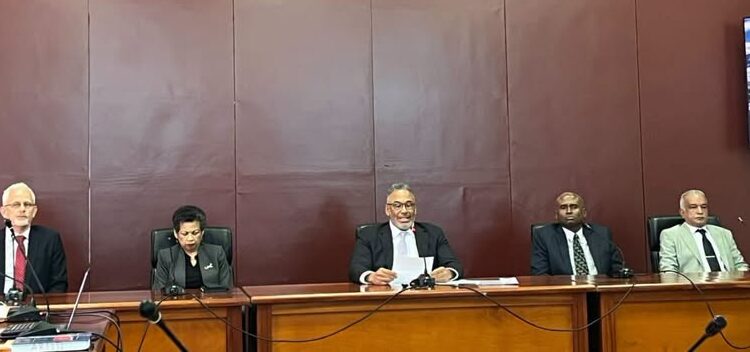
Speaking at the 2026 Guyana Prize for Literature, Phillips said storytelling is not merely an artistic pursuit but a national responsibility, particularly in a society where much of its history has been shaped by external and colonial perspectives.
“Tell those stories truthfully. Tell them with imagination and skill. Give future readers more than official deeds and public events. Give them private hopes, anxieties, contradictions, and the people who live through this time,” he said.
The 2026 Guyana Prize for Literature and its accompanying festival took place from August 6 to August 9, 2026, across multiple venues in Georgetown, including the Castellani House, the Pegasus Hotel, and the National Cultural Centre. The multi-day event brought together writers, performers, and cultural practitioners for workshops, readings, and public discussions.
Phillips underscored the role of writers in reclaiming and reshaping historical narratives by amplifying voices that have long been marginalised, while documenting the realities of modern Guyanese life.
He encouraged authors to reflect the country’s full diversity—from coastland communities to hinterland regions and the diaspora—while preserving language, confronting difficult chapters of history, and imagining the nation’s future.
“If we do not tell these stories with knowledge and confidence, others will tell them incompletely, or they may not be told at all,” he warned.
Despite Guyana producing internationally recognised literary voices, the prime minister acknowledged ongoing structural challenges facing the sector, including limited publishing avenues, small markets, and insufficient access to professional editing and mentorship.
He called for a more robust literary ecosystem, pointing to the need for workshops, reading groups, school writing programmes, residencies, and stronger partnerships among writers, publishers, academic institutions, and the private sector.
Phillips also highlighted steps taken by the government to revitalise the industry, including the restoration and modernisation of the Guyana Prize for Literature. The competition has been digitised to ease submission and judging processes, particularly for writers in the diaspora.
The initiative has also been expanded into a four-day literary festival, featuring workshops, storytelling sessions, poetry, drama, and public discussions aimed at broadening participation and strengthening cultural engagement.
These measures form part of a wider push to develop Guyana’s creative economy, with $3.7 billion allocated in 2026 to support sectors such as literature, film, fashion, heritage, and the performing arts.
Phillips said the goal is to create sustainable pathways for creative professionals while enhancing Guyana’s cultural footprint internationally.
In closing, he encouraged writers to remain committed to growth and discipline in their craft.
“Keep writing. And keep reading. Invest in yourself as we continue to find ways to invest in you,” he said.
He added that while awards and publication are important milestones, they are not endpoints, noting that the stories written today will shape how future generations understand this era of Guyana’s development.