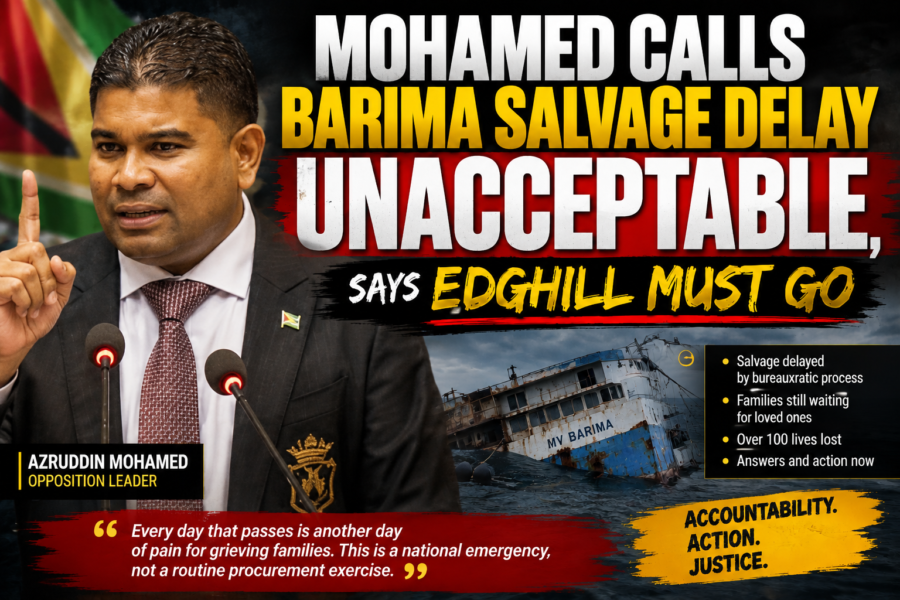
The Government’s decision to salvage the sunken MV Barima has sparked fresh criticism, with Opposition Leader Azruddin Mohamed welcoming the move but condemning what he describes as an unacceptable procurement process that will further delay the recovery of victims still believed trapped inside the wreck.
On Saturday, Public Works Minister Juan Edghill announced that the Government, through the Maritime Administration Department (MARAD), has issued an Invitation for Expressions of Interest (EOI) for the salvage of the vessel. The notice calls on qualified marine salvage contractors to submit bids before a contractor is selected to undertake the operation.
For Mohamed, however, the process falls far short of the urgency demanded by what has become Guyana’s deadliest maritime disaster in modern history.
“The decision to raise the MV Barima is the right one, and I welcome it,” he said. “But the timeline remains far too slow.”
Mohamed questioned why the Government was able to appoint a partisan Commission of Inquiry within days of the tragedy, yet families must now wait weeks for the procurement process to run its course before the salvage operation can begin.
“If the government was able to assemble a Commission of Inquiry within days, why should families have to wait another two weeks just for the Expression of Interest process to close before salvage can even begin?“
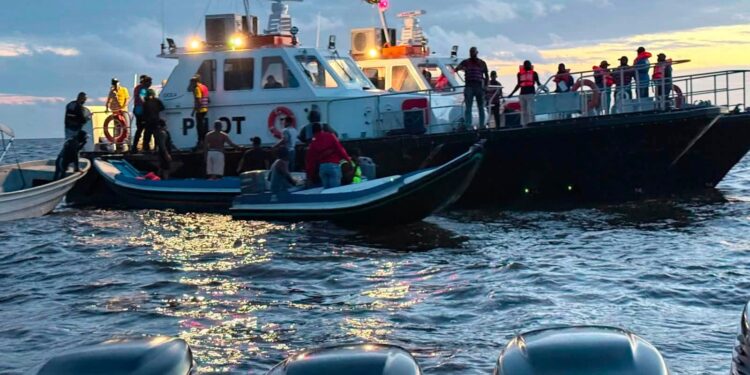
The MV Barima capsized off Guyana’s northwestern coast on July 18, 2026, while sailing from Georgetown to Port Kaituma with an estimated 179 passengers and crew aboard. More than 100 people are believed to have died, making it the country’s worst maritime tragedy in modern history. While scores of bodies have been recovered, relatives have consistently maintained that additional victims remain trapped inside the submerged ferry.
Mohamed warned that every passing day not only prolongs the agony of grieving families but also risks destroying crucial evidence that could help determine what caused the disaster.
“We are happy the families refused to have the memorial,” he said. “There are still loved ones trapped inside that vessel. Evidence is being corroded. Every day matters. Swift effort should be made to recover the bodies before further decomposition makes identification even more difficult.”
His remarks echo the concerns of victims’ relatives, many of whom boycotted the Government’s memorial service, insisting that recovering every victim must take precedence over official ceremonies.
Mohamed argued that the recovery should be treated as a national emergency rather than being subjected to the pace of routine government procurement.
“This operation should be treated as a national emergency, not a routine procurement exercise. I remain willing to offer my assistance in any way that can help expedite this effort. We will continue protesting because we don’t trust this government.”
The salvage operation is expected to play a critical role not only in recovering victims but also in preserving forensic evidence that could prove vital to both the ongoing criminal investigation and the partisan Commission of Inquiry. Maritime specialists have long warned that prolonged exposure to seawater accelerates corrosion and deterioration, potentially compromising evidence relating to the vessel’s condition and the circumstances that led to the sinking.
Although the full circumstances surrounding the tragedy remain under investigation, murder charges have already been brought against Captain Kevin Price, Chief Mate Rondell Dwayne Roberts and Cargo Superintendent Delon Granderson, while unresolved questions persist over whether government agencies allowed an ageing vessel, whose condition has been widely questioned, to continue carrying passengers.
Mohamed maintained that accountability cannot stop with criminal prosecutions.
“With over 100 lives lost, Edghill must go.”
His demand adds to mounting public pressure on the Government as families continue to insist that recovering those still entombed inside the MV Barima—before time and the sea erase the remaining evidence—must take precedence over bureaucratic procedures.