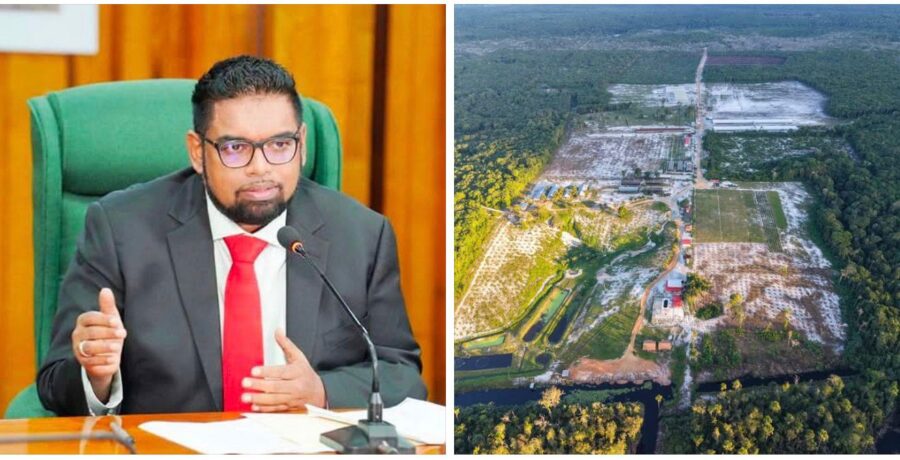
The parliamentary opposition A Partnership for National Unity (APNU) has called on President Mohamed Irfaan Ali to resign to facilitate an independent forensic investigation into his reported farming operation at Long Creek, asserting that the state land allocation system has been manipulated to benefit those connected to political power.
The call came during a press conference on Friday, where APNU—which holds 12 of the Opposition’s 29 seats in the 65-member National Assembly—asserted that the People’s Progressive Party/Civic (PPP/C) administration has presided over a land distribution system that favours the politically connected while tens of thousands of Guyanese remain on waiting lists for house lots and agricultural lands.
“The APNU condemns the glaring double standard that has become the hallmark of the PPP Government under President Irfaan Ali,” the party declared in a statement.
The opposition argued that while “thousands of hardworking Guyanese, especially public servants, continue to struggle with inadequate wages and salaries,” the President is “at the centre of serious allegations regarding an extensive farming operation at Long Creek.”
“These questions demand answers, not political spin,” APNU said.
The controversy erupted after photographs and videos circulated on social media by Leader of the Opposition and We Invest in Nationhood (WIN), Azruddin Mohamed showing President Ali multi-billion-dollar expansive farming operation along the Soesdyke-Linden Highway. The images have fuelled public debate over the size of the property, how it was acquired and whether the Head of State received preferential access to state lands.
The issue is particularly sensitive because President Ali has ministerial responsibility for the Guyana Lands and Surveys Commission, the agency responsible for the administration and allocation of state lands.
According to APNU, “The President also exercises oversight over the Guyana Lands and Surveys Commission and therefore has responsibility for the policies and management of land allocation and has accumulated this land while thousands of Guyanese wait years for land allocations.“
The party further stated that “more than 30,000 applications for land exist along the Soesdyke-Linden corridor, yet ordinary citizens are repeatedly told to wait because land is unavailable or the process is delayed.“
The Soesdyke-Linden Highway corridor has become one of Guyana’s fastest-growing development zones, with the government identifying it for major housing, agricultural and industrial expansion. However, prospective landowners have long complained of protracted delays in obtaining house lots and agricultural leases, particularly in high-demand areas.
APNU argued that the disparity is most evident among public servants.
“Teachers, nurses, police officers, members of the disciplined services, and other public servants dedicate their lives to serving this nation, yet many cannot secure a house lot or agricultural land after years of applying. Meanwhile, they are expected to survive on wages that continue to lag behind the rising cost of living while watching those at the highest levels of government acquire substantial landholdings and develop agriculture mega projects.”
The coalition maintained that ordinary Guyanese are being denied opportunities while politically connected individuals benefit from state resources.
“APNU is adamant that the government cannot justify asking ordinary Guyanese to wait for years while the President, family, friends, and favourites give themselves large pieces of state lands. This is unequal treatment, misuse and abuse of power and personal enrichment at the expense of the people of Guyana.”
Calling the issue one of public accountability, APNU said the only way to restore confidence is through an independent investigation.
“This glaring unequal treatment is deeply disturbing and damaging to public confidence and can only be addressed through full transparency, accountability and independent investigation. To this end, the President should resign to facilitate an impartial and thorough forensic investigation.“
The opposition said Guyanese deserve complete transparency regarding the President’s landholdings.
“Guyanese deserve to know how much land has been acquired, when it was acquired, how it was acquired, and whether every applicable fee, law, policy, and procedure was applied to ensure that the same procedures that ordinary citizens have to follow were followed.“
APNU also questioned the manner in which lands are being allocated along the Soesdyke-Linden Highway, arguing that parcels are being distributed without preserving sufficient reserves for the highway’s planned expansion into a four-lane roadway.
“It raises the question of whether there is an absence of planning or a deliberate policy to compensate family, friends and favourites when it is time to expand the highway into a four-lane highway,” the partnership stated.
The opposition is demanding the immediate publication of all records relating to the President’s and other senior government officials’ landholdings, together with a comprehensive audit of land allocations along the corridor, including the number of applications, waiting times, acreage allocated and allocations involving politically affiliated persons.
It also linked the controversy to broader concerns over governance and the treatment of public sector workers.
“The Government must stop treating public servants as an afterthought. They deserve living wages, timely access to land, and the same opportunities available to those in positions of power. We demand a reduction in waste and corruption and the allocation of those resources to increase the wages and salaries of workers.“
Concluding its statement, APNU declared: “Guyana’s resources belong to all Guyanese—not to a privileged political elite. APNU will continue to fight for transparency, accountability, fair access to land, and a Government that serves the people rather than itself and the powerful.“
The government had not publicly responded to APNU’s latest allegations and calls for a forensic investigation up to the time of publication.