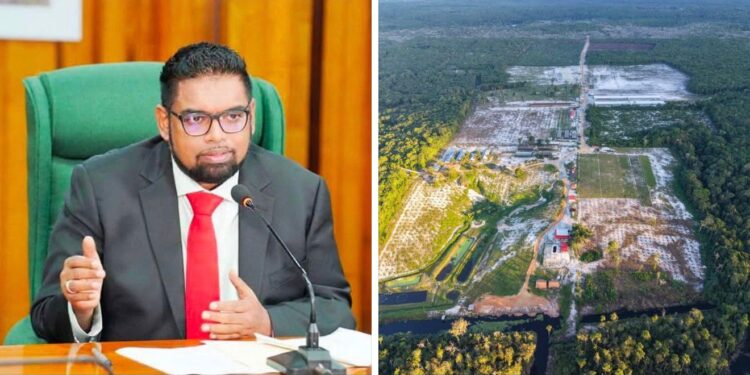
Social commentator GHK Lall is questioning the timing of the dramatic breakthrough in the investigation into the execution-style murder of gold dealer and biker Ricardo “Paper Shorts” Fagundes, suggesting that after more than five years of apparent inactivity, the case suddenly regained momentum only after political controversy engulfed President Irfaan Ali’s multi-billion-dollar ranch.
In his op-ed “The Sequence Enlightens, The Story Darkens,” published today by Village Voice News, Lall argues that the chronology of recent events raises troubling questions about the administration of justice, urging Guyanese to focus not only on what has happened, but when it happened.
“I urge my fellow Guyanese: the sequence, study the sequence,” Lall wrote. “There’s the rich story.”
Lall’s commentary comes days after the July 8, 2026 arrest of Mark Richmond, a security guard attached to Opposition Leader Azruddin Mohamed, who was taken into police custody for questioning after investigators reopened the Fagundes murder probe.

According to court filings, Richmond voluntarily surrendered to detectives at the Criminal Investigation Department Headquarters at Eve Leary, accompanied by his attorney, after police requested an interview. After being detained for more than 72 hours without being charged, he filed a habeas corpus application in the High Court, arguing that his continued detention violates Article 139(4) of the Constitution, which requires an arrested person to be brought before a court within 72 hours unless otherwise authorised by law.
The application, first reported by journalist Travis Chase, seeks his immediate release if no lawful basis exists for his continued detention.
The arrest represents the first major breakthrough in one of Guyana’s most notorious unsolved murders.
Fagundes was gunned down outside the Palm Court nightclub on Main Street, Georgetown, on the night of March 21, 2021. Investigators said he stepped outside after receiving a telephone call when two heavily armed gunmen emerged from a waiting white Toyota Fielder and riddled him with bullets before fleeing.
The brazen assassination occurred within metres of State House, the official residence of President Ali. CCTV cameras captured the attack, while police later recovered a burnt getaway vehicle along the Soesdyke-Linden Highway. Despite surveillance footage, COVID-19 checkpoints and an extensive investigation, the case stalled. No arrests were made, and for years the investigation appeared to have gone cold. The murder has long been linked publicly to allegations of organised criminal activity.
For Lall, that prolonged silence makes the recent developments difficult to ignore.
He noted that a murder committed “within a stone throw of the official residence” of the President should have triggered an immediate, sustained law enforcement response.
“But a killer volley near the president’s front yard had called for all-hands-on-duty and an all-points bulletin,” he wrote. “Despite COVID-19 roadblocks, surveillance cameras, and covert intel, law enforcement came up empty.”
He said the investigation faded despite a grieving family’s repeated calls for justice.
“A family grieved. Scant sympathy. Clamored for justice. Nothing.”
Lall argues that everything changed only after President Ali’s approximately 155-acre ranch at Long Creek on the LInden-Soesdyke Highway, became the subject of intense public scrutiny. Questions raised by businessman and Opposition Leader Azruddin Mohamed over the ownership, financing and development of the property sparked one of the country’s most heated political controversies.
“It took developments over a farm for redevelopment of interest in that Main Street cold case,” Lall wrote.
He contends that what had remained frozen for years suddenly moved with remarkable speed.
“What became too hot to remain in cold storage.”
Lall goes further, suggesting the renewed momentum in the investigation would not have occurred without the political fallout surrounding the ranch.
“I think that if there was no farm exposure, there would be no talk of murder and suspected murderers. And no arrest for the dirty, rotten crime.”
He acknowledged that the conclusion reflects his personal interpretation. “It’s my conviction, the sum of reflections, persuasions, interpretations.”
Throughout the column, Lall repeatedly returns to what he considers the defining issue—the sequence of events.
“March 2021 to June 2026: In this country, friendships have contributed enormously to subversions of justice,” he wrote. “In Guyana, warring foes may lead to the rediscovery of that elusive entity called justice.”
He argues that the investigation remained effectively dormant until the ranch controversy erupted.
“For years such matters were under lockdown. Not a whiff. Not a leaf stirring. Then, an estate with its alleged states of disarray, dispute, and distress are unchained. Revelation begets revelation.”
According to Lall, one allegation quickly gave rise to another. “One crime alleged. Another crime—a set of them—thrown right back into the face of the first accuser.”
He said the sequence has intensified public concerns about whether justice in Guyana is administered consistently or activated selectively.
“I started with the sequence,” Lall wrote. “Softly I leave my fellow citizens with the same sequence: a murder. A shrug. A lull. A whistleblower. Development dashed. Cold case. Cold front. Then a farm. Next, stops pulled out. Last, the bottom falling out.”
Describing the unfolding events as resembling “anancy story,” Lall nevertheless said they reflect Guyana’s political and institutional reality. He concluded by urging Guyanese to judge recent developments by observable facts rather than official narratives.
“Facts on the ground will always defeat criminal fictions. Be they political, social, or environmental,” Lall wrote. “Guyanese are now living under a full-fledged crime wave. Checkout who denied. Now check who disclose.”
The Guyana Police Force has not indicated that the reopening of the Fagundes investigation is connected to the controversy surrounding President Ali’s ranch, and no evidence has been publicly presented linking the two matters. Lall’s commentary reflects his analysis of the sequence of events and raises broader questions about public confidence in the administration of justice.