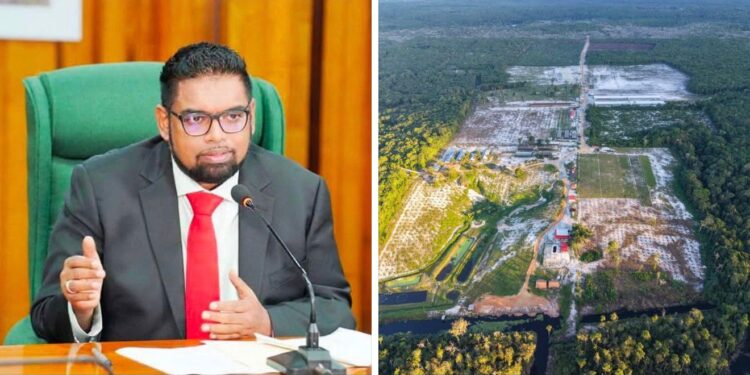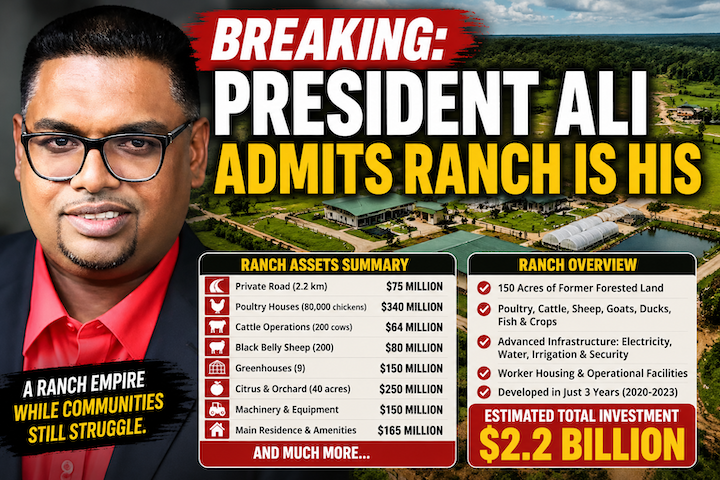
President Irfaan Ali has now publicly acknowledged that the sprawling agricultural ranch at the centre of growing public controversy belongs to him, ending weeks of speculation over ownership and shifting the national conversation to an even more consequential question: How was an operation of this scale financed?
The ranch, located along the Linden-Soesdyke Highway, has been described as an expansive, highly developed agricultural estate featuring modern poultry operations, cattle facilities, sheep and goat farms, aquaculture systems, hydroponic greenhouses, orchards, worker housing, recreational amenities and extensive infrastructure. According to estimates compiled in a widely circulated video, the total investment in the property exceeds $2.2 billion. Those figures have not been independently verified and no official valuation has been released.
The estimates paint a picture of a highly capital-intensive operation. They include approximately $75 million for a private access road, $300 million for land clearing and preparation, $340 million for two commercial poultry tunnel houses, $250 million for orchards and citrus production, $150 million in hydroponic greenhouses and another $150 million in machinery and equipment. The estimates also place the value of residential and recreational amenities, including a swimming pool and entertainment facilities, at approximately $165 million.
Even if the estimates are ultimately revised downward, financial experts note that the development still appears to represent an investment of extraordinary magnitude. The central issue is not whether a successful businessman or farmer can own a large ranch. The issue is whether the known income of a sitting president can reasonably support an investment of this scale without additional financing sources, prior accumulated wealth, business income, borrowing, partnerships or other arrangements.
President Ali’s official salary as Head of State is publicly known and, even with benefits and allowances, would amount to only a fraction of the estimated value of the ranch. A presidential salary of approximately $3.7 million per month translates into roughly $44.4 million annually, or about $222 million over a five-year term before taxes and living expenses. At that rate, it would take decades of saving every dollar earned to accumulate the estimated capital required to build a $2.2 billion estate.
That financial reality is why questions surrounding the ranch are unlikely to disappear simply because ownership has now been confirmed. Instead, the admission intensifies calls for greater transparency. Citizens will naturally want to know whether the ranch was financed through loans, business income, family resources, partnerships or other legitimate sources of capital.
The controversy also raises broader questions about public confidence and the standards expected of elected officials. Around the world, senior public officials are routinely required to make detailed asset declarations precisely to avoid the appearance of conflicts of interest and to assure citizens that public office is not being used for private enrichment.
President Ali’s admission that the ranch is his may have resolved one question, but it has opened a much larger one. In a country grappling with concerns about governance, transparency and inequality, the financial story behind the ranch may ultimately prove more important than the ranch itself.
The issue before the nation is therefore straightforward: not whether the President owns a farm, but whether the financing, disclosures and circumstances surrounding that ownership can withstand the scrutiny that inevitably accompanies public office.