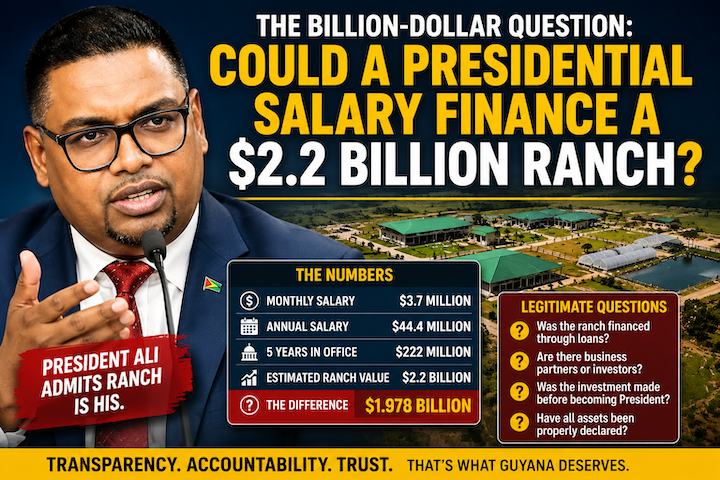
By now, one fact is no longer in dispute. President Irfaan Ali has acknowledged that the sprawling ranch at the centre of a national controversy is indeed his. That admission, however, has not quieted the public debate. Instead, it has given birth to a far bigger question, one that cuts to the heart of transparency and public trust: How was such an enormous agricultural empire financed?
The ranch, according to estimates contained in a widely circulated video, is no ordinary farm. It is alleged to comprise a 150-acre estate featuring commercial poultry operations capable of housing 80,000 chickens, extensive cattle and sheep facilities, hydroponic greenhouses, orchards, fish farms, heavy machinery, workers’ housing, private roads and recreational amenities. The video’s creators estimate the value of the development at approximately $2.2 billion, though those figures have not been independently verified.
Whether the actual value is $2.2 billion, $1 billion or somewhere in between, the scale of the operation is undeniably impressive. In fact, many of Guyana’s most established private businesses would struggle to assemble that level of investment in only a few years.
That is where the mathematics become interesting.
President Ali’s publicly known salary is approximately $3.7 million per month. Over five years in office, that amounts to roughly $222 million in earnings before accounting for taxes and ordinary living expenses. Even under the most generous assumptions, a presidential salary alone appears insufficient to finance an investment valued in the billions of dollars.
This is not an accusation of wrongdoing. Successful entrepreneurs often build large enterprises through loans, family resources, previous business interests, partnerships and investments accumulated over many years. There may very well be a reasonable explanation for the financing of the ranch.
But in public life, perception matters almost as much as reality.
A president occupies a position unlike any other in society. The office commands extraordinary authority and influence, which is why democracies around the world demand a higher standard of transparency from their leaders than from ordinary citizens. The larger the asset and the greater the wealth, the greater the public interest in understanding how that wealth was accumulated.
Indeed, if an ordinary public servant suddenly acquired a multi-billion-dollar estate, questions would be immediate and unavoidable. The same principle applies to the nation’s highest office.
The controversy surrounding the ranch therefore raises a series of legitimate questions. Was the estate financed through private borrowing? Does it involve business partners? Was much of the investment made before President Ali entered office? Is the ranch owned directly or through a company structure? Have all of the relevant assets and interests been disclosed in accordance with the law?
These are not unreasonable questions. They are precisely the questions that citizens in any democracy should ask when substantial wealth appears to have been accumulated by those entrusted with public power.
The timing of the controversy also matters. Guyana is undergoing an unprecedented economic transformation fueled by oil revenues, yet many citizens continue to grapple with high food prices, expensive transportation, low wages and inadequate public services. Against that backdrop, images of an expansive private estate naturally provoke public curiosity and, in some quarters, resentment.
The issue is therefore larger than one ranch.
It is about confidence in public institutions. It is about whether citizens believe the rules apply equally to everyone. And it is about whether public officials are willing to provide sufficient transparency to reassure the nation that public office is not being used, directly or indirectly, for private enrichment.
President Ali’s admission has answered the question of ownership.
The questions of financing, valuation and disclosure remain.
And until those questions are fully addressed, the arithmetic of the ranch may prove to be one of the most closely scrutinized stories of Guyana’s oil era.