By LCN Newsroom — Energy and Trade
La Caribeña News · 17 August 2026
In short. Guyana has 271,946 households on the 2022 census and average residential consumption of about 175 kWh a month. A rooftop system sized to that needs about 1.56 kW. Depending on the cost per kilowatt used, fitting every household costs between US$486 million and US$1.27 billion. The Wales gas programme is budgeted at no less than US$1 billion, with a stated ceiling of US$1.1 billion and a pipeline beyond that. Neither figure buys firm capacity from solar.
This article follows Guyana publishes what each solar farm costs but not what the power plant costs, which set out why Guyana’s solar procurement can be priced per watt and its gas programme cannot.
Would the Indian model work in Guyana, and for whom?
For households and businesses both. Not as a substitute for the plant. Those answers are not in tension, and Guyana is already running the household version.
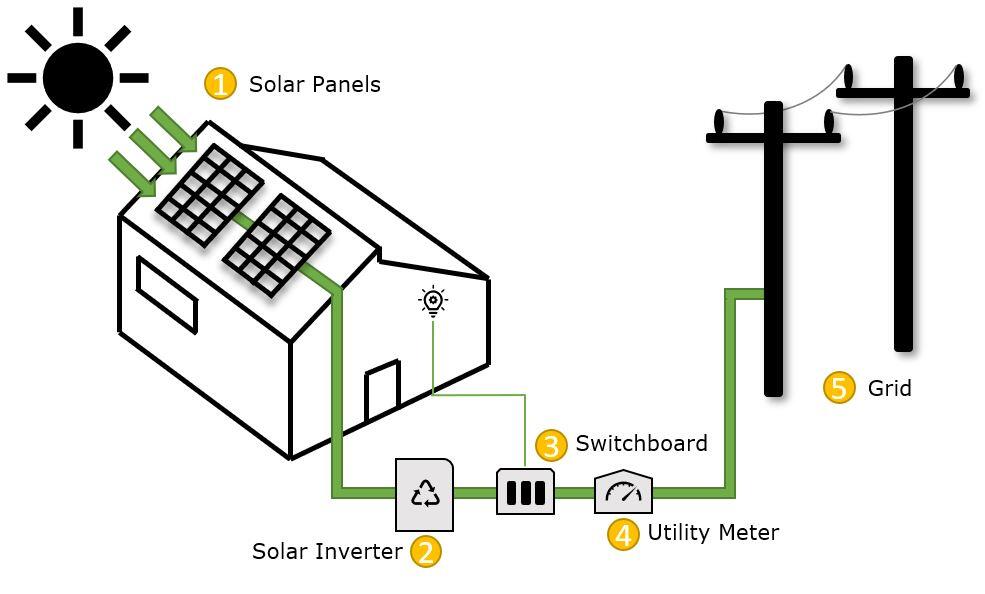
Take the battery out and what remains is grid-tied rooftop solar, which is what India built and what Guyana has permitted since 27 June 2025. Net billing allows any customer to install under 100 kWac with no consumption-based restriction.
The tax treatment is already in place. The Guyana Revenue Authority’s VAT schedule exempts “machinery and equipment for obtaining, generating and utilizing electricity from renewable energy sources, including solar panels, solar lamps, deep-cycle batteries, solar generators… power inverters.” The Guyana Energy Agency adds import duty exemptions, a two-year corporation tax holiday for importers of solar equipment, and a change to the Wear and Tear Schedule allowing capital expense to be written off within two years.
The economics come from the government’s own programme, and that programme is aimed at homes. ADepartment of Public Information release of 13 April 2026on the National Grid-Connected Solar Programme, headlined around a target of 5,000 households, puts a 5 kW system at approximately GY$1.2 million, generating electricity “valued at roughly $28,000 monthly,” with financing between “$7,000 and $26,000” a month.
A household therefore comes out ahead from the first month on financed terms, before the system is paid off.
Those figures imply a system producing about 645 kWh a month, a capacity factor of 17.7%, and an installed cost of GY$240,000 per kW, or about US$1.15 a watt. At the residential tariff of GY$43.43 that is a simple payback of 3.6 years. At the commercial tariff of GY$56.38 it is 2.8 years. The arithmetic is ours; the inputs are the government’s.
The gap between those two paybacks is where the difference between a household and a business sits, and it is a difference of degree. A commercial customer pays a tariff about 30% higher, so each self-consumed unit is worth more. A business open at midday also consumes more of what its roof makes at the moment it makes it, while a household is often empty at noon and busiest after dark.
That matters more in Guyana than it does in India, because the two countries credit exports differently. India runs net metering, where an exported kilowatt-hour is redeemed one-for-one later, so the timing of household consumption is largely irrelevant. Guyana runs net billing. The Guyana Energy Agency describes exports accumulating in an energy credits bank, with unused credits cashed out annually at 90% of the prevailing tariff. Credits offset consumption first and the haircut falls on the surplus, which penalises oversizing a household system in a way it does not penalise a right-sized one.
The binding constraint is not the economics. It is the GY$1.2 million at the front. India closes that gap with a capital subsidy of up to ₹78,000 a household. Guyana closes it with tax exemptions and financing, which works but works more slowly.
Which leaves scale as the real question. The programme targets 5,000 homes. The 2022 census counted 271,946 households.
What it does not do is reduce the capacity Guyana must build, and GPL says so in its own accounting. The Development and Expansion Programme lists distributed solar as “DBIS Solar-DER Non-Firm Capacity” and distinguishes firm capacity, which counts “only conventional capacities.” Every GuySOL farm is paired with a battery in order to qualify as firm. Rooftop solar without storage contributes zero against peak demand.
No hourly load curve for the Demerara-Berbice Interconnected System has been published, so the hour of system peak is not a matter of public record. What is on record is Region Ten’s account of Linden, where the regional director said on 15 August 2026 that the town “has two peak periods. During the day between one to three pm, and then in the night as well, between seven to nine.”
So rooftop solar is not an alternative to Wales. It is a reduction in what Wales and the existing fleet have to burn, paid for by the customer rather than the state.
What would it cost to put a rooftop system on every household?
Somewhere between US$486 million and US$1.27 billion. The range is wide because the government’s own promotional figure does not survive comparison with the government’s own procurement.
Start with consumption, because that is what sizes the system. GPL’s Development and Expansion Programme gives residential sales of 438.9 GWh across 205,385 customers, which is about 175 kWh a month per household. The Department of Public Information’s 5 kW example produces about 645 kWh a month. The reference system is nearly four times what an average Guyanese household uses.
Sizing to the household rather than to the brochure is what makes this affordable at all. The question is what a kilowatt costs.
Why the government’s own figure looks too low
The DPI release implies GY$240,000 per installed kilowatt, which is about US$1,148. Guyana’s utility-scale solar costs more than that. The Linden contract works out at US$1,505 per kilowatt and the GUYSOL programme average at US$2,520.
Rooftop is not normally cheaper per kilowatt than utility-scale. It is normally more expensive, because a rooftop installation loses every economy of scale and adds access, mounting and a separate site visit for each customer.
The implied yield points the same way. The DPI figures work out at a 17.7% capacity factor. GPL’s own Linden projection is 15.4%, and rooftop generally underperforms a purpose-built farm because panels sit at whatever angle the roof provides.
Both discrepancies run in the same direction, which is toward a figure that flatters the programme. Either the GY$1.2 million excludes costs the release does not name, or it is a subsidised programme price rather than a market one. The release does not say which, and that is a fair question to put to the Ministry.
The range, on Guyana’s own numbers
Using GPL’s 15.4% capacity factor, a household using 175 kWh a month needs about 1.56 kW. Fitting all 271,946 census households installs about 423 MW.
|
Cost basis |
US$/kW |
Per household |
All 271,946 households |
GPL’s 205,385 customers |
|
DPI implied figure |
1,148 |
US$1,787 |
US$486m |
US$367m |
|
Linden utility-scale |
1,505 |
US$2,343 |
US$637m |
US$481m |
|
Rooftop at 1.5× Linden |
2,258 |
US$3,515 |
US$956m |
US$722m |
|
GUYSOL programme average |
2,520 |
US$3,923 |
US$1,067m |
US$806m |
|
Rooftop at 2× Linden |
3,010 |
US$4,686 |
US$1,274m |
US$962m |
The defensible reading is the middle of that table. At a rooftop premium over Guyana’s best utility-scale price, a national household programme lands between roughly US$640 million and US$1.07 billion.
Against which gas number?
The comparison changes depending on which one, and the honest answer is to show all three.
One point of language before the table. The Office of the Prime Minister’s US$1 billion is not the price of the 300 MW power plant. It is the budget for a package of five assets, of which the power plant is one. The plant alone therefore costs less than US$1 billion, and no published figure says how much less. The programme, by contrast, costs at least US$1 billion, because the same release sets a US$1.1 billion ceiling including contingency, the project is two years late, and the government has already acknowledged a US$97 million settlement on top of the original contract.
|
Gas figure |
What it is |
Rooftop at US$640m to US$1.07bn |
|
US$759m |
Original Lindsayca and CH4 contract, November 2022, for the NGL plant and power plant |
Rooftop range straddles it |
|
Office of the Prime Minister budget, May 2026, adding transmission, substations and the control centre |
Rooftop midpoint sits below it |
|
|
About US$2bn |
Vice President Jagdeo’s reported all-in, December 2024, including the pipeline |
Rooftop is roughly a third to a half |
There is an asymmetry in that table that should be stated rather than left for a reader to spot.
The gas figure has moved. The Office of the Prime Minister’s own May 2026 restatement is about 32% above the 2022 contract price, and the same office acknowledged a US$97 million settlement it described as “a 12.8 percent increase over the original contract sum of $759 M.” The project is two years late and not yet generating.
The rooftop range is a snapshot. It carries no delay, no escalation, no arbitration and no contingency, because it is arithmetic rather than a tendered price. A real national programme would meet the same pressures that moved the gas number, and there is no reason to assume it would resist them better.
So the fair comparison is between a gas figure that has already grown by roughly a third and a solar figure that has never been tested by a contract.
The answer to the question everyone in Georgetown has been asking, then, is not that solar was obviously cheaper. It is that a rooftop system for every household in the country sits within the same range as a gas programme costing at least US$1 billion, would have delivered no firm capacity at all, and has never been priced by anyone who had to build it.
What the figures do not include
They buy no batteries, so they remove nothing from the firm capacity GPL must build.
They assume every kilowatt-hour generated displaces one GPL would otherwise produce. Real systems curtail, and GPL has published no hosting capacity study.
They exclude metering, inspection, grid reinforcement and the cost of administering a scheme across a quarter of a million properties.
They exclude the roughly 67,000 households counted in the census but not billed by GPL, many of them hinterland properties already served by a different and much smaller system.
They use one average. Under net billing, a scheme sized on an average leaves heavy users short and light users banking credits that cash out at 90%.
And they price retail. Procuring 423 MW at once would not cost what procuring 5 kW costs, in either direction.
The state has form on entering markets its own figures do not obviously support, as with the G$496 million state bottled water plant. The running fuel saving here, on the same published inputs, is about GY$18.5 billion a year, or roughly US$88 million, against a GPL subsidy budgeted at GY$25 billion for 2026.
What would it save?
About US$21 million a year in fuel, for about US$78 million of private capital, on a scenario built entirely from published figures.
The inputs are these. GPL’s fuel bill runs about GY$47 billion a year, 93% of it heavy fuel oil. System generation was about 1,485 GWh in 2025. That is GY$31.65 of fuel per kWh generated. Total losses were 24.71% in 2024, so every kilowatt-hour a customer does not draw at the meter avoids about 1.33 kilowatt-hours of generation, and therefore about GY$42 of fuel.
Commercial and industrial customers took 421 GWh in 2023, being 292.9 GWh industrial and 128.1 GWh commercial, on GPL’s figures.
Assume a quarter of that consumption is displaced by on-site solar. That is 105 GWh a year at the meter, avoiding about 140 GWh of generation and about GY$4.4 billion of fuel, which is roughly US$21 million a year at GY$209 to the dollar.
Delivering it needs about 68 MW of rooftop solar. At the government’s own GY$240,000 per kW that is about GY$16.3 billion, or roughly US$78 million. Paid by businesses, not by the Treasury.
The scenario deliberately leaves households out. Residential customers took 438.9 GWh in 2023, more than commercial and industrial combined, so including them would produce a larger figure. It is excluded because a household self-consumes less of its own midday output than a business does, and no data exists to model that split for Guyana.
Three things about that number deserve stating plainly. It is our calculation, not the government’s. The 25% displacement figure is an assumption, chosen because it is conservative rather than because it is modelled, and no hourly load data exists to test it. And it saves fuel, not capacity: GPL would still need every megawatt of firm generation it is building.
What it does change is the two numbers Guyana talks about most. The electricity subsidy budgeted at GY$25 billion for 2026 exists largely because the fuel bill exists. And the Low Carbon Development Strategy, which sets a 50% renewable target for isolated grids by 2027 and 70% by 2030 but states no national renewable share target at all, would have a considerably better set of figures to report.
Was taking households off the grid ever the cheap option?
No, and the evidence against it is a government that tried. This is a different question from the one above. Grid-tied rooftop without batteries works for a household. Cutting that household loose from the grid entirely, which requires batteries, does not.
The proposal circulating among Guyanese business people since the gas project began is that oil revenue should have put households on solar panels with battery storage, taking them off the grid entirely and leaving the grid to businesses. The instinct behind it is sound. The specific form is the most expensive way to buy a kilowatt-hour that exists at scale.
In May 2025 the United States Department of Energy withdrew US$365 million from Puerto Rico’s residential solar and battery programme and moved it to grid hardening, on the stated basis that the redirected money would serve millions of people rather than thousands. That is the only real-world test of household solar as a substitute for central generation in a hurricane-exposed island economy, and the agency reversed it mid-programme.
India runs the largest household rooftop solar programme in the world. PM Surya Ghar: Muft Bijli Yojana, which translates as the Prime Minister’s Solar House Free Electricity Scheme, was launched in February 2024 and had reached 5.06 million homes and 14.8 GW by August 2026.
It includes no battery storage. It reduces bills. It does not replace firm capacity. A programme of that scale, in a country with India’s manufacturing base, chose not to buy household batteries.
Bangladesh’s IDCOL programme reached 4.1 million homes at about US$266 each, and then collapsed when the grid arrived, leaving below-standard debt of about US$143 million by 2018. A distributed programme built against a grid that is about to improve strands its own assets. Guyana is about to add 228 MW.
Was solar financeable on the same terms?
Yes, from the same lender, under the same mandate, eighteen months earlier.
The United States Export-Import Bank approved US$527 million for the Wales project on 26 December 2024, with Guyana’s Ministry of Finance as borrower and Lindsayca of Texas and CH4 Systems of Puerto Rico as exporters. EXIM stated the transaction falls under its China and Transformational Exports Program, because the US companies involved “faced direct competition from the People’s Republic of China.”
Renewable energy, storage and efficiency is one of the ten transformational export areas under that same programme. On 1 June 2023 EXIM approved more than US$900 millionunder it for over 500 MW of solar in Angola, exporting US mounting systems, connectors, switches and sensors, framed in the same terms of countering Chinese competition.
Renewable transactions under the programme carry 18-year repayment terms and local-cost financing of up to 30% of the US export contract. EXIM has already guaranteed a rooftop solar project in Barbados.
There is a condition, and it is the one that matters for equipment. EXIM finance covers 85% of an export contract’s value or 100% of the US content, whichever is less, and goods must ship from the United States. Full support requires at least 51% US content. Nothing in US law prevented Guyana from buying Chinese solar equipment with its own money. What US finance cannot do is pay for it.
That constraint is now shared. On 23 April 2026 the European Commission barred the European Investment Bank and major EU financing instruments from funding energy projects using inverters from high-risk countries, extended in May to battery storage power conversion systems. Both major Western concessional lenders now condition equipment origin.
Chinese suppliers hold roughly 55% of the global inverter market between Huawei and Sungrow, and nine of the top ten inverter suppliers are Chinese, on Wood Mackenzie’s 2024 figures. Bloomberg New Energy Finance put average battery pack prices in 2025 at US$84 per kWh in China against US$121 in North America.
What does this mean for a Guyanese business?
Three things, all checkable.
Guyana’s fiscal room to fund any of this rests on an oil agreement that pays a 2% royalty against Suriname’s 6.25%. Meanwhile the commercial tariff is GY$56.38 per kWh and has not moved since April 2021, held there by a subsidy budgeted at GY$25 billion for 2026. The promised halving is tied to 228 MW, which the Prime Minister has now placed in the first quarter of 2027.
Net billing under 100 kWac is available without a demand test, which is the largest system most commercial premises would install.
And Guyana’s own solar procurement has been getting cheaper, from US$2.52 a watt across GUYSOL to US$1.51 a watt at Linden. A firm pricing its own rooftop should be benchmarking against the more recent number.
Frequently asked questions
What would it cost to give every Guyanese household a rooftop system? Between US$486 million and US$1.27 billion depending on the cost per kilowatt used, sized at 1.56 kW each to match average consumption of 175 kWh a month. The defensible middle is roughly US$640 million to US$1.07 billion.
Why does the government’s own figure look too low? It implies US$1,148 per installed kilowatt. Guyana pays US$1,505 per kilowatt for utility-scale solar at Linden and US$2,520 across the GUYSOL programme. Rooftop is not normally cheaper per kilowatt than utility-scale.
Would India’s no-battery rooftop model work in Guyana? For both households and businesses. On the government’s own figures a 5 kW system costs about GY$1.2 million and pays back in 3.6 years at the residential tariff or 2.8 at the commercial one. It does not replace the gas plant, because GPL counts distributed solar as non-firm capacity.
Why does the government programme target only 5,000 homes? No published reason. The constraint is the GY$1.2 million capital cost per system rather than the returns, which are positive from the first month on financed terms. Guyana has 271,946 households.
How much fuel could rooftop solar save? On our calculation from published figures, displacing a quarter of commercial and industrial consumption would need about 68 MW of rooftop solar, cost about US$78 million in private capital, and save about US$21 million a year in fuel.