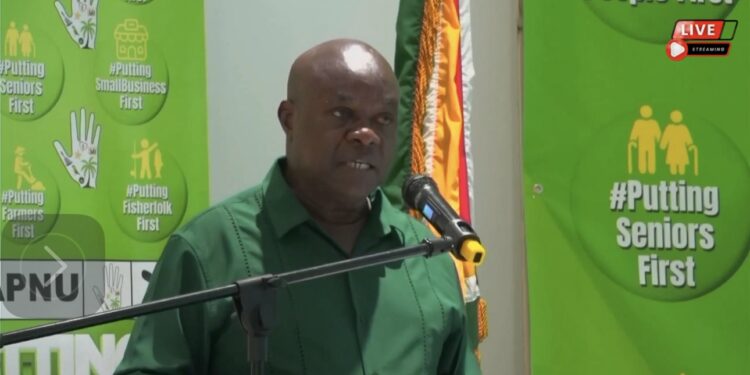
A Partnership for National Unity (APNU) Lead Parliamentarian, Dr. Terrence Campbell, has declared that a broad-based opposition coalition can successfully challenge the governing People’s Progressive Party (PPP), urging opposition parties to put aside past differences in pursuit of a common electoral objective.
Campbell, who serves as APNU’s parliamentary leader, made the appeal during Tuesday evening’s edition of Dr. David Hinds’ Politics 101 programme. APNU currently holds 12 of the Opposition’s 29 seats in Guyana’s 65-member National Assembly, making it the second-largest opposition bloc.
He argued that political divisions and personal grievances must give way to a united strategy if the opposition is serious about removing the PPP from office.
“We will all have to come together to remove this wicked PPP. We will all have to learn to forgive each other… whatever hurt is there,” Campbell told viewers.
His comments come as debate continues within opposition ranks over the best strategy to challenge the PPP, which has governed since returning to office in August 2020, and prior to that from 1992-2015. Guyana’s opposition landscape has become increasingly diverse, with several smaller political movements emerging alongside the established parties, raising renewed questions about coalition-building ahead of the next General and Regional Elections, constitutionally due in 2030.
Campbell acknowledged that any successful coalition would require political compromises and cooperation among parties and individuals who may not enjoy universal support across their respective bases.
“If we think working along with Simona Broomes or working along with Amanza is a noble situation, then we are doomed,” he said, arguing that any viable coalition must prioritise electoral success over personal or political sentiment.
His remarks referred to Dr. Simona Charles Broomes, leader of the Assembly for Liberty and Prosperity (ALP), and Amanza Walton-Desir, leader of the Forward Guyana Movement (FGM), both of whom have established political movements outside the traditional opposition parties. He also alluded to the We Invest in Nationhood (WIN) party, which, within just three months of its formation, contested the 2025 General and Regional Elections and secured 16 seats in the National Assembly—the largest share of the Opposition’s 29 seats—reshaping Guyana’s political landscape in an unprecedented electoral upset.
Campbell’s appeal formed part of a broader discussion on opposition strategy and the importance of presenting a united front at the polls.
Joining him on the programme was APNU Member of Parliament Ganesh Mahipaul, who supported the call for what he described as a “grand coalition,” contending that Guyana’s political history has demonstrated the importance of opposition unity in challenging the PPP.
Mahipaul said emerging political figures should not be viewed as adversaries of the opposition but as independent political actors seeking representation.
“They are not real enemies of the PNC. A grand coalition is what will indeed unseat the PPP.”
He cautioned, however, that coalition-building would require discipline, mutual respect and an end to public infighting among opposition leaders.
“Never, ever give up,” Mahipaul said, maintaining that unity remains the opposition’s only realistic path to electoral success.
The issue of opposition unity has gained renewed prominence as parties continue discussions about possible alliances ahead of Guyana’s next elections. While neither Campbell nor Mahipaul outlined what such a coalition would look like or who should lead it, both maintained that overcoming longstanding divisions will be essential if the opposition hopes to mount a credible challenge to the governing PPP.