GEORGETOWN, Guyana — Indigenous rights advocate Jean La Rose has sounded an alarm over what she described as the continued exclusion of Indigenous peoples from major decisions affecting their lands, communities and future, warning that expanding extractive activity, environmental degradation and weaknesses in education are threatening Indigenous life in Guyana.
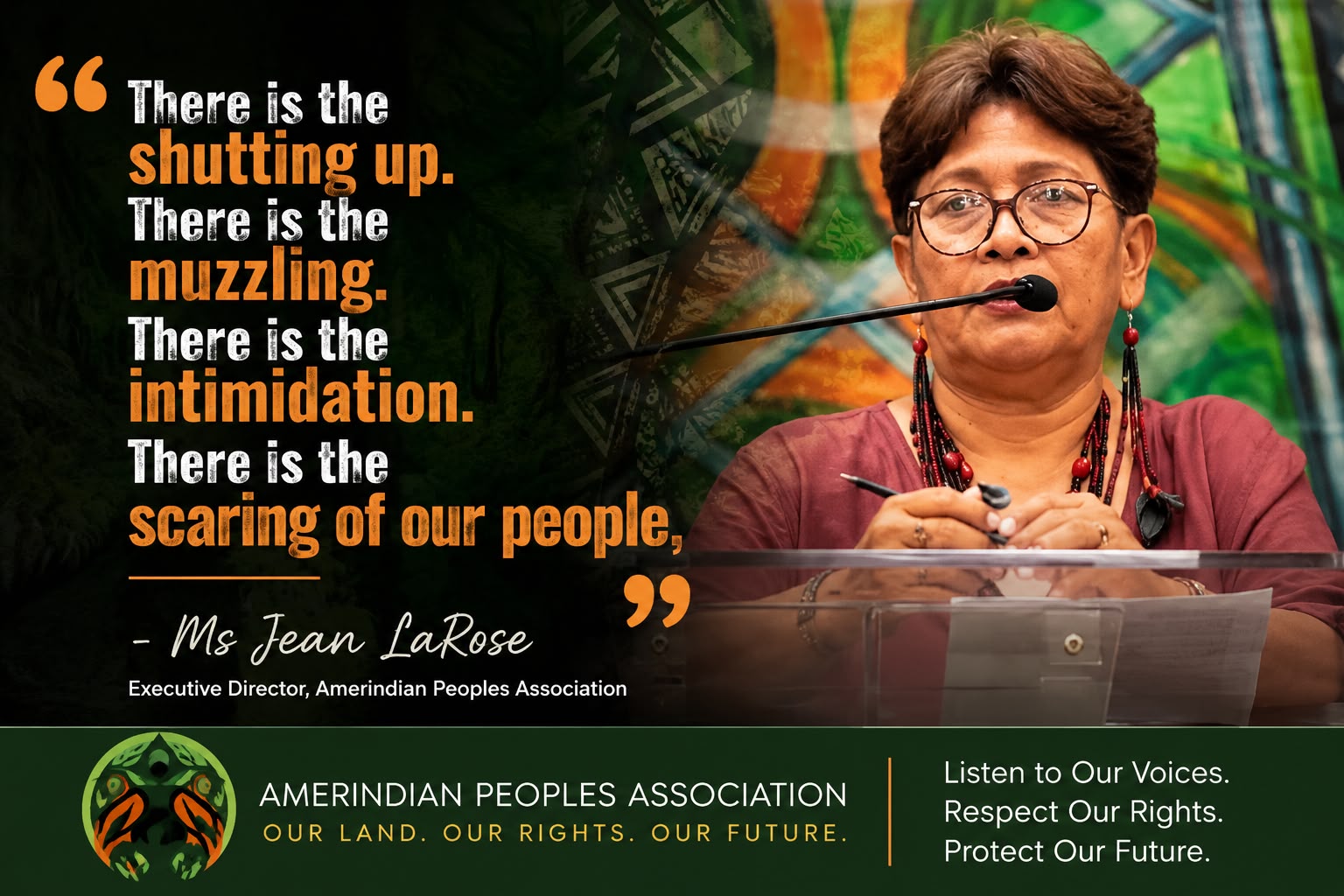
La Rose, Executive Director of the Amerindian Peoples Association (APA), made the remarks on Friday at “Ina Maimu Yetatokon (Listen to Our Voices)”, an APA-sponsored event held at the Marriott Hotel in Georgetown.
La Rose, who joined the APA in 1994, was awarded the prestigious Goldman Environmental Prize in 2002 for her work defending Indigenous lands from mining, securing recognition of traditional land rights and protecting Guyana’s forests.
In a wide-ranging presentation, she focused on education, Indigenous participation in national decision-making, the Amerindian Act, environmental protection, mining and what she said was the intimidation and silencing of some Indigenous leaders.
A central theme of her presentation was that decisions affecting Indigenous communities continue to be made without sufficient participation by the people who must live with their consequences.
“We cannot continue to allow decision making happening at the top without us being considered, without us being involved, because we are the ones who know our situations in our communities,” La Rose said.
She said that while Guyana has enacted laws and developed policies since Independence, Indigenous peoples have too often not been the ones shaping them.
La Rose pointed specifically to the Amerindian Act, saying Indigenous advocates fought hard for its revision in 2006 but that the eventual legislation failed to incorporate many recommendations in the form Indigenous communities had sought.
She questioned provisions that leave significant decision-making authority with the subject minister, arguing that such arrangements fall short of genuine self-determination. She also expressed concern about how any further revision of the Act might be handled in Parliament.
“Hopefully, the majority in Parliament does not only carry what language the new Amerindian Act comes out with, because that can not necessarily be a good thing,” she said.
La Rose also raised constitutional reform and elections as national processes in which Indigenous people should have a meaningful role, questioning the extent to which communities are being involved in shaping reforms.
“There is the muzzling. There is the intimidation”
La Rose made particularly pointed remarks about the ability of Indigenous leaders to speak freely.
She said feedback suggested some Toshaos are afraid to speak at national forums, including the National Toshaos Conference, and argued that Indigenous leaders must be given greater opportunity to exchange experiences among themselves and openly represent their communities.
“There is the shutting up. There is the muzzling. There is the intimidation. There is the scaring of our people,” she said.
La Rose said she herself had experienced victimisation for speaking her mind and said Toshaos and village councils in some communities had also faced victimisation. She urged Indigenous leaders to use the spaces available to them despite those pressures and called on the government to ensure that Indigenous people have genuine opportunities to exercise freedom of speech and influence national legislation and policy.
Alarm over mining and uranium
La Rose also issued a stark warning about the pace of extractive activity in Guyana, questioning whether sufficient systems exist to regulate and monitor concessions and protect communities from environmental damage.
“It’s almost like every day you see an Australian company getting a land concession. You see a Canadian company getting a land concession,” she said.
She singled out the prospect of uranium mining for particular concern, warning about the potential consequences for Indigenous communities if radioactive mining waste were to contaminate waterways.
La Rose said she was aware of at least one Indigenous community concerned about possible uranium mining activity in its area and questioned the role of the Environmental Protection Agency in ensuring safe environmental and mining practices.
She drew a connection between the potential danger from uranium contamination and the existing problem of mercury pollution associated with mining.
“We already have those problems with mercury. Now we’re talking uranium,” she said.
La Rose questioned whether Guyana has adequate mechanisms to regulate, monitor or refuse potentially damaging activities.
“Are we giving away Guyana just like that?” she asked. “What are the systems in place to regulate, to monitor, to even say no to certain activities taking place?”
Indigenous heritage is more than food and dance
La Rose also challenged conventional discussions of Indigenous heritage, arguing that protecting Indigenous culture must extend beyond celebrations of food, dance, music and craft.
Clean rivers, healthy forests, traditional lands and the ecosystems on which communities depend, she argued, are equally part of Indigenous heritage.
She warned that extraction and infrastructure development are damaging habitats, driving away animals on which communities depend and polluting waterways.
“When the river is spoiled, when the forest is cut down, we cannot regain it anymore,” La Rose warned. “Now is the time for us to do that.”
Her warning extended beyond Indigenous communities. La Rose told Guyanese living on the coast that they may not immediately experience the consequences of environmental destruction in the hinterland, but they could ultimately be affected as well.
“You may live on the coast and you may not feel the impact of what is happening there, but down the line you will also feel that,” she said.
Education must preserve identity
La Rose also identified major shortcomings in the education of Indigenous children, arguing that education should prepare children for professional opportunities while grounding them in their own history, culture, language and communities.
She questioned an education system in which children can grow up without understanding the roles of their own village leaders and institutions, and argued that Indigenous knowledge, including languages, craft, history and community practices, should receive greater emphasis.
The curriculum, she said, should help engender pride in Indigenous children rather than focusing overwhelmingly on examinations and competition for places at the country’s top schools.
La Rose recalled leaving her own village at age 12 to attend school in Georgetown, describing the experience of living among unfamiliar people, food and an unfamiliar school system. She said Indigenous communities also need structures capable of absorbing trained Indigenous professionals who want to return and serve.
“If we lose our history, if we lose our culture, we lose ourselves as a people,” she warned.
La Rose ended with an appeal for Indigenous Guyanese to place environmental preservation, participation in decision-making and the exercise of their voices at the centre of the struggle for their communities’ future.
“We have to make our government listen to us,” she said. “We have to make them listen to our voices.”