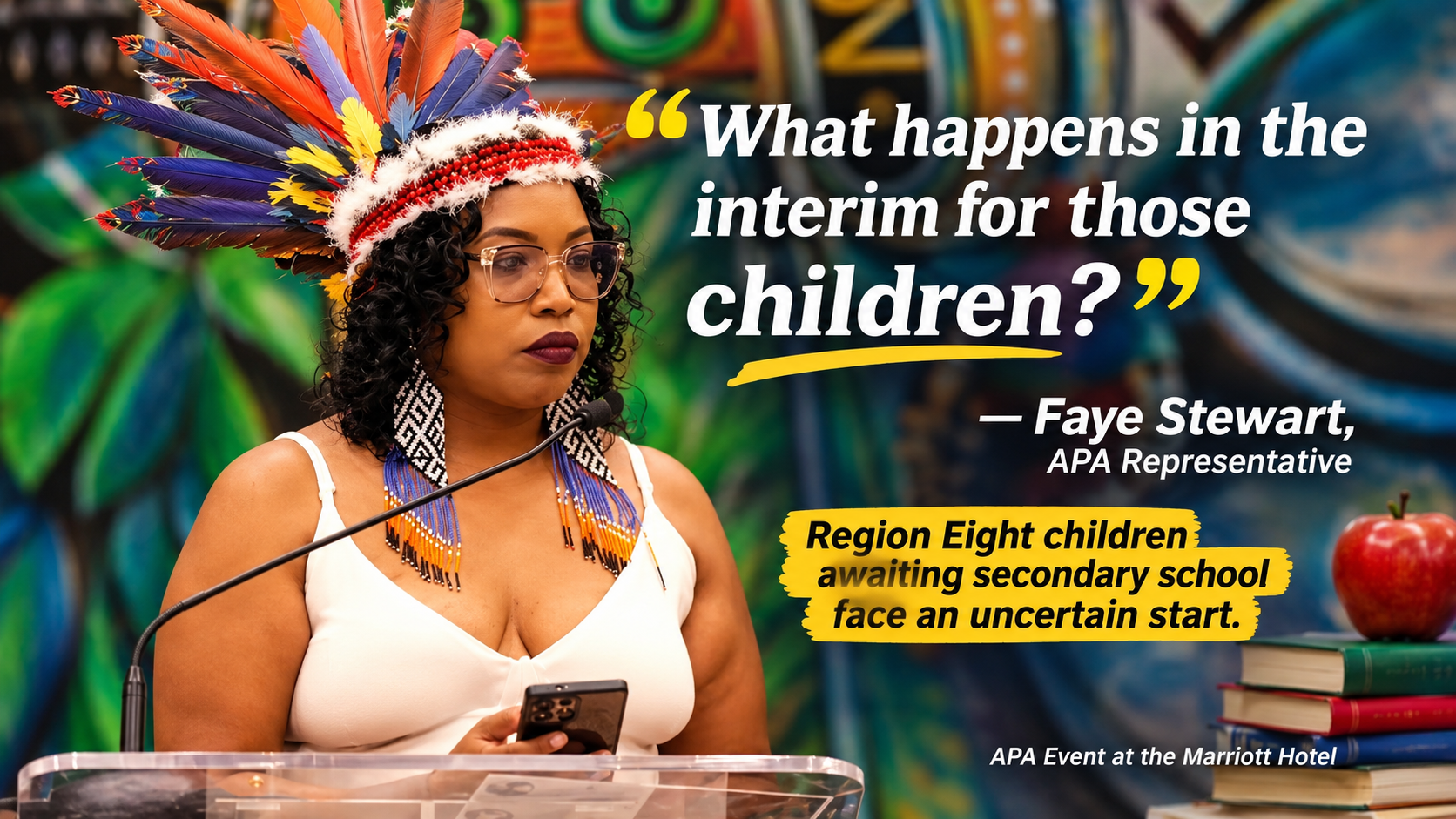
GEORGETOWN, Guyana – Faye Stewart, Amerindian Peoples Association (APA) member and Indigenous Rights Advocate, has raised urgent concerns about the future of children in Region Eight who have completed the National Grade Six Assessment but face uncertainty over where they will attend secondary school in September.
Stewart, who served as Master of Ceremonies at the APA’s Ina Maimu Yetatokon (Listen to Our Voices) event at the Marriott Hotel on Friday evening, raised the issue while reflecting on gaps in access to education affecting Indigenous communities.
She recounted a recent conversation with a parent from the Indigenous community of Chenapau whose daughter had written the Grade Six examinations and was awarded a place at Kato Secondary School.
According to Stewart, however, the family now faces a difficult question because of accommodation constraints. She said the Kato Secondary School dormitory is still under construction, while the dormitory at Paramakatoi Secondary School is currently full.
“So she doesn’t know what she’s going to do with this child,” Stewart said.
She stressed that the experience of one parent could represent a much larger problem across Region Eight, particularly in Sub-Region One, which has more than 13 Indigenous communities.
“This is one parent we’re talking about,” Stewart said. “What happens to the rest of the children who just wrote the Grade Six exams, and their only option is to attend Kato Secondary or Paramakatoi Secondary?”
Stewart said the situation raises important questions for the Ministry of Education, which has a responsibility to ensure equal and equitable access to education for Guyanese children regardless of where they live.
With September approaching, she questioned what arrangements are being made for children who are excited about entering secondary school but may have nowhere to stay while attending.
“Let’s think about those children who are presently excitedly awaiting September to hit secondary school. What are we doing with those children? Where are they going?” she asked.
Stewart said the situation was painful to contemplate, particularly because the number of children affected could be significant.
“It really hurt me because it is difficult. It is very difficult to think about the future for those children,” she said.
She acknowledged that secondary schools are currently being constructed in Region Eight, particularly in Sub-Region One, but said construction does not answer the immediate question confronting students and their families.
“The question still remains: What happens in the interim for those children?” Stewart asked.
She also briefly referenced the Mahdia Secondary School dormitory fire and the subsequent Commission of Inquiry, noting that there remain unresolved issues and recommendations from that process which have not been implemented. She did not dwell on the matter, however, saying her immediate concern was the children now preparing to enter secondary school.
Stewart’s intervention came during an evening in which speakers examined a range of issues affecting Indigenous Guyanese. As she prepared to open the floor for questions, she identified a common thread running through the discussions: agency.
“Whether we’re talking about advocacy, culture, safety, access to services or development, ultimately, we are confronting the question of whether Indigenous peoples have the power to meaningfully shape the decisions and systems that affect our lives,” Stewart said.
Her remarks brought the broader discussion about Indigenous rights directly to the practical realities confronting families in hinterland communities, where access to a secondary school can depend not only on earning a placement, but also on whether a dormitory space is available.
For the affected families, Stewart said, the question is immediate: where will their children go when the new school year begins?