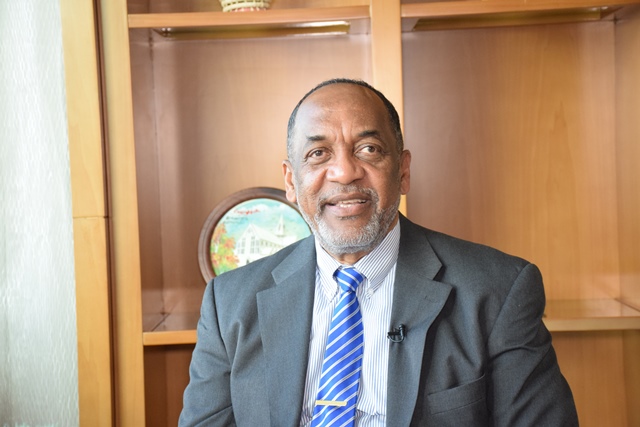
Energy expert Dr. Vincent Adams has sharply criticised the Government of Guyana’s handling of the country’s electricity sector, arguing that its ongoing negotiations with Turkish power provider Karpowership expose serious weaknesses in governance, contract management and national sovereignty.
Adams’ comments came in response to questions from Village Voice News regarding reports that the government is scrambling to secure a new agreement with Karpowership after the company reportedly declined a request for a 30-day extension of its electricity supply contract, granting only a one-week extension that expired on June 1.
According to a report first published by Kaieteur News, negotiations remain ongoing, but Karpowership has indicated that any continuation of the arrangement will require revised commercial terms and pricing structures.
The Turkish company currently operates two floating power plants in Guyana, supplying approximately 96 megawatts of electricity to the national grid. The vessels were brought in during 2024 as an emergency measure to address chronic electricity shortages while the government’s flagship Wales Gas-to-Energy (GTE) project was under development.
However, repeated delays to the Gas-to-Energy project—now expected to be completed by the end of 2026 after missing several earlier deadlines—have prolonged Guyana’s dependence on the floating power plants. Critics contend that those delays have strengthened Karpowership’s bargaining position while leaving the government with few immediate alternatives for maintaining a stable electricity supply.
The situation has also renewed scrutiny of promises made by the People’s Progressive Party (PPP/C ) administration since taking office. In October 2020, Prime Minister Brigadier (Ret’d) Mark Phillips, who holds responsibility for the energy sector, pledged to make blackouts a thing of the past and fix Guyana’s troubled electricity system. More than five years later, however, blackouts remain a frequent occurrence across the country, and Guyana now faces the possibility that Karpowership could discontinue its services if negotiations fail and its demands for revised commercial terms are not met.
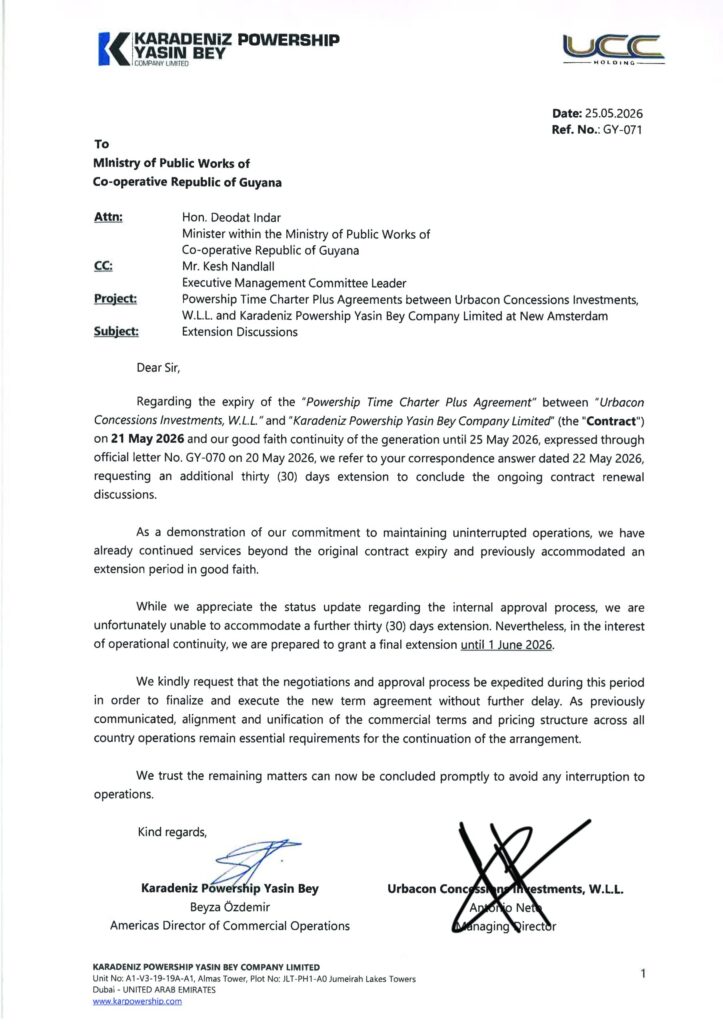
The standoff has also intensified concerns about energy security and Guyana’s continued reliance on temporary power-generation arrangements. Analysts have warned that the absence of an immediate replacement for the electricity generated by the two vessels has left the country vulnerable to commercial pressures and potential service disruptions.
Against that backdrop, Adams said the current situation represents a humiliation for a country celebrating 60 years of independence.
“In the nation’s 60th year of independence, it is a national embarrassment and disgrace for the Guyana Government to have diminished the pride of this great nation to beggarliness and groveling to some little nonentity foreign company – a vivid manifestation of the maniacal corruption, unbearable incompetence and servility to foreign entities welcomed as the new colonial masters,” Adams said.
Drawing on decades of international experience negotiating and implementing government contracts, Adams argued that no sovereign state should find itself in a position where a private company can dictate terms to a government.
“In all my decades of international experience writing, negotiating and implementing government contracts of every type and value, it is unheard of, for any country to allow itself to be so spinelessly bullied and brought to its knees by any company, much less a small fry commanding a massive 25% increase in contract price to the tune of $3.4 Million/day, or else!” he stated.
“In normally run countries the government calls the shots and when it says jump, the contractor asks how high? The opposite takes place in Guyana.”
Adams argued that the dispute is the direct result of government decisions and a lack of transparency.
“Consequently, this predicament is of the govt’s own making which also brings to light its authoritarian culture of cover-up, lies, and hiding of information from the public,” he said.
According to Adams, the public would have remained unaware of the situation had details of the negotiations not been leaked to the media.
“True to form like, just like the countless previous transgressions, the public would have remained in the dark had it not been leaked to the press, sending the govt into hiding from questions.”
He further contended that the controversy highlights the consequences of what he described as a flawed procurement process.
“Addedly, this dilemma spotlights the dire consequences of the shady award of this contract just like the others suffering the same fate and would have never occurred under a procurement process that followed the law with free, open and fair competition.“
Adams said the current predicament is not an isolated incident but part of a broader pattern of governance failures that have left Guyana increasingly dependent on foreign entities.
“The Guyanese people would no doubt have been willing to extend some sort of solace had this errant behaviour been only a rarity; but sadly, it typifies the daily dose of surrendering of the nation’s sovereignty to new colonial masters,” he said, citing Justice Sandil Kissoon’s 2003 ruling that the government had acted as a “derelict, pliant and submissive govt” in relation to ExxonMobil.
He also accused the administration of abandoning its promise to renegotiate Guyana’s oil contract with ExxonMobil.
“We witness the shameless flip-flopping of the govt’s foam at the mouth promise to renegotiate the oil contract, even putting it in their manifesto, only to subserviently fall in line with Exxon’s demand to change their mind,” Adams said.
He further criticised the government’s decision to challenge a court ruling requiring stronger financial safeguards against a potential oil spill.
“Even worse was the government’s betraying its own people, when rabidly fighting with Exxon to appeal Kissoon’s ruling for a Parent Company Guarantee to cover the full cost of an oil spill; thus, leaving Guyana vulnerable to financial bankruptcy and environmental catastrophe.”
Last month, the Court of Appeal ruled in favour of ExxonMobil and the Environmental Protection Agency (EPA), overturning a decision by Justice Sandil Kissoon that had required the oil company to provide an unlimited parent company guarantee covering the costs of any oil spill
The energy expert also linked the current predicament to the government’s management of the Gas-to-Energy project, which was intended to reduce electricity costs and improve reliability but has become associated with delays and escalating costs.
“This fiasco again serves to highlight the epic incompetence of this govt,” Adams said.
“We see the gross ineptitude admitted to, by the govt itself in managing not only the Exxon contract, but the many others including the gas to energy contract resulting in years of delay and US$ Billions in cost overruns.”
According to Adams, the government’s inability to successfully deliver the Gas-to-Energy project has contributed directly to Guyana’s continued reliance on Karpowership and its current negotiating predicament.
He also pointed to findings by international lending agencies regarding waste in public projects and referenced recent controversies surrounding government infrastructure initiatives.
“Lest we forget that international financing agencies conclusion that wastages account for over 50% of project costs, as evidenced by the President’s 5 a.m. spectacle of unintended revelations of corruption and incompetence; and how could we forget the responsible Minister blaming delays and cost overruns on spirits chasing away workers from building the road through the cemetery.”
Adams concluded by questioning the government’s overall capacity to effectively manage major projects and critical public services.
“It further begs the question, how could we expect the Govt to manage complicated contract activities, when it can’t even put up lantern posts, has made blackouts and floods the way of life for the Guyanese people for the entire six years though drowning in money since taking office; and can’t even manage the simple sharing out of cash grants?” he said.
Government officials have not publicly disclosed the commercial terms currently being negotiated with Karpowership or the potential cost implications of a new agreement. According to Kaieteur News, Minister within the Ministry of Public Works Deodat Indar did not respond to requests for comment on the matter.