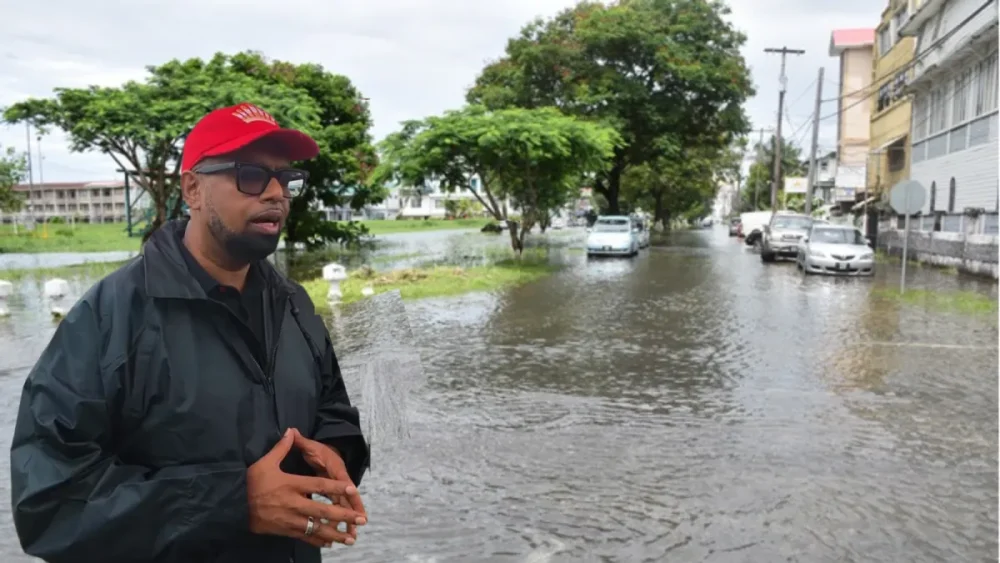
The People’s Progressive Party (PPP) government’s nationwide response to flooding triggered by heavy rainfall has been met with questions about whether longstanding shortcomings in drainage maintenance and support for local democratic organs contributed to the very conditions officials are now seeking to address.
On Saturday, President Irfaan Ali convened an emergency Cabinet meeting before dispatching ministers across several regions to assess flooding, engage residents and coordinate relief efforts.
According to the government, ministers visited affected communities in Regions Three, Four, Five, Six and Nine, while drainage pumps, sluices and other infrastructure were placed into continuous operation to reduce water levels.
However, the flooding has also renewed scrutiny of the administration’s management of drainage infrastructure and its relationship with municipalities and Neighbourhood Democratic Councils (NDCs), many of which have long complained about inadequate resources to maintain drains, canals and other critical systems.
Questions have also been raised about the condition of waterways and drainage channels in several communities, with residents and local officials previously highlighting concerns about clogged drains, malfunctioning sluices, silted canals and blocked outfalls that impede the efficient movement of water during periods of high tide or heavy rainfall.
The government reported that Agriculture Minister Zulfikar Mustapha and officials from the National Drainage and Irrigation Authority (NDIA) inspected drainage infrastructure in communities including Plaisance, Montrose, Success and Ogle, while additional pumps were deployed to vulnerable areas.
While welcoming the response, some local government stakeholders questioned whether greater emphasis on preventative maintenance before the rainy season could have reduced the severity of flooding experienced in several communities.
The administration also urged residents to avoid disposing of garbage in drains and canals, noting that blocked waterways can significantly hamper drainage efforts. However, concerns continue to be expressed about poor solid waste management, the maintenance of major drainage networks, which fall under the responsibility of central government agencies.
Government officials have maintained that pumps, sluices and drainage systems are operating continuously and that all relevant agencies remain on high alert as rainfall continues across parts of the country.
The flooding has also revived broader concerns about governance at the local level. Municipal and NDC officials have for years argued that their ability to effectively maintain drainage networks and other critical infrastructure has been undermined by inadequate funding, delayed transfers and what they describe as the political marginalisation of opposition-controlled local authorities.
They contend that many of the issues now contributing to flooding—including blocked drains, silted canals, neglected waterways and deteriorating drainage systems—have been repeatedly highlighted to central government but have received insufficient attention.
Rather than continuing a pattern of responding after communities have already been inundated, local government advocates argue that the administration should focus on empowering councils to perform the functions assigned to them under the law. They maintain that effective flood mitigation requires an end to political partisanship in the allocation of resources, greater support for municipalities and NDCs, and sustained investment in drainage maintenance and canal desilting programmes.
According to these stakeholders, emergency visits by ministers and the deployment of pumps after flooding occurs cannot substitute for the preventative measures that residents, councillors and community leaders have been demanding for years but which they say successive appeals to the government have largely failed to secure.