The Irfaan Ali administration’s latest promises of accountability, transparency and fiscal prudence are already being met with skepticism against the backdrop of mounting corruption allegations, weakened oversight institutions, and the absence of visible enforcement against public officials accused of wrongdoing.
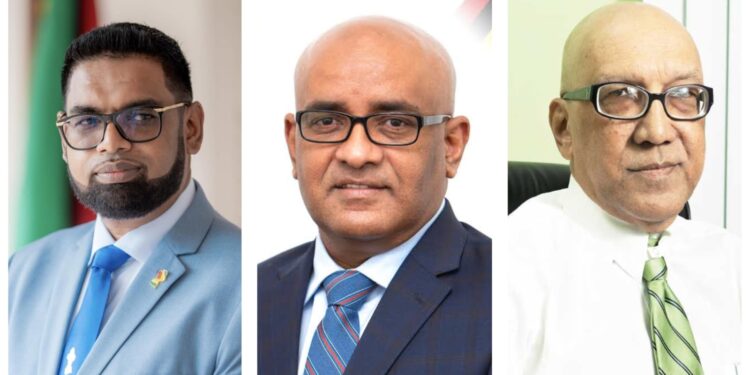
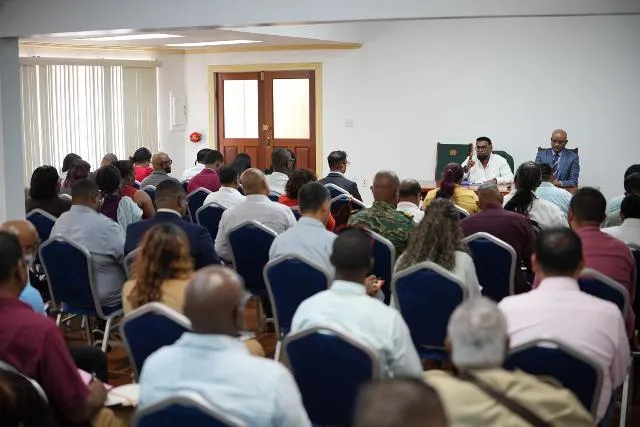
In a statement issued Wednesday, President Ali and Bharrat Jagdeo met with Cabinet members, soon-to-be appointed Regional Executive Officers, Permanent Secretaries, officers from the National Procurement and Tender Administration Board, and regional accounting officers.
According to the release, the meeting focused on “government’s continued commitment to accountability, transparency, fiscal prudence, and improved service delivery across all levels of Government administration.”
The President stressed that public office carries a “sacred trust” and declared that “every dollar spent must be to advance the welfare of the people and support national development.”
The statement further said all procurement systems, including regional tender boards, are required to operate with “full transparency and strict adherence to the law,” while government intends to use technological tools, including artificial intelligence, to monitor procurement systems and detect “unsavoury practices.”
“The President emphasised that any breaches in financial and procurement procedures, including involvement with multiple companies, will attract severe consequences, including removal from office where necessary,” the release stated.
Vice President Jagdeo, according to the statement, also stressed that “every expenditure must be measured against its contribution to the welfare of citizens and national development, as the Government strengthens oversight systems, eliminates waste, and upholds accountability, efficiency, and transparency in governance.”
Yet despite the rhetoric, serious questions continue to surround the administration’s credibility on accountability because of years of unresolved allegations, weakened institutions, and an apparent reluctance to investigate politically sensitive matters.
Guyana was recently ranked by Transparency International as the most corrupt country in the English-speaking Caribbean under its Corruption Perceptions Index, a troubling distinction that continues to cast a shadow over government claims of transparency.
At the same time, the country’s main constitutional oversight body, the National Assembly of Guyana, has not convened for almost 90 days, effectively stalling parliamentary scrutiny of government spending, procurement practices, and executive decision-making.
The prolonged absence of parliamentary sittings has also delayed responses to numerous questions submitted by opposition parliamentarians concerning public spending, governance, and allegations of corruption.
Observers have also pointed to the dismantling of the State Assets Recovery Agency (SARA), which was originally established to investigate and recover allegedly stolen state assets. The agency was effectively neutralized after the PPP/C returned to office, removing what many viewed as one of the few institutional mechanisms specifically focused on state corruption investigations.
Questions also remain unanswered regarding the VICE News explosive 2022 allegations involving senior government officials and Chinese businessmen in claims of large-scale corruption and influence. Despite the public controversy and extensive discussion generated by the expose, no known criminal charges were filed, no senior official was dismissed, and no public findings from any comprehensive investigation have been released.
Indeed, despite a steady stream of allegations surrounding procurement, contracts, land deals, and public spending under the Ali administration, not a single senior government official has been publicly prosecuted or removed from office over corruption-related conduct.
Concerns also continue over the distribution of billions of dollars in government cash grants and relief payments. While the administration has promoted the initiatives as support for citizens amid rising living costs, questions persist regarding the lack of detailed public accounting on the full disbursement process, verification mechanisms, and auditing procedures.
The latest accountability pledge also comes amid fresh allegations raised by the We Invest In Nationhood (WIN) party concerning alleged drug overpricing in Region Three. WIN recently presented what it described as evidence of inflated pharmaceutical procurement costs and questioned whether taxpayers were being overcharged. To date, the government has not publicly responded in detail to those allegations.
Additionally, longstanding concerns remain over allegations of irregularities in road contracts and public infrastructure projects, including accusations of inflated pricing, politically connected contractors, poor oversight, and questionable procurement practices.
Against that backdrop, Wednesday’s statement is already being viewed in some quarters as another public relations exercise rather than evidence of meaningful reform.
The central question now confronting the Ali administration is whether its repeated declarations about accountability are genuine commitments or carefully managed political messaging designed to shield the government from growing public scrutiny. After years of corruption allegations, controversial contracts, unanswered questions, dismantled oversight structures, and the complete absence of prosecutions or dismissals involving senior officials, many Guyanese are increasingly concluding that the government’s problem is not a lack of information or evidence, but a lack of political will to hold its own accountable.