Guyana has moved to strengthen its fight against cervical cancer following a week-long in-country mission by the Pan American Health Organisation/World Health Organisation (PAHO/WHO) and experts from MD Anderson Cancer Center, in collaboration with the Ministry of Health.
The mission, held from March 17–21, focused on enhancing national capacity for HPV vaccination, screening, diagnosis, and treatment, as the country works toward achieving the global 90-70-90 targets for cervical cancer elimination.
Cervical cancer remains a major public health concern in Guyana and across the Caribbean. The disease, driven primarily by human papillomavirus (HPV), is the second leading cause of cancer-related deaths among women in Guyana. In 2022, the mortality rate stood at 30.3 per 100,000 women.
Health officials say recent initiatives are beginning to show progress. The rollout of the universal HPV DNA testing voucher programme in 2024–2025 enabled more women to access free, high-quality testing within their communities. A total of 20,853 women were screened under the programme, reflecting increased awareness and participation in cervical cancer prevention efforts.
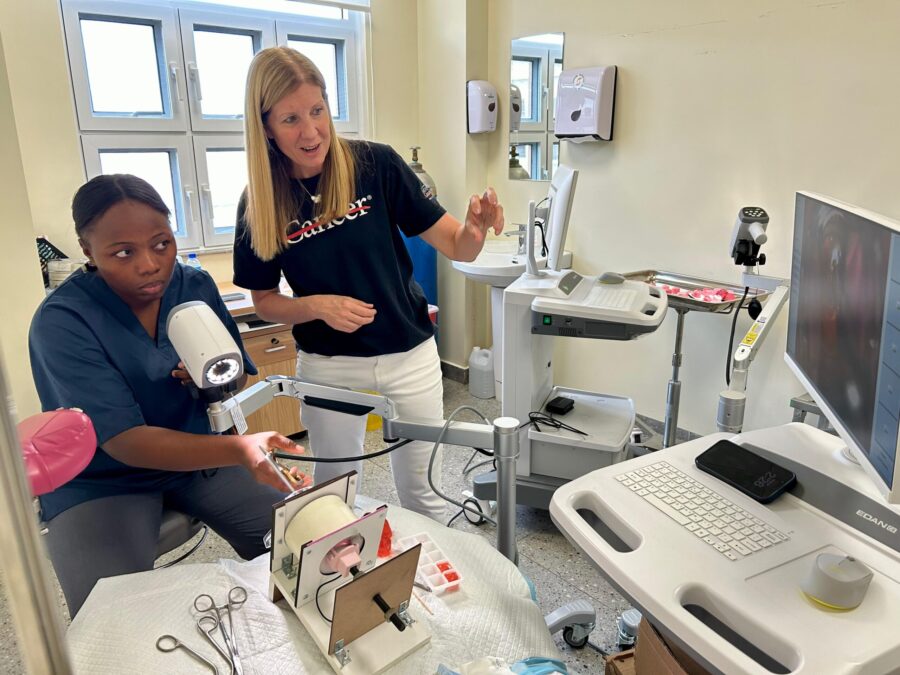
The visiting PAHO/WHO and MD Anderson team—led by Regional Advisor for Cancer Prevention and Control Dr. Mauricio Maza—conducted stakeholder consultations, facility assessments, and clinical training sessions during the mission.
Experts, including Dr. Kathleen Schmeler, Dr. Melissa Lopez Varon, Dr. Sarah Berger, Dr. Mila Salcedo, and Ms. Reina Guerrero, worked alongside local health professionals to strengthen Guyana’s cervical cancer response.
Key activities during the mission included efforts to enhance HPV testing uptake through improved voucher distribution, promotion of HPV self-collection, and strengthened follow-up systems. Clinical training was also provided in colposcopy, thermal ablation, and loop electrosurgical excision procedures (LEEP), aimed at expanding treatment capacity at both primary and secondary healthcare levels.
The team also supported strategies to boost uptake of the nonavalent HPV vaccine in schools and communities, while assisting with the integration of HPV testing data into national health information systems to improve tracking and decision-making.
The mission concluded with a stakeholder consultation to review Guyana’s cervical cancer elimination strategy and to outline a roadmap for scaling high-impact interventions.
The Ministry of Health, PAHO/WHO, and MD Anderson reaffirmed their commitment to supporting Guyana in achieving the World Health Organisation’s goal of eliminating cervical cancer as a public health problem.